
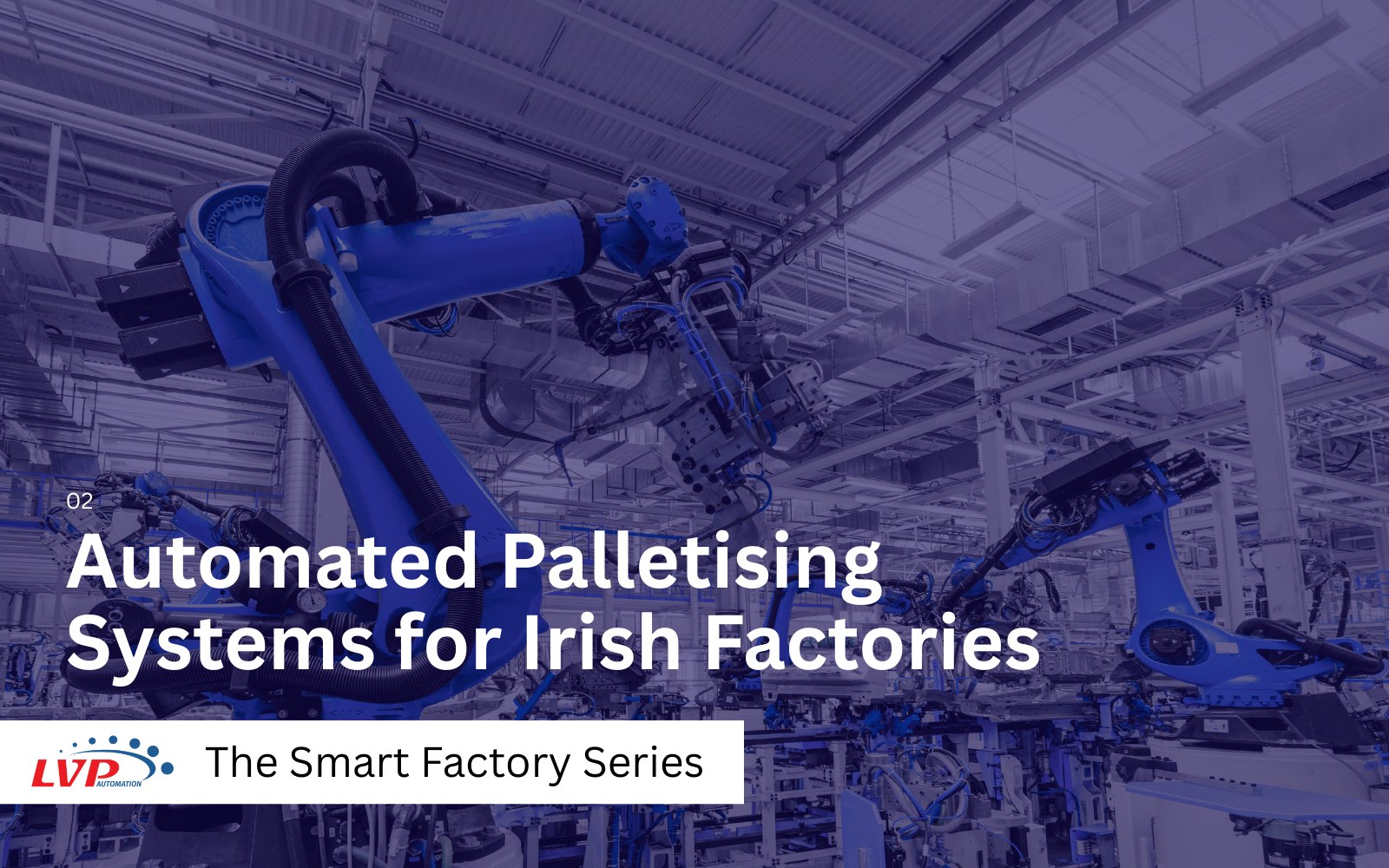
Automated palletising systems are one of the most effective ways for Irish manufacturers to increase efficiency, reduce manual handling and remove end-of-line bottlenecks. As production volumes grow and labour becomes harder to source, automating palletising operations provides a practical and scalable solution.
For many manufacturers, palletising is the first major step in implementing a broader factory automation strategy that improves consistency, safety and long-term operational performance.
What Are Automated Palletising Systems?
Automated palletising systems use robotics and intelligent control systems to stack products onto pallets accurately and consistently. Instead of relying on manual lifting and stacking, automated palletisers perform the same task repeatedly with precision and speed.
These systems are commonly used in food production, packaging, pharmaceuticals, logistics and general manufacturing environments where high output and consistent pallet quality are essential.
For manufacturers beginning their automation journey, palletising is often the gateway into wider factory automation solutions that integrate production, storage and dispatch.
Why Manual Palletising Is No Longer Sustainable
Manual palletising presents several operational challenges. It is labour-intensive, physically demanding and prone to inconsistency. As labour availability tightens across Ireland, relying on manual palletising can quickly become a bottleneck that slows the entire production line.
Injuries caused by repetitive lifting also contribute to downtime and increased operational risk. Automated palletising systems eliminate these issues by operating continuously without fatigue, delivering stable pallet loads and reducing the risk of workplace injuries.
By removing end-of-line delays, manufacturers can improve overall throughput and maintain consistent output across multiple shifts.
Types of Automated Palletising Systems
There is no one-size-fits-all palletising solution. The right system depends on production speed, available space and product type.
Compact palletisers are ideal for factories with limited floor space or lower throughput requirements. Semi-automatic palletisers provide a practical entry point into automation while retaining some operator involvement. High-capacity palletisers are designed for fast-moving production lines, while multi-line palletisers can handle output from multiple lines feeding into a central palletising system.
Each configuration can be designed to accommodate different product formats, weights and pallet patterns.
Manufacturers looking to future-proof their operations often combine palletising with warehouse automation solutions to create a seamless flow from production through to dispatch.
Benefits of Automated Palletising for Irish Manufacturers
Automated palletising delivers clear and measurable benefits. Productivity increases as systems operate consistently without breaks. Pallet loads are stacked accurately every time, reducing product damage and transport instability.
Automation also improves health and safety by removing repetitive lifting tasks and reducing manual strain. From a cost perspective, reduced labour dependency and improved output stability support long-term operational efficiency.
When integrated with autonomous mobile robots, palletised goods can be transported automatically to storage or dispatch areas, creating a fully connected automation workflow.
How Palletising Fits Into a Broader Automation Strategy
Palletising rarely operates in isolation. It is typically part of a wider automation ecosystem that includes picking, transport and warehouse systems.
For example, finished products may be stacked using automated palletisers, transferred via autonomous mobile robots, and stored in automated warehouse systems before dispatch.
Manufacturers that integrate palletising into a complete factory automation strategy gain better visibility, smoother workflows and improved scalability.
This connected approach reduces delays between production stages and ensures automation investments work together rather than independently.
Why Choose LVP Automation for Palletising Solutions
At LVP Automation, we design and implement automated palletising systems tailored to Irish manufacturing environments.
Our approach focuses on understanding production demands, available space and long-term growth plans before recommending a solution. Whether the requirement is a compact system for a smaller facility or a high-capacity palletiser for continuous production, each system is engineered for reliability and integration.
By aligning palletising with broader automation goals, manufacturers can maximise the return on their investment.
Frequently Asked Questions About Automated Palletising
Is automated palletising suitable for small factories?
Yes. Compact and semi-automatic palletisers are specifically designed for smaller facilities with limited space or lower output.
How much does an automated palletiser cost?
Costs vary depending on throughput, product type and system complexity. A production assessment ensures the system matches operational needs.
Can palletisers integrate with existing production lines?
Yes. Modern palletising systems are designed to integrate seamlessly with conveyors and other equipment.
Does automated palletising replace workers?
Automation reduces repetitive manual lifting while allowing employees to move into higher-skilled roles.