
Stepper Motors

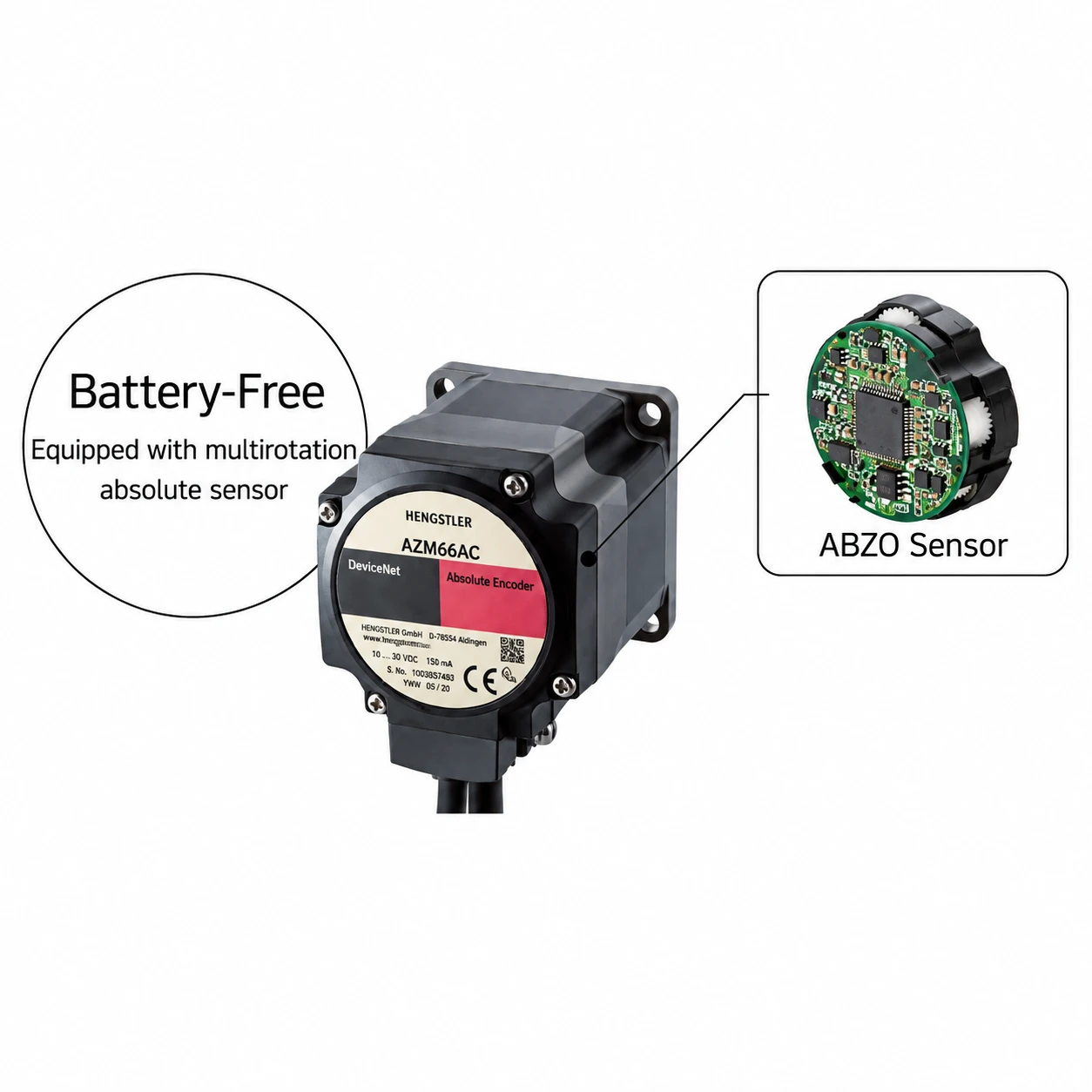
Stepper motors give accurate, repeatable positioning with high holding torque and simple pulse or I/O control. AZ Series absolute models hold position without a battery, so a machine starts without homing and recovers after a power loss. Matched planetary and right-angle gearheads raise torque in a compact package. LVP Automation is the Irish agent for Oriental Motor, sizing, selecting and supporting from Dublin.

Brand
Oriental Motor
Motor type
Stepping motors, including AZ Series absolut…
Position feedback
Battery-free absolute (AZ)
Resolution
Fine step angles with microstepping, series-…
Control interface
Pulse / I/O / fieldbus
Sized and selected for your load and duty cycleIrish agent for Oriental Motor
Positioning & indexing
Repeatable moves for jigs, gantries and dial tables
Absolute, battery-free
AZ Series resumes position without homing
Compact high torque
Matched planetary and right-angle gearheads
Ireland-wide support
Sizing, selection and commissioning from Dublin 11

Stepper motors explained

What a stepper motor does

A stepper motor moves in fixed increments rather than spinning continuously, so a controller can command a set number of steps and know where the shaft has ended up. That makes it a positioning device first and a rotating device second, which is why steppers sit under so many indexing, feeding and pick-and-place mechanisms.

Because position is defined by counting steps rather than by a tuned feedback loop, a stepper holds its place under load without the continuous tuning a servo axis expects. For a machine that has to hit the same handful of positions all day, that is usually the shortest route to dependable motion.

01

Stepper, servo or brushless DC

Steppers suit accurate, repeatable positioning with strong holding torque and simple control. Servos are the answer where speeds and dynamics are genuinely high. Brushless DC is the efficient choice for continuous running at a set speed. Most of the selection argument comes down to which of those three an axis actually needs, and it is worth settling before any sizing work starts.
02

Accuracy and what limits it

Fine step angles and microstepping give steppers excellent repeatability, and microstepping also smooths the motion between steps. The limit on overall accuracy is usually mechanical rather than electrical: backlash in a gearbox or coupling, and compliance in the drivetrain, both show up at the tool before the motor does.

03

Absolute position without a battery

AZ Series absolute technology holds a position reference without a backup battery, so a machine can start from a known position instead of running a homing sequence. On short cycles that removes dead time at every start-up, and after a power loss the axis recovers its position rather than needing to be re-referenced.

04

Open loop, or with an encoder

Many stepper axes run open loop and need no feedback device at all. An encoder is worth adding where the cycle is demanding enough to want stall detection, or where the machine has to report actual position rather than assume it.

05

Control and motion profiles

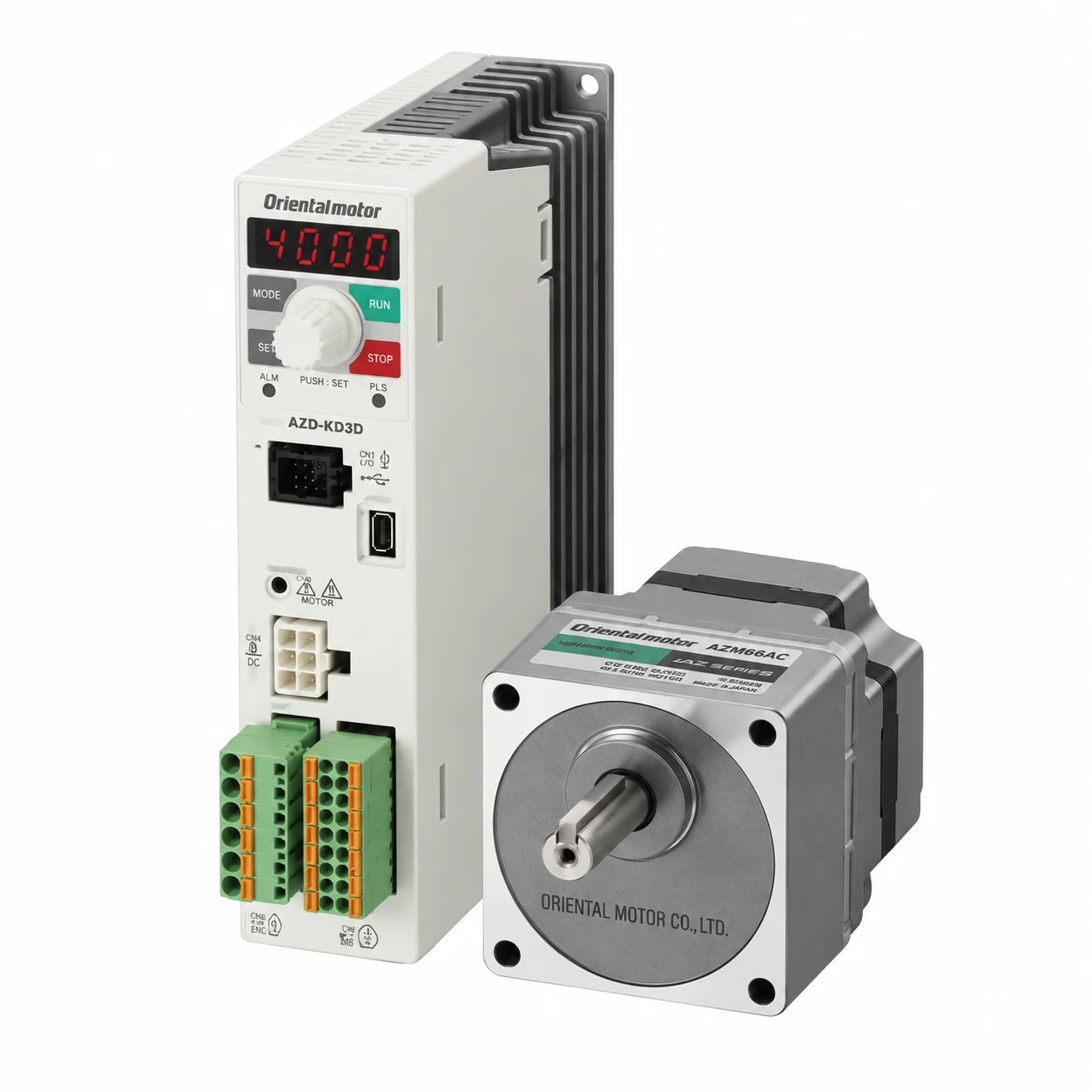
Drivers accept pulse and direction signals or digital I/O, with fieldbus options depending on the series. Acceleration and deceleration profiles are configured in the driver or from the HMI, and that is also where vibration and resonance are dealt with, alongside sensible inertia ratios and, where an axis needs it, a damper or a gearhead.

06

Gearheads, torque and footprint

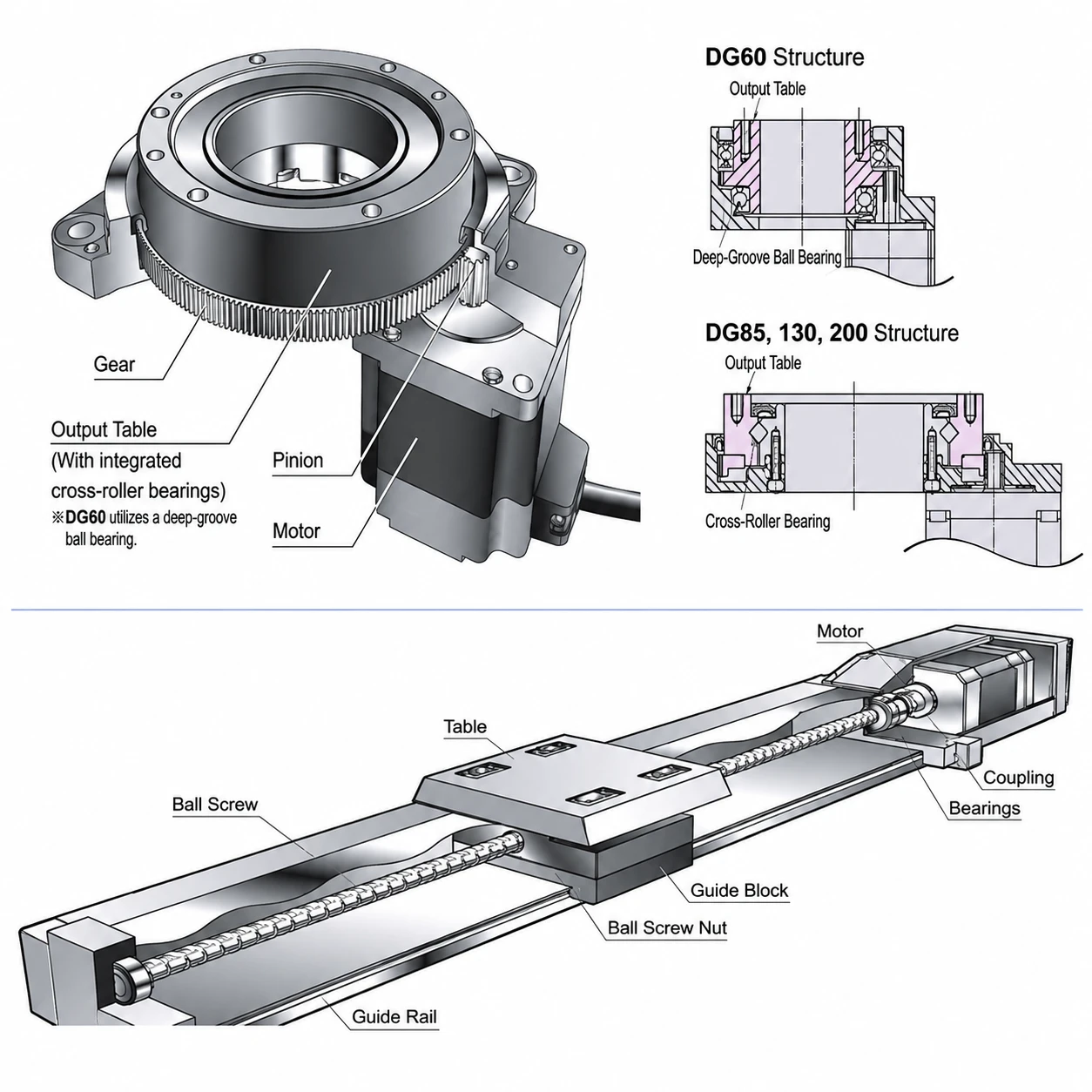
Matched planetary and right-angle gearheads raise both torque and resolution while keeping the package short. That is what makes a stepper viable on feeders, small conveyors and dial tables, where strong low-speed torque is needed but there is very little room to put a motor.

Where stepper motors sit in a machine

A stepper is rarely specified on its own. It has to match the load, the duty cycle and the ambient conditions it will run in, and its driver has to match your panel standard and available mains, all of which is settled during selection rather than after delivery. Where an axis needs a linear stroke rather than a rotation, actuators and motion systems cover the same ground, and brushless DC motors are the alternative where the requirement is continuous speed rather than position.

LVP Automation is the Irish agent for Oriental Motor, founded in 1885 and the oldest motor manufacturer in Japan, with its European operation established in Dusseldorf in 1982. We size, select and ship motors, drivers and gearheads from Finglas, Dublin 11, with commissioning guidance and after-sales support as part of our wider automation services. Oriental Motor applications covers where these products are used across Irish industry.

Specification

Brand
Oriental Motor. LVP Automation is the Irish agent
Motor type
Stepping motors, including AZ Series absolute models
Position feedback
Battery-free absolute on AZ Series; open loop on standard series
Resolution
Fine step angles with microstepping, series-dependent
Control interface
Pulse and direction, or digital I/O; fieldbus options by series
Gearheads
Matched planetary or right-angle, to raise torque and resolution
Encoders
Optional, for feedback, monitoring or stall detection
Driver supply
Multiple voltage options, matched to your panel standard at selection
Duty
Continuous within thermal limits; sized to your duty cycle and ambient
Support
Sizing, selection, commissioning guidance and after-sales support from Dublin 11

Where Stepper Motors Excel

Precise Indexing & Pick-and-Place

Hit exact positions and repeat them all day—great for fixtures, jigs, small gantries and automated format changes.

Compact Motion With High Torque

Short motor + gearbox packages deliver strong low-speed torque for feeders, small conveyors and dial tables.

Fast, Home-Free Start-Ups

With AZ Series absolute tech, machines resume known positions after power cycles—no limit/home moves, less downtime.

FAQs about Stepper Motors

Quick answers on selection, accuracy, control, duty cycle, gearheads and support in Ireland.

When should I choose a stepper over a servo or BLDC?

Choose a stepper for accurate, repeatable positioning and strong hold torque with simple control. Use servo for very high speeds/dynamics and BLDC for efficient continuous speed control.

How accurate are stepper motors?

Steppers offer fine step angles and excellent repeatability; microstepping smooths motion. Overall accuracy depends on mechanics (backlash, compliance).

What’s special about the AZ Series?

It provides battery-free absolute position reference, so you can power up and run without homing—great for short cycles and recovery.

Do I need encoders?

Many stepper apps run open-loop; encoders can be added for feedback/monitoring or to detect stalls in demanding cycles.

How do I control speed and position?

Via the driver: pulse/direction, digital I/O, or available fieldbus options (series-dependent). Profiles (accel/decel) are set in the driver/HMI.

Are gearboxes available?

Yes—matched planetary or right-angle gearheads increase torque and resolution while keeping footprints compact.

Can steppers run continuously?

Yes, within thermal limits. We size the motor/driver for your duty cycle and ambient to avoid overheating.

What supply voltages are supported?

Multiple driver voltage options exist; we’ll align with your panel standard and available mains.

How do I minimise vibration/resonance?

Use microstepping, appropriate inertia ratios, and—if needed—dampers or gearboxes. We’ll tune motion profiles accordingly.

Can LVP help with sizing and lead times?

Absolutely—LVP will size, select and ship the motor/driver/gearhead you need, with commissioning guidance and after-sales support across Ireland.

Downloads

Similar Products

Let's Connect

Have a question about our conveyor systems or need a tailored automation solution for your business? Our team at LVP Automation is here to help. Fill out the form below with your details, and we’ll get back to you as soon as possible. Whether you need a quote, technical support, or more information on our products, we’re ready to assist.