
Conveyor Belting
Conveyor Belting Supplied, Specified and Fitted
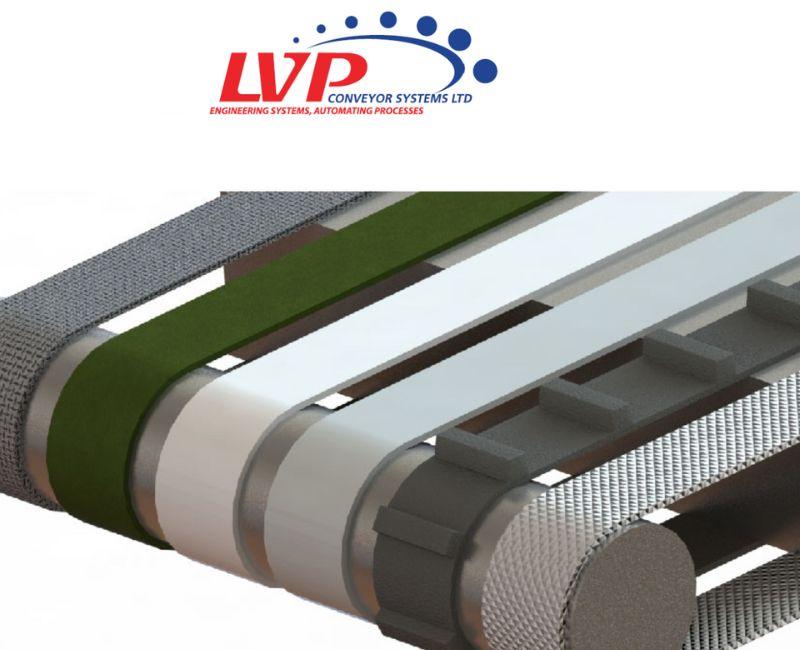
The belt is the part of a conveyor that actually touches your product, and the part most likely to be the reason the line has stopped. LVP Automation supplies belting for conveyors of any make: PVC and PU, modular plastic, rubber and specialist grades, including food-grade, heat-resistant and abrasion-resistant belts.
The right belt depends on more than the machine it goes on. What it carries, whether the product is hot, oily, sharp or sticky, whether the line gets washed down, how steep the incline runs and how the belt is joined all change the answer. Get one of them wrong and the belt tracks off, delaminates or wears through long before it should. We work from the application rather than simply matching the belt that was fitted before, which may have been the wrong choice in the first place. We are based in Finglas, Dublin 11 and supply customers across Ireland.
What Our Belting Service Covers
- Belt Types for the Job: PVC and PU, modular plastic, rubber and specialist grades, including food-grade, heat-resistant and abrasion-resistant belting.
- Cleats, Sidewalls and Profiles: Inclines, elevators and product separation need more than a flat belt. Cleats, sidewalls, V-guides and perforation are specified with the belt rather than added later.
- Made to Your Measurements: Belts cut, joined and finished to the length, width and joint type your conveyor actually needs.
- Specified from the Application: What the belt carries, how hot or greasy it runs, whether the line is washed down and how steep the incline is all decide the material. That is where we start.
- Food-Grade Where It Matters: Belting for food contact and washdown lines, chosen for the cleaning regime the conveyor is actually put through.
- Supplied or Fitted: Belting on its own, or fitted by our on-site team along with a look at the pulleys, rollers and tracking that shortened the life of the last one.
Why conveyor belts fail early
A belt that lasted eighteen months where it should have lasted five years usually failed for a reason that is still present. Fitting the same belt again simply restarts the clock.
- Mistracking. A belt running to one side wears its own edge away. The cause is normally a pulley out of square, a frame that has been knocked, or uneven loading rather than the belt itself.
- Tension. Too slack and the belt slips and stalls under load. Too tight and the bearings, the joint and the belt all pay for it.
- Worn pulleys and rollers. A grooved pulley or a seized roller destroys a new belt quickly and quietly.
- Contamination. Oil, sugar, cleaning chemicals and fine dust each attack particular belt materials. A belt that is fine in one factory fails in another carrying the same product.
- Wrong specification. An abrasive product on a general-purpose belt, or a hot product on a belt not rated for it, will wear out no matter how well it is fitted.
- The joint. Where a belt repeatedly fails at the joint rather than across the face, the joint type or its preparation is the thing to change.
What we need in order to quote a replacement belt
Belt width and overall length, or the conveyor’s centre distance if the belt is beyond measuring. The existing joint type. What the belt carries and roughly how much of it. Whether the line is inclined. Whether it is washed down, and with what. And a photograph of the belt in place, including the worn area, which often says more about the cause than the measurements do. If the belt is still fitted, a photo of the nameplate or any printed marking on the underside helps.
Belt joints
An endless welded joint runs quietly, cleans well and suits food and washdown lines, but the belt has to be fitted around the frame. A mechanical fastener lets a belt be fitted and replaced in place without dismantling the conveyor, which matters where downtime is the binding constraint. Neither is universally better. The right choice usually comes down to how the conveyor is built and how quickly it has to be back in service.
Related services and products
Belting sits close to several other things. Worn pulleys, rollers and bearings are covered under spare parts and accessories, and fitting, tracking and tensioning under on-site repair and maintenance. If a belt keeps stalling or the drive keeps tripping, the question may be motor sizing rather than belting. For complete conveyors rather than replacement belts, see plastic belt conveyors, PU and PVC belt conveyors and modular belt conveyors.
Common questions
Can you supply belting for a conveyor you did not build? Yes. Most replacement belting we supply goes onto other manufacturers’ conveyors.
Our belt keeps running off to one side. Is it a belt problem? Usually not. Persistent mistracking is nearly always the frame, a pulley out of square, a worn roller or uneven loading. A new belt on an untouched frame will track off in exactly the same way.
Do we need a food-grade belt? If the belt touches open food, yes, and the cleaning regime matters as much as the contact itself: a belt that copes with a wipe-down may not survive daily caustic washdown.
Can you fit the belt as well as supply it? Yes, through our on-site team. Where a belt has failed early, it is worth having the pulleys, rollers and tracking checked at the same time rather than fitting a new belt to the same conditions.
How long does a conveyor belt last? There is no useful average. It depends on the product, the hours run, the cleaning regime and how well the conveyor is set up. What is more telling is whether the belt failed across the face, at the edge or at the joint, because each points somewhere different.
Where do you cover? We are based in Finglas, Dublin 11 and supply customers across Ireland.
Let's Connect
Have a question about our conveyor systems or need a tailored automation solution for your business? Our team at LVP Automation is here to help. Fill out the form below with your details, and we’ll get back to you as soon as possible. Whether you need a quote, technical support, or more information on our products, we’re ready to assist.