Conveyor and Automation Simulation
Conveyor and Automation Simulation Before You Build
A layout that works on a drawing can still fail at rate. Simulation builds a working model of the line — conveyors, merges, diverts, buffers and the product moving through them — and then runs it, so throughput, queueing and bottlenecks appear on screen rather than on the factory floor after the steelwork is in.
LVP Automation models conveyor, warehouse and wider material handling systems, both for new lines and for changes to lines already running. We can test what happens at your target rate, where product backs up, whether a merge copes with two streams arriving together, and what the line does when one section stops. The models further down this page are our own. We are based in Finglas, Dublin 11 and work with customers across Ireland.
What Our Simulation Service Covers
- Modelled at Your Rate: The model runs at the throughput you actually need, so a layout that only works on paper shows itself before anything is ordered.
- Bottlenecks Found Early: Simulation shows where product queues and which section sets the ceiling for the whole line, whether that is a conveyor run, a pick face or a palletising cell.
- Merges and Diverts Tested: Merge points are where throughput is usually lost. The model shows what happens when two streams arrive at once.
- Accumulation Sized Properly: How much buffer is needed to ride out a stoppage downstream is a question a running model can answer and a drawing cannot.
- Changes Tried Before They Are Made: A new product, a faster rate or an added line can be tested against the existing layout without stopping production.
- Something to Show: A model gives you a visual case to put in front of the people who have to sign off the spend.
What the models above show
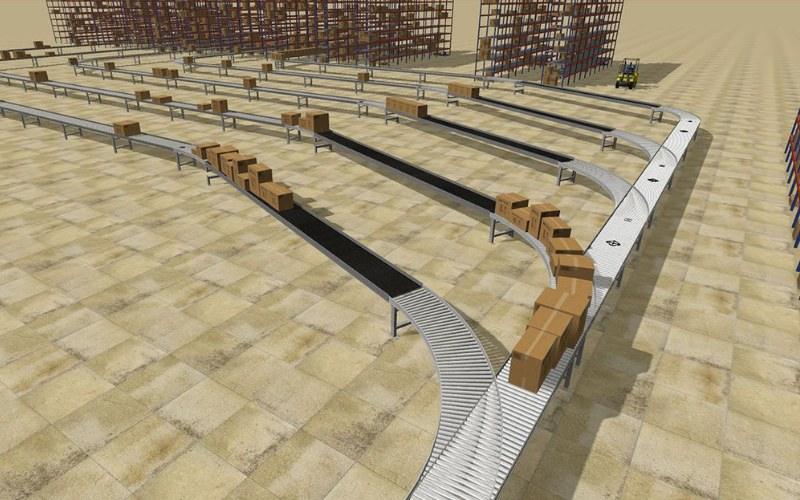
LVP Model 1 — a bank of parallel roller lanes feeding through a curve onto a single take-away line, with pallet positions laid out alongside. The layout most warehouses recognise: several sources, one outfeed, and the question of whether the outfeed can take everything the lanes send it.
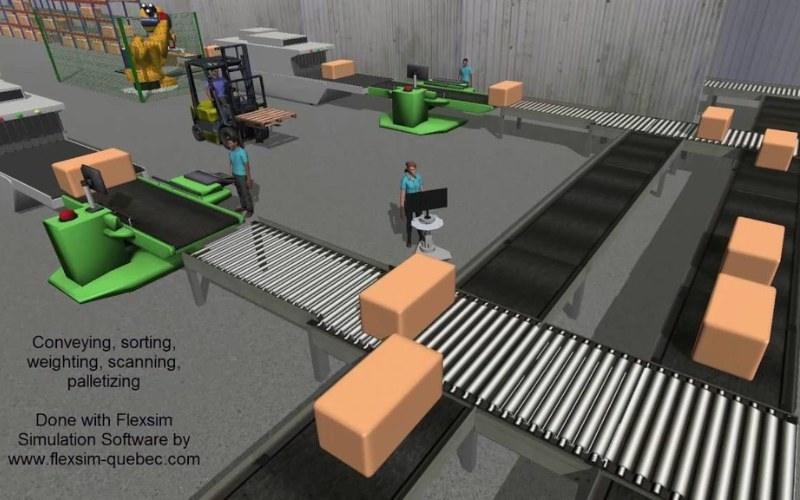
LVP Model 2 — the same arrangement carrying real product, with cartons accumulating along the lanes and moving away on the curved take-away line. This is what a model is for: watching where product gathers and how long it sits there before the line clears.
LVP Model 612mm merge issue — a close view of a merge point where a curved line joins a straight main line at 612mm width. Cartons arrive together and pile up against each other at the junction instead of passing through it.
LVP Model 712mm merge — the same merge modelled at 712mm. Cartons pass through the junction squarely and keep moving. Two models, one dimension changed, and the difference visible before anything was fabricated.
What a simulation answers
- Whether the layout actually achieves the rate it is being bought to achieve
- Which section becomes the ceiling on the whole line, and by how much
- How a merge behaves when both streams arrive together rather than politely in turn
- How much accumulation is needed to absorb a stoppage downstream without starving the line upstream
- What happens during changeover, at start-up, and when one section goes down
- Whether an extra product, a faster rate or a new line can be absorbed by what is already installed
What we model
Conveyor runs and their transfers, merges and diverts, accumulation and buffering, pick faces and order consolidation, sortation, palletising and end-of-line, and the warehouse flows that connect them. If product moves through it and rate matters, it can be modelled.
When simulation earns its place, and when it does not
Worth doing where the capital cost is significant, where several streams merge or divert, where the required rate is close to what the layout can theoretically manage, or where the line has to be justified to somebody who was not in the room for the design discussion.
Not worth doing for a short, single-stream conveyor with generous headroom on rate and no merge points. Where the answer is obvious from the layout and the numbers, a model tells you what you already know. We will say so rather than sell one.
What we need to build a model
A layout or drawing of the line, the products and their dimensions and weights, the rate you need in units per hour or per shift, the pattern of arrivals through a shift, and what happens at each merge, divert and buffer. Where the line already exists, real production figures make the model considerably more useful than estimates do.
Related services
Simulation usually sits alongside other work. It most often follows or informs conveyor system design, and the control logic tested in the model is written for real in PLC programming. Drive duty assumptions taken from a model feed into motor sizing and selection, and where a concept has to be proven before a full design begins, see proof of concept development.
Common questions
Can you simulate a line you did not design? Yes. A model is built from the layout, the product and the rate, not from who supplied the equipment.
Do we need a simulation before we can order a conveyor? No. It is a way of reducing risk on a decision, not a required step. It earns its cost on complex or high-value lines and on changes to lines that cannot afford to be got wrong.
Can you model a change to a line that is already running? Yes, and this is often where a model pays best, because the existing line gives real figures to build on and production does not have to stop to test the idea.
Can you model a whole warehouse rather than one conveyor? Yes. Material handling problems are usually about how sections interact, so modelling the flow end to end is often more useful than modelling one line in isolation.
What do we get at the end? A working model of the line you can watch running, together with what it showed about rate, bottlenecks and the points where throughput is lost.
Where do you cover? We are based in Finglas, Dublin 11 and work with customers across Ireland.
Let's Connect
Have a question about our conveyor systems or need a tailored automation solution for your business? Our team at LVP Automation is here to help. Fill out the form below with your details, and we’ll get back to you as soon as possible. Whether you need a quote, technical support, or more information on our products, we’re ready to assist.