Curve angle
45°, 90° and 180° are standard. A 180° turn is normally used to run a line back on itself where the building depth will not take one long straight run. Custom angles can be discussed where a layout needs them.

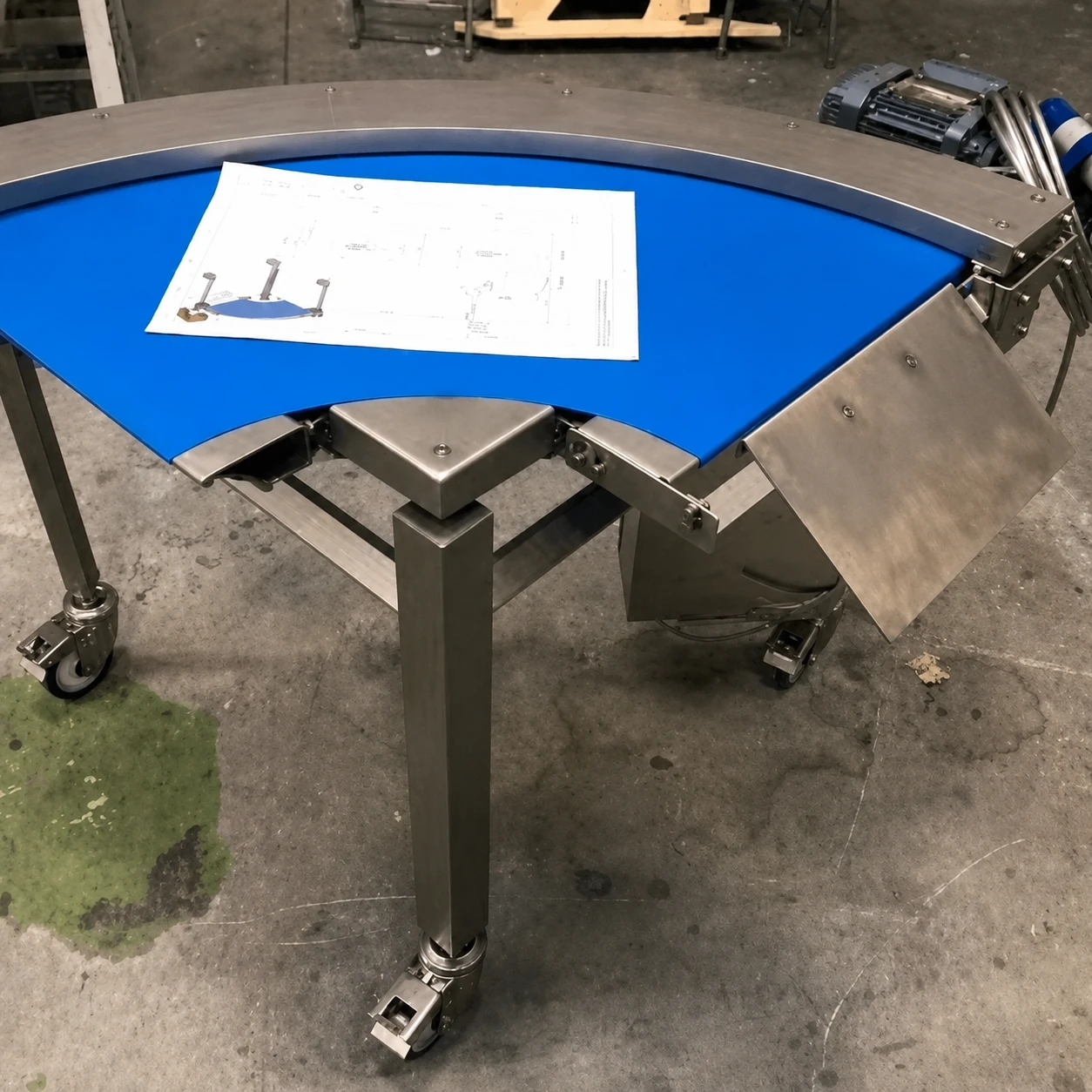
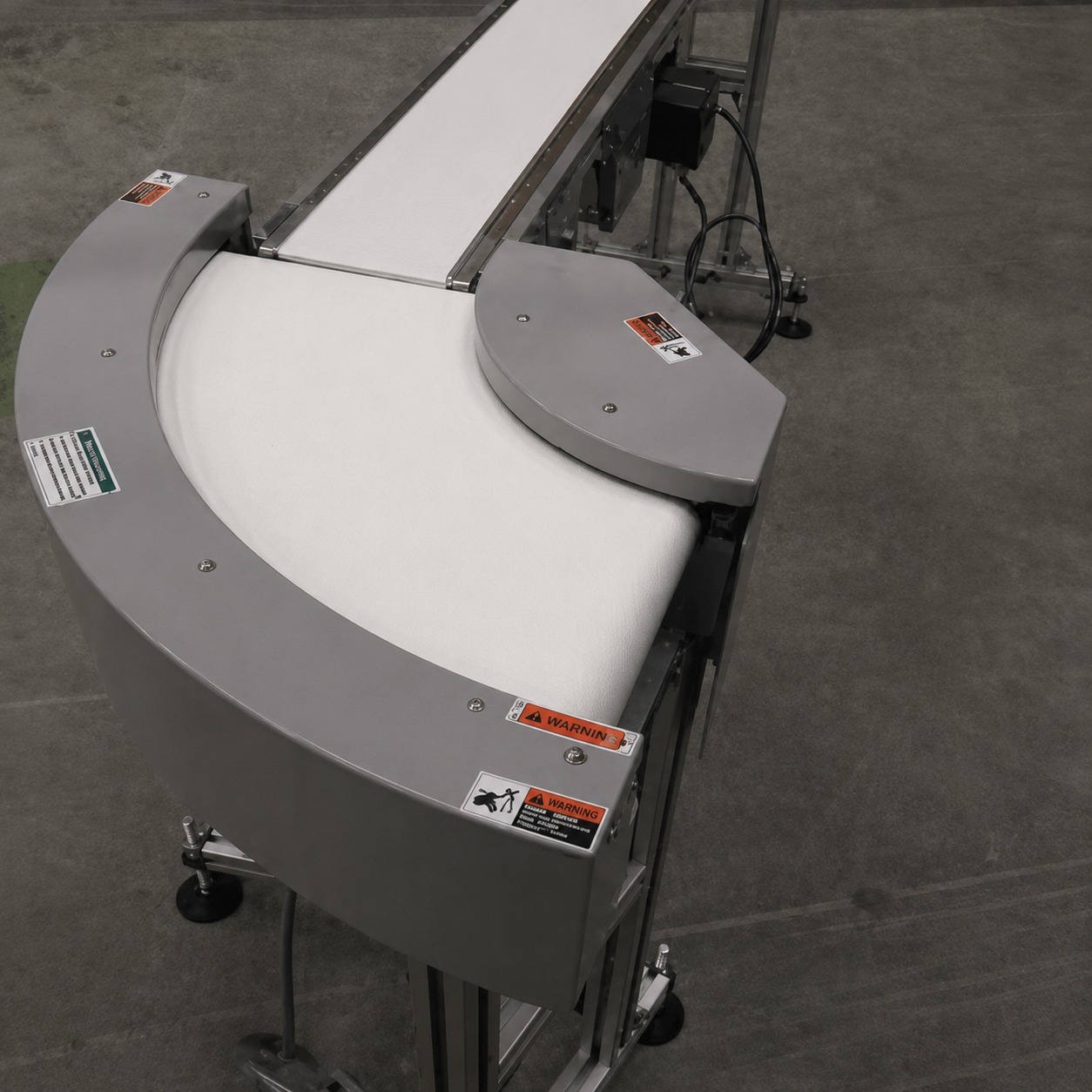
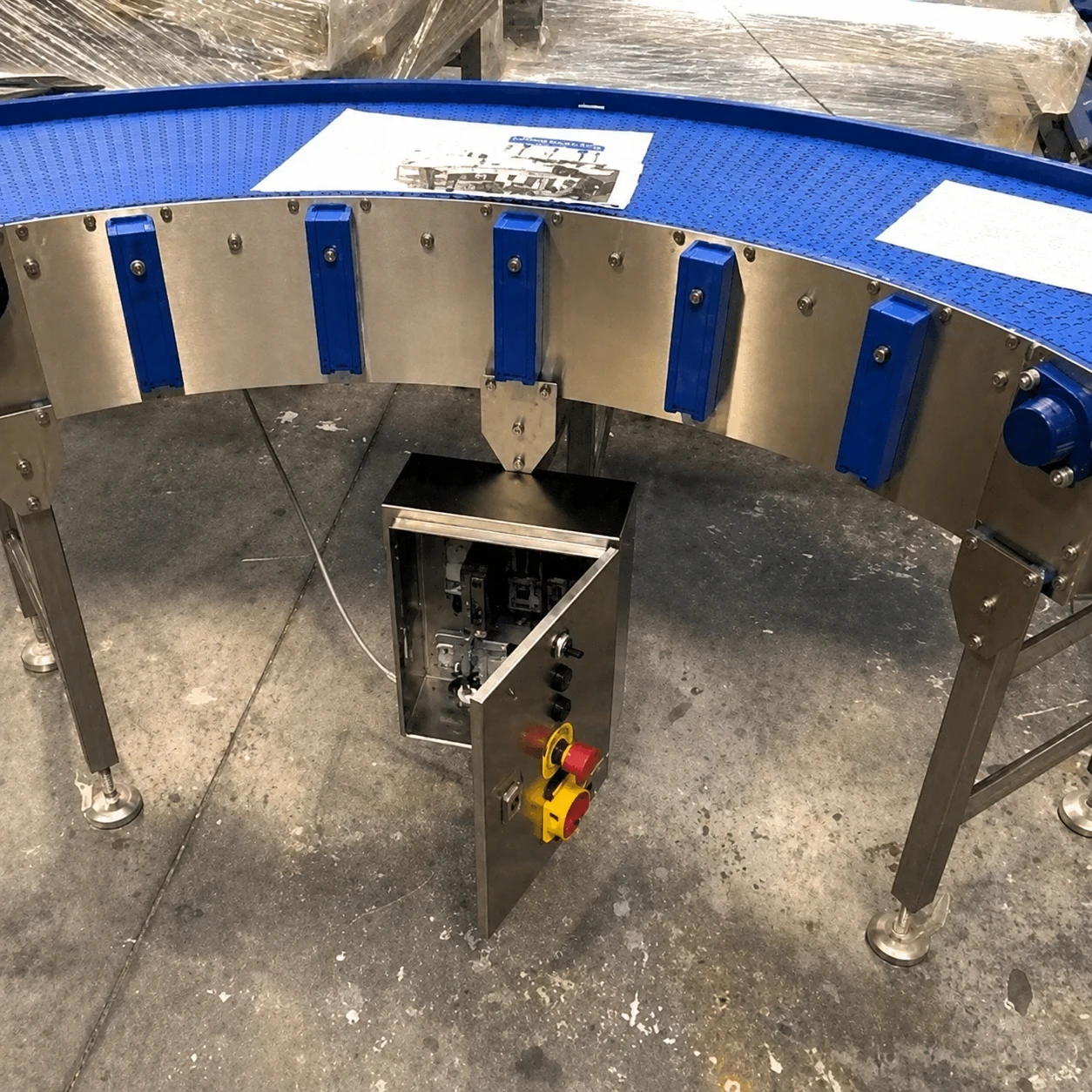
Curve belt conveyors turn product through 45°, 90° or 180° in a compact footprint, so a line can change direction without re-planning the layout around it. Frames are available in stainless steel, anodised aluminium or powder-coated mild steel, in widths from 200mm to 900mm, with multiple radius options for food production and pharmaceutical cleanrooms. Designed, built and supported by LVP Automation in Dublin.
A curve belt conveyor, also called a corner conveyor or a conveyor bend, carries product around a change of direction on one continuous belt rather than transferring it between two straight sections. Because the belt runs through the turn, product keeps its orientation and there is no gap for small or unstable items to catch on.
That matters most in buildings that were not laid out for the line now running in them. A curve lets flow follow the space available, around a column, past an existing machine or along a wall, without re-planning the layout to keep everything in a straight line.
45°, 90° and 180° are standard. A 180° turn is normally used to run a line back on itself where the building depth will not take one long straight run. Custom angles can be discussed where a layout needs them.
Radius is set by product size, line speed and available space, and those three pull against each other. Larger products and faster lines usually need a larger radius to stay stable through the turn, while a tighter radius saves floor area. Where space is genuinely tight this is the trade-off to settle first, because it constrains everything after it.
Modular plastic belt suits robust, washdown-heavy applications and handles curves well. PU belt runs more smoothly and quietly and is straightforward to clean. The choice usually follows the product and the cleaning regime rather than the conveyor itself.
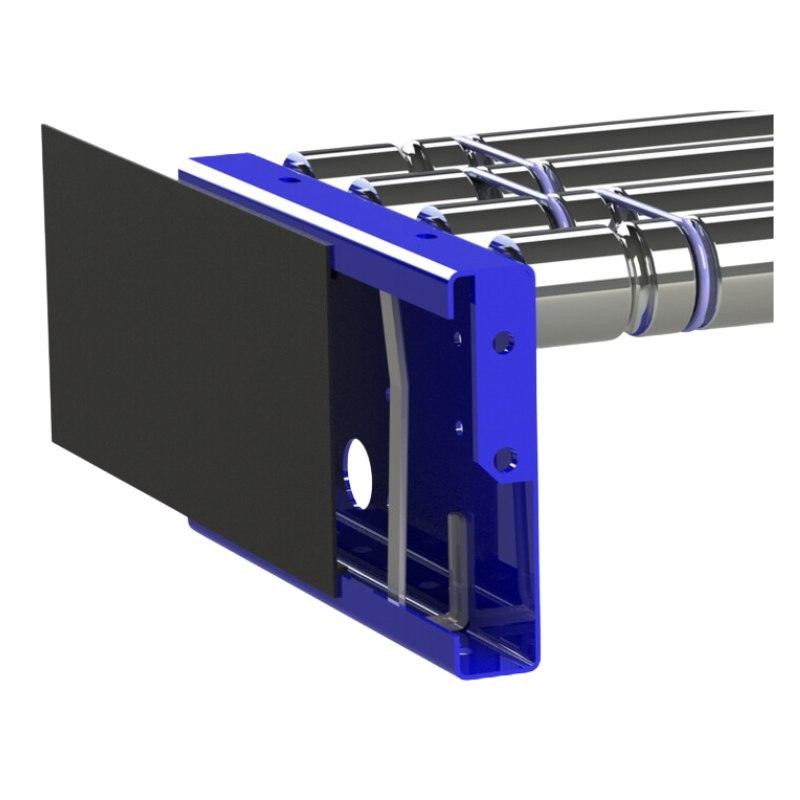
The join between the curve and the straight sections either side is where small product is lost. Standard end rollers are fine for cases and cartons. Knife-edge end rollers reduce the transfer gap so packets, pouches and small or flexible items pass cleanly instead of tipping or catching. If any part of your product range is small or soft, settle the transfer before the conveyor.
Stainless steel frames with open profiles and food-grade belting suit food and beverage production and pharmaceutical cleanrooms, where the frame has to be cleaned as thoroughly as the belt. Anodised aluminium and powder-coated mild steel cover general manufacturing and end-of-line FMCG handling, where washdown is less demanding and cost carries more weight.
Where product has to stop in a defined position rather than simply flow, a stepper motor drive with low-friction belting gives repeatable start and stop behaviour through the curve. That is the arrangement used where a curve feeds a machine expecting product in a known place. It affects drive selection, so it is worth raising at enquiry rather than adding later. Our page on conveyor indexing covers how this works across a line, and accumulation covers what happens when the line downstream stops.
A curve is rarely bought on its own. It connects straight conveyor sections and usually has to match their width, height and speed, so what feeds the curve and what it feeds into matter as much as the curve itself.
LVP Automation designs, builds and supports curve belt conveyors from Finglas, Dublin 11, working with manufacturers across Ireland as part of our wider automation services.
Turn product flow neatly around equipment, columns or walls—keep throughput high without re-planning your whole line.
Stainless frames, open profiles and food-grade belts suit food & beverage plants and pharma cleanrooms.
Knife-edge rollers and guided sidewalls enable smooth hand-offs for packets, pouches and other small SKUs.
Quick answers on radii, belts, speeds, transfers, hygiene and integration.
Standard 45°, 90° and 180°. Custom angles can be discussed if your layout requires them.
Based on product size, speed and space. Larger products and higher speeds usually need a larger radius for stability.
Modular belts suit robust, washdown-friendly applications and curves; PU belts offer smooth, quiet running and easy cleaning.
Yes—knife-edge end rollers reduce the transfer gap to help tiny or flexible packs pass cleanly.
Absolutely—stainless frames with food-grade belts and hygienic design for FDA-grade applications.
Standard 200–900 mm; we’ll size the belt to your product dimensions and throughput.
From slow, controlled indexing to higher line speeds; we specify drive ratios and belt type to maintain stability on the curve.
Yes—stepper motor drive with low-friction belts gives precise stop/start for inspection, merging or metering.
We supply matched heights, guides and transfer plates; PLC/HMI handshakes coordinate starts/stops and sensors.
Routine belt tracking/tension checks, cleaning and inspection of rollers/drives. Modular belts allow quick section replacement.
Have a question about our conveyor systems or need a tailored automation solution for your business? Our team at LVP Automation is here to help. Fill out the form below with your details, and we’ll get back to you as soon as possible. Whether you need a quote, technical support, or more information on our products, we’re ready to assist.
Your cookie choices
We use cookies to see how our website is used and improve it. They're only set if you accept them. You can change your mind at any time. Read our cookie policy