Shuttle Systems

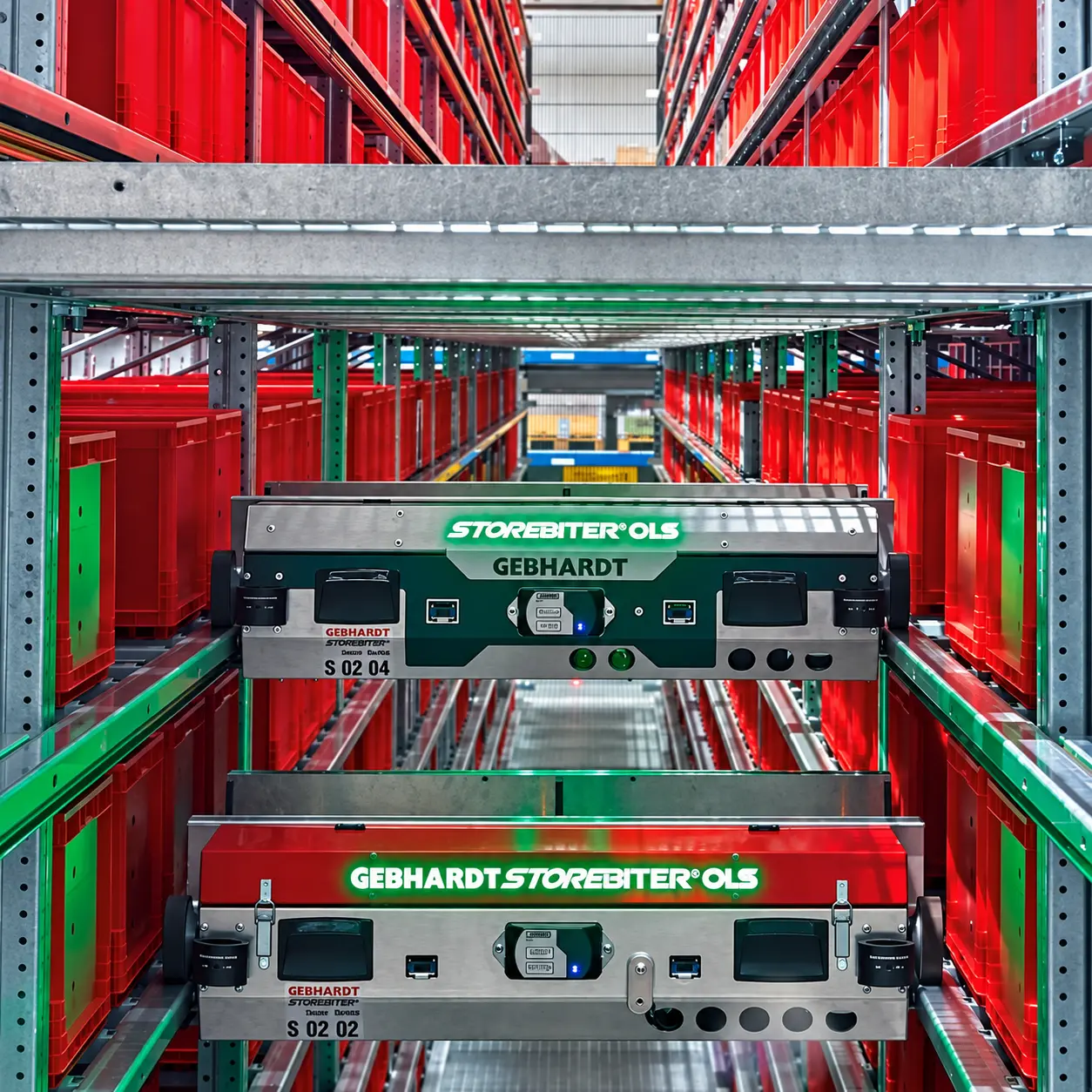
Gebhardt’s shuttle systems, including the StoreBiter® MLS, OLS, and OLS X models, are designed to provide dynamic and efficient storage and retrieval solutions for a variety of goods, including containers, trays, and cardboard boxes. These flexible systems support various storage depths and configurations, ensuring high performance and energy efficiency in diverse warehouse environments. Select models feature double-layer capacitors for energy savings, enhancing operational efficiency. Gebhardt’s shuttle systems can be seamlessly integrated with Goods-to-Person workstations, optimising workflows and improving productivity.

Models
MLS, OLS, 300 and 500
MLS payload
Up to 120 kg
MLS heights
Up to 7.5 m
MLS travel speed
Up to 4 m/s
MLS lifting
0.8 m/s lift
Storage depth modelled before you orderSpecified, installed and supported from Dublin 11
Up to 120 kg
One container, or up to four smaller ones
Up to 4 m/s
Travel speed on the standard StoreBiter MLS
1,500 kg option
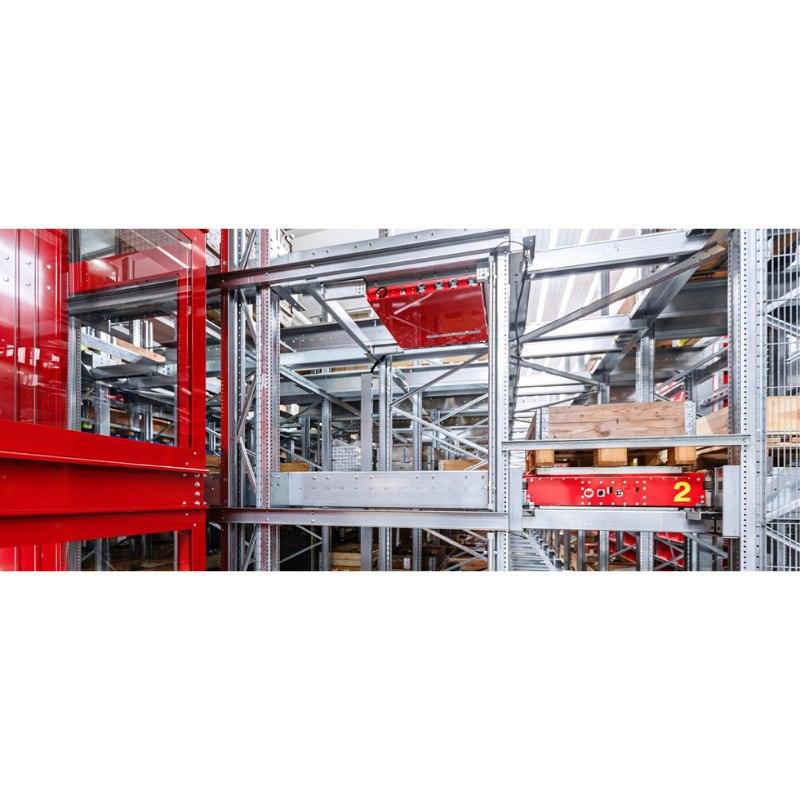
StoreBiter 500 for pallets and trays
Ireland-wide support
Specification, install and service from Dublin 11

Shuttle systems explained

One shuttle per level, or one shuttle that climbs

That single choice decides most of the rest. A one level shuttle stays on its own tier and hands totes to a lift at the aisle end, so throughput comes from running many shuttles at once. A multi level shuttle carries its own lifting function and moves between tiers itself, so fewer machines cover the same racking. More shuttles cost more but fail softer, because losing one takes out a level rather than an aisle. Fewer machines cost less and concentrate the risk.

01

The StoreBiter MLS range and how high it goes

The multi level StoreBiter comes in three heights. The standard MLS works to 3 m and travels at 4 m/s with 1.5 m/s² acceleration. MLS high reaches 5 m and MLS ultrahigh reaches 7.5 m, both at 3 m/s with 1.2 m/s². Lifting is 0.8 m/s at 2 m/s² across all three. The taller machines trade a little speed for reach, which is usually the right trade when the alternative is a second aisle.
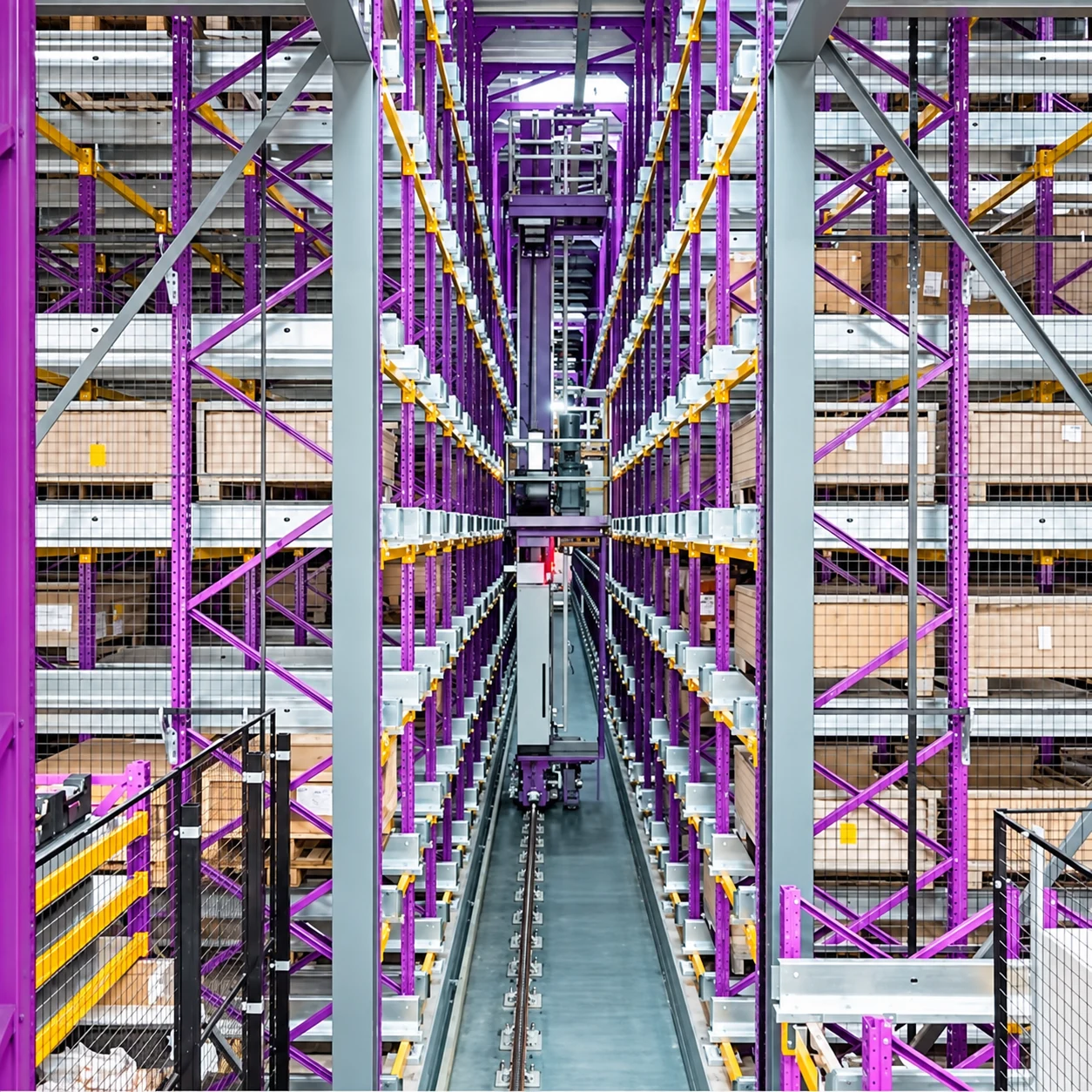
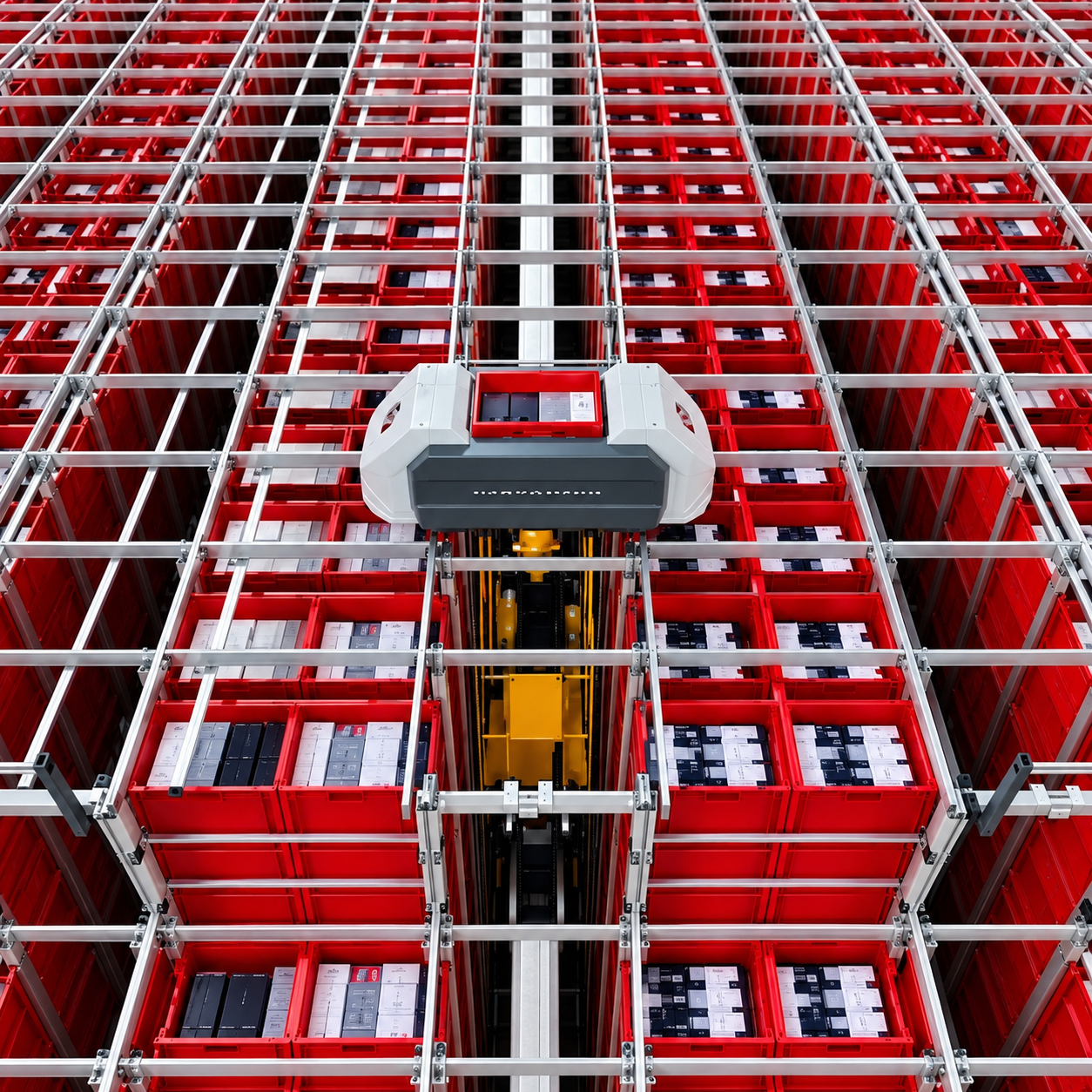
02

Payload is a division problem

The MLS carries 120 kg, but how you divide it matters more than the total. It will take one container at 120 kg, two at 60 kg, three at 35 kg or four at 25 kg. Conveyed goods run to 850 mm wide and 1,450 mm long. If your totes are light and small, the four container configuration roughly quadruples the work done per trip, and that is where the throughput actually comes from rather than from top speed.

03

The 300 and 500 series

The StoreBiter 300 MLS handles 2 x 50 kg to a height of 2 m, travelling at 4 m/s with 2 m/s² and lifting at 1.5 m/s. The 300 OLS is the one level version at 2 x 50 kg and 3 m/s with 2.5 m/s², gaining throughput by moving on both axes at once. The StoreBiter 500 is a different class again at 1,500 kg and 1.5 m/s, built for multiple depth storage of pallets and trays rather than totes.

04

Single, double or multiple deep

Single deep reaches every location directly and gives the fastest access. Double and multiple deep raise density but sometimes require moving one container to reach another. The honest answer comes from SKU velocity: fast movers at the front in single deep, slow movers buried deeper. Get that modelling wrong and you either buy racking you cannot fill or throughput you cannot reach.

05

Goods to person, and where picking actually happens

Shuttles are only half the system. The pick stations at the aisle end are where the labour is, and sequencing totes so they arrive in the order the picker needs them is what turns a fast shuttle into a fast operation. Buffering before the station absorbs the variation, which matters more than raw shuttle speed once you are past a certain volume. Downstream this usually meets sorting technology before dispatch.

06

Energy and the operating envelope

Double layer capacitors on selected models store braking energy and release it on the next acceleration, which cuts peak draw as well as consumption. That matters when you are running many machines in one aisle and sizing the supply for all of them starting at once. The standard envelope is 5 to 40 °C ambient and up to 80 % humidity non condensing, so chilled and awkward environments need to be raised at design stage rather than discovered later.

Software, expansion and support

A warehouse control system sits between the shuttles and your WMS or ERP, handling tasks, confirmations, inventory updates and exceptions. Expansion means adding shuttles, levels or aisles rather than rebuilding, which is the main reason to start smaller than your five year forecast. Where the requirement is deeper storage or heavier unit loads, automated storage and retrieval and warehouse robotics cover the ground either side. LVP Automation specifies, integrates and supports shuttle systems from Finglas, Dublin 11 as part of our wider automation services.

Specification

Models
GEBHARDT StoreBiter MLS, MLS high and MLS ultrahigh, StoreBiter 300 MLS, 300 OLS and StoreBiter 500
MLS payload
1 x 120 kg, 2 x 60 kg, 3 x 35 kg or 4 x 25 kg
MLS heights
3 m on the standard MLS, 5 m on MLS high and 7.5 m on MLS ultrahigh
MLS travel speed
4 m/s at 1.5 m/s² on the standard MLS, 3 m/s at 1.2 m/s² on high and ultrahigh
MLS lifting
0.8 m/s at 2 m/s²
Conveyed goods size
Up to 850 mm wide and 1,450 mm long
StoreBiter 300 MLS
2 x 50 kg to 2 m, 4 m/s at 2 m/s² on the x-axis and 1.5 m/s at 1.5 m/s² on the y-axis
StoreBiter 300 OLS
2 x 50 kg on one level, 3 m/s at 2.5 m/s², moving on both axes at once
StoreBiter 500
1,500 kg at 1.5 m/s and 1 m/s², for multiple depth storage of pallets and trays
Operating envelope
5 to 40 °C ambient and up to 80 % humidity, non condensing

Where the Shuttle System Excels

High-Density, High-Speed Storage

Achieve strong picks/hour with multi-aisle, multi-level shuttles feeding sequenced buffers, ideal for e-commerce, pharma and spare parts.

Energy-Smart Operations

Capacitor-equipped models cut peak draw and recover energy during braking, lowering running costs without sacrificing performance.

Ergonomic Goods-to-Person

Direct to G2P workstations with balanced flows, light guidance and put-to-wall options for fast, low-error picking.

FAQs about the Shuttle System

Quick answers on loads, speeds, layouts, software, energy options and expansion.

What load types do shuttle systems handle?

Containers, totes, trays and suitably rigid cartons within defined size/weight limits, matched per model (MLS/OLS/OLS X).

Single, double or multi-deep, how do I choose?

Single-deep maximises access speed; double/multi-deep boosts density. We model SKU velocity to pick the right mix.

How fast is a shuttle system?

Throughput depends on aisles, levels and stations. Multi-aisle systems regularly deliver very high order lines/hour with proper buffering.

Can it integrate with my WMS/ERP?

Yes, via a warehouse control system (WCS) that exchanges tasks, inventory and confirmations with your WMS/ERP.

What about energy consumption?

Options include double-layer capacitors and regenerative braking to reduce peak draw and overall kWh per order.

How many G2P workstations do I need?

We size stations to order volume and service levels; stations can scale up/down seasonally with modular buffers.

Is sequencing for orders supported?

Yes, pre-sequencing buffers ensure items arrive in pack-ready order, improving cartonisation and pack speed.

How do you expand later?

Add shuttles, levels or aisles. The modular design and WCS allow staged growth with minimal disruption.

What maintenance is required?

Preventative checks on shuttles, lifts and rails; quick-swap parts and remote diagnostics keep availability high.

Is it suitable for chilled or restricted spaces?

Yes, shuttles can be specified for chilled boxes and tight footprints; we validate temperature ranges and clearances during design.

Downloads

Similar Products

Let's Connect

Have a question about our conveyor systems or need a tailored automation solution for your business? Our team at LVP Automation is here to help. Fill out the form below with your details, and we’ll get back to you as soon as possible. Whether you need a quote, technical support, or more information on our products, we’re ready to assist.