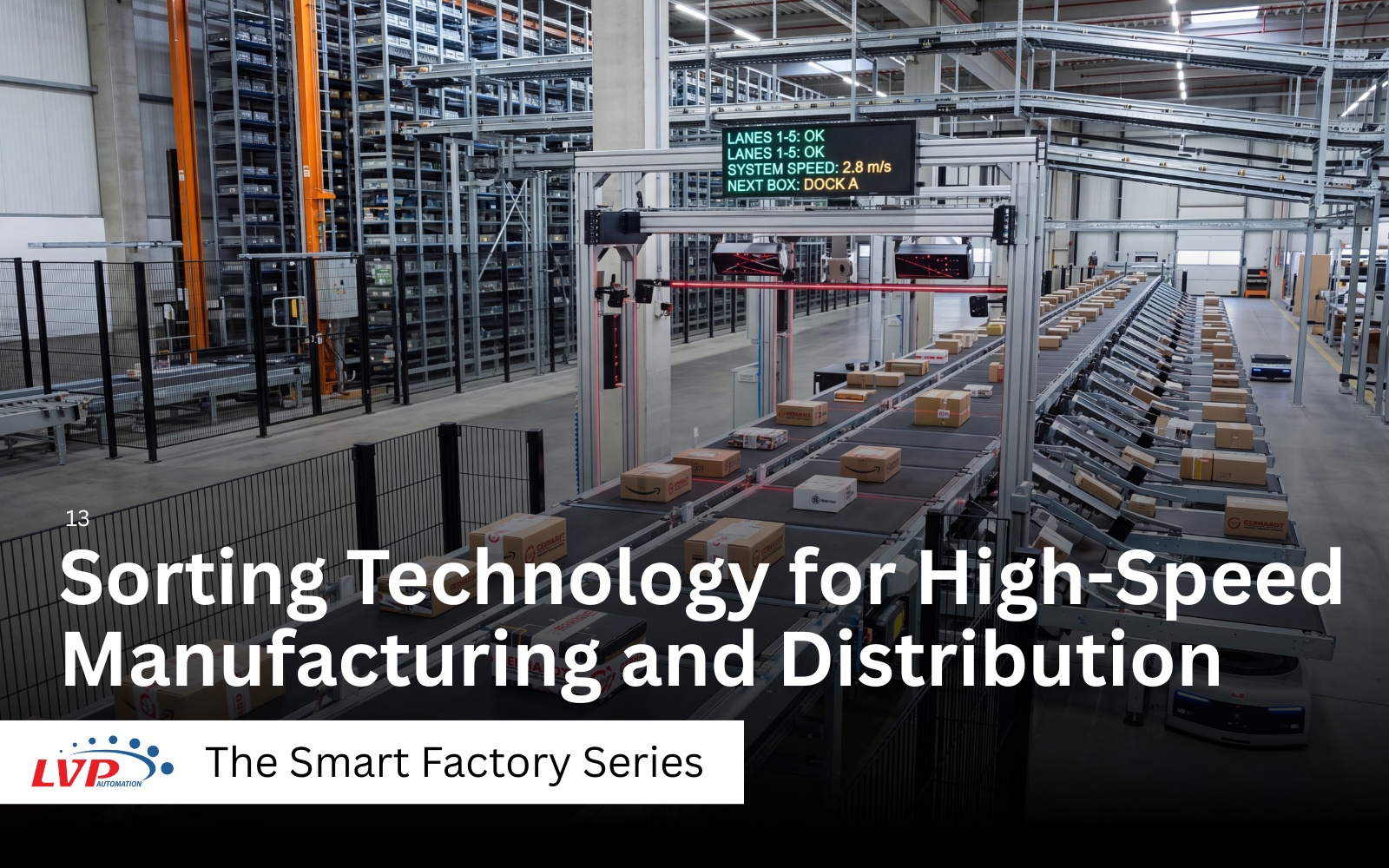
Sortation is the point where a stream of mixed product becomes separate, ordered destinations — orders, routes, lanes, customers. It is usually what allows a distribution operation to scale rather than simply run faster.
This page covers the main sorter types and what genuinely separates them, the three things that decide which one fits, and the part of a sortation project that absorbs most of the engineering: getting product onto the sorter correctly in the first place.
What a sortation system does
Three things happen in sequence, and each is a distinct engineering problem:
- Induction — product is separated into a single stream, correctly gapped, and identified by scanning or vision.
- Transport — the sorter carries it while the control system tracks which item is where.
- Divert — the item is discharged into the correct destination as it passes.
Most conversations concentrate on the second and third. Most of the difficulty is in the first, which is covered further down.
The main sorter types
What separates them is throughput, how gently they handle product, how many destinations they can serve, and what range of items they will accept.
Diverters and pop-up devices
The simplest approach: an arm, a set of wheels or rollers that lift or swing to push an item off the main line into a spur. Modest rates, few destinations, low cost, and easy to add to an existing conveyor.
Suited to operations with a handful of lanes rather than dozens, and to product that tolerates being pushed sideways.
Shoe and slat sorters
A moving slat bed with shoes that travel across it, guiding items off at an angle rather than shoving them. Because the divert is gradual and the product is guided rather than struck, it handles a wide range of sizes and is gentler than a pusher at similar rates.
A common choice in case and carton handling where product varies and rates are substantial without being extreme.
Tilt-tray sorters
Individual trays circulate on a loop, each carrying one item, and tip to discharge at the right destination. Because each tray is independent, the system supports a large number of destinations and handles items that vary considerably in shape.
Well suited to mixed goods and high destination counts. The item must be able to slide off a tilting surface, which is worth checking against anything sticky, very light or awkwardly shaped.
Cross-belt sorters
Similar loop principle, but each carrier has its own short powered belt that runs sideways to discharge. Because the item is driven off rather than tipped, placement is more controlled and gentler, and it handles small, light and irregular items that would not reliably slide off a tray.
Generally the highest throughput option and the most capable across a wide product range, at the highest cost.
Robotic sortation
Small autonomous robots carrying single items to a chute or destination. Flexible in layout, scalable by adding units, and straightforward to install into an existing building because it needs less fixed structure. Rates per unit are lower, so throughput is a fleet-size question.
The three questions that decide it
How many items per hour, at peak
Peak rather than average, and peak measured over a realistic window rather than a whole shift. Rate separates the categories more sharply than anything else: a handful of diverts an hour and several thousand items an hour are different classes of equipment entirely.
How many destinations
The number of lanes, chutes or destinations the sorter has to serve. Loop sorters — tilt-tray and cross-belt — support far more destinations than in-line diverters, because every carrier can reach every point on the loop. Where the answer is four lanes, a loop is overkill; where it is sixty, in-line diverting is not viable.
What is being sorted
Size range, weight range, base rigidity and how gently it needs handling. This is what most often rules out an otherwise suitable option. Polybags, very light items, and anything that will not slide reliably behave quite differently from uniform cartons, and the awkward end of the range defines the system — the same principle described in conveying awkward products.
Induction is where the work is
A sorter can only divert what it has correctly identified and correctly positioned. Getting product into that state is called induction, and it is routinely underestimated.
Singulation
Items have to arrive one at a time. Product coming from picking or a previous process rarely does that by itself, so singulation — separating a stream into individual items in single file — is usually a mechanical problem to be solved before the sorter sees anything.
Gapping
Items need consistent spacing so the control system can track each one and the divert can act on the right one. Too tight and two items divert together; too wide and throughput falls short of what the sorter is capable of. This is conveying work, and it is where accumulation and indexing earn their place.
Identification
Every item needs reading — barcode, label or vision. Read rate is a genuine specification item, because every failed read becomes an exception that has to go somewhere and be dealt with. Vision and barcode verification is what does this work.
Exceptions
Unread items, items that do not divert, and items that arrive in a state the sorter cannot handle all need a destination and a process. A reject lane is not an admission of failure; a system without one is an unfinished design.
What sortation does not fix
- A dispatch constraint. Sorting faster than vehicles can be loaded fills the lanes and stops.
- Bad data. The sorter routes to what the record says. Wrong record, wrong destination, faster.
- Product that will not induct. If items cannot be reliably singulated and read, no sorter downstream will save it.
- Volume that is not there. Sortation rewards sustained volume. Intermittent demand rarely justifies fixed sortation infrastructure.
Common questions
What is the difference between a tilt-tray and a cross-belt sorter?
Both circulate carriers on a loop. A tilt-tray tips the item off; a cross-belt drives it off with a small powered belt. The cross-belt places items more precisely and handles small, light and irregular goods that will not reliably slide off a tilting surface. It generally costs more.
How many destinations can a sorter handle?
It depends on the type more than the size. Loop sorters scale to large numbers of destinations because every carrier can reach every point; in-line diverting is practical for a limited number of lanes. Destination count is often what decides the category before rate does.
Do we need a sorter or just diverters?
If you have a few lanes and moderate rates, diverters on an existing conveyor may be all that is required, and they are considerably cheaper. Loop sortation earns its cost at high destination counts, high rates, or wide product variety — ideally more than one of the three.
What limits sorter throughput in practice?
Usually induction rather than the sorter. The rated speed assumes items arriving singulated, gapped and successfully read. Where singulation is unreliable or read rates are poor, actual throughput sits well below the specification, and the fix is upstream.
Can sortation be retrofitted?
Frequently. Diverters can be added to existing conveying with relatively little disruption. Loop sorters need floor area and a plan for how the operation continues during installation. Robotic sortation is often the easiest to introduce into an existing building because it needs less fixed structure.
How do we know a design will hold up?
Model it against your real order profile rather than a peak-day assumption. Sortation is where flow assumptions are most often wrong, and where being wrong is expensive — which is what simulation exists to test.
Where sortation sits in the operation
Sortation is one of four functions in a warehouse automation system, alongside storage, retrieval and transport. It takes what picking produces and routes it, and hands off to AMRs or conveying for the final move to dispatch.
Because it sits between two other processes, sortation is unusually sensitive to what happens either side of it. Sorting faster than dispatch can absorb simply moves the queue — the general point is in factory automation in Ireland.
Talk to us about sortation
LVP Automation designs and integrates sortation into wider systems for manufacturers and distribution operations in Ireland, including the conveying and buffering that feeds the sorter and the identification that makes it work. The wider capability is on our automation services page.
We are based in Finglas, Dublin 11. Tell us your peak rate, your destination count and what you are sorting and we will tell you which approach fits.