Picking is the most labour-intensive job in most warehouses and the hardest one to automate well. It is also where mistakes cost most, because a picking error reaches the customer rather than stopping an internal process.
This page separates the two very different things called picking, sets out the three ways picking can be organised, and is honest about why one of them remains genuinely difficult for robots.
Two different problems, one word
Case picking
Whole cases or cartons taken from a pallet or a rack and assembled into an order. The items are uniform, rigid, of known dimensions and reasonably heavy. This is a well-solved problem: a robot with a suitable gripper handles it reliably, and the engineering is closer to palletising than to anything exotic.
Piece picking
Individual items taken out of a case or tote to make up a mixed order — one of these, three of those, one of something else. The items vary in size, weight, shape, rigidity and packaging, and the robot has to recognise and grasp each one.
This is a substantially harder problem, and conflating the two is the most common reason a picking project disappoints. When a supplier says “automated picking”, establish which of the two they mean before anything else.
Three ways to organise picking
Person to goods
The conventional arrangement: a picker walks or drives to the location and takes the item. Simple, flexible, and dominated by travel — in a conventional warehouse a large share of picking time is spent moving rather than picking.
Automation here is usually about guidance and confirmation rather than replacing the person: better routing, and scanning or verification to catch errors before they leave the building.
Goods to person
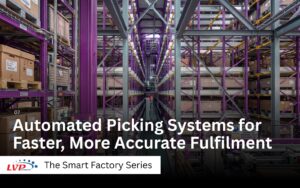
Storage brings the item to a fixed workstation and a person picks it there. Travel disappears, throughput per picker rises sharply, and accuracy improves because the workstation can present and verify exactly what is needed.
This is what automated storage and retrieval delivers, and for most operations it is the highest-value change available — it addresses storage density and picking productivity in one investment, and the picking itself stays human, which sidesteps the hard problem entirely.
Goods to robot
The same principle with a robot at the workstation instead of a person. It removes the labour from picking completely, and it is where the difficulty concentrates, because the robot now has to handle whatever arrives.
It works well where the range is narrow and the items are consistent. It becomes difficult in exactly the operations that most want it: broad ranges of mixed consumer goods.
Why piece picking is the hard part
Grasping is harder than seeing
Vision has improved enormously, and identifying an item in a cluttered tote is largely a solved problem. Physically picking it up is not. A gripper that handles a rigid boxed item may fail on a poly bag, a blister pack, something in a net, or an item that is heavier at one end than the other.
The same issue appears on conveyors and is described in conveying awkward products: shape and rigidity decide what is possible, and the awkward variant defines the system.
The last few percent decide the business case
A robot that handles most of a range sounds like a success until you count what happens to the remainder. Every item the robot cannot pick becomes an exception that needs a person, and if a person has to be on hand for exceptions anyway, the labour saving is much smaller than the headline suggests.
This is the number worth interrogating in any proposal: not what proportion it can pick, but what happens to the rest, and whether that still needs someone standing there.
Range breadth matters more than volume
A high-volume operation picking a narrow, consistent range is a far better candidate than a lower-volume one picking anything and everything. Automation rewards repetition, and a broad range of dissimilar items is the opposite of repetition.
What decides which approach fits
Order profile
Lines per order, and units per line. Single-line orders behave completely differently from multi-line ones, and an operation shipping mostly single items has options that a multi-line picking operation does not.
SKU count and concentration
How many active lines, and what share of the volume comes from the fastest-moving ones. Most operations find a small proportion of SKUs generates the bulk of the picks — which often means automating part of the range and leaving the tail manual is more sensible than automating everything.
Item characteristics
Size range, weight range, packaging type and how much the items vary. This decides whether piece picking is realistic at all, and it is worth assessing against the actual range rather than a representative sample.
Accuracy requirement
Where errors are expensive — regulated products, high-value goods, or anything with a costly returns process — verification may justify investment even where full picking automation does not. Vision and barcode verification addresses accuracy without addressing labour.
Growth direction
Whether the operation is growing in volume, in range, or in both. Volume growth suits goods-to-person; range growth makes robotic piece picking harder rather than easier.
Where automated picking is the wrong answer
- A very broad range of dissimilar items. The exceptions will define the system and the staffing.
- Low or highly seasonal volume. Fixed capacity is poorly suited to demand that swings.
- Inaccurate stock data. Automation retrieves what the record says is there. If the record is wrong, the error simply arrives faster.
- A constraint elsewhere. If dispatch or receiving is the bottleneck, faster picking builds a queue rather than shipping more.
- Items that genuinely resist grasping. Some products are not currently practical to pick robotically, and it is cheaper to know that early.
Where handling a specific product is the open question, testing it before the design commits is what proof of concept development is for.
Common questions
What is the difference between case picking and piece picking?
Case picking moves whole cartons, which are uniform and rigid — a well-solved robotic problem. Piece picking takes individual items out of a case to make a mixed order, where the items vary in shape, weight and packaging. They are different engineering problems and worth distinguishing at the first conversation.
Should we automate picking or storage first?
For most operations, storage. Goods-to-person removes the travel that dominates picking time and improves accuracy at the workstation, while leaving the picking itself to a person. It captures much of the benefit without taking on the hardest part of the problem.
Can a robot pick anything?
No, and any proposal implying otherwise deserves scrutiny. Rigid, regular, reasonably sized items are straightforward. Bags, blister packs, netted goods, very light items and anything unbalanced are harder. What matters is not the percentage it can handle but what happens to the remainder.
Do we need to automate the whole range?
Rarely, and it is often the wrong goal. Where a minority of lines drive most of the picks, automating that portion and leaving the tail manual is usually the better return. Trying to cover the full range is what makes projects expensive and fragile.
How does picking connect to the rest of the operation?
Picked orders have to be consolidated, checked, packed and dispatched. Sortation routes them, AMRs move them, and conveying links the areas. Picking faster than dispatch can absorb simply relocates the queue.
How do we know it will work before committing?
Two different tests. Whether the robot can physically handle your items is a proof of concept using the actual products. Whether the throughput and flow stand up against your real order profile is a simulation. They answer different questions and both are cheaper than finding out afterwards.
Where picking sits in the wider system
Picking is one of four functions in a warehouse automation system, alongside storage, transport and sortation. It is the one most directly connected to what the customer experiences, and the one where the technology is least mature — which is why it repays a careful look at what is actually being proposed.
Talk to us about picking and fulfilment
LVP Automation supplies pick and place systems, robots and cobots and the storage technology behind goods-to-person picking, for manufacturers and distribution operations in Ireland. The wider capability is on our automation services page.
We are based in Finglas, Dublin 11. Tell us your order profile and your range — lines per order, SKU count, and what the items actually are — and we will tell you which approach suits.