Palletising is a common starting point for factories automating for the first time. The work is repetitive, physically hard, and it sits at the end of the line where a delay backs up everything upstream. It is also self-contained enough to automate without disturbing production.
This page covers what an automated palletising system is made of, the main types and what each suits, and the six things that actually decide the specification. Where a topic has its own guide, it is linked.
What an automated palletising system does
A palletiser takes finished cases, bags, trays or crates arriving from the line and stacks them onto a pallet in a defined pattern, layer after layer, until the pallet is complete. It then releases the full pallet and starts the next one.
The parts of a palletising cell
Whatever the type, the same elements are present:
- Infeed — the conveyor delivering product, usually with orientation and spacing controlled before the palletiser sees it.
- The palletiser itself — a robot arm, a gantry, or a layer-forming machine.
- The gripper or end effector — what actually holds the product. More on this below, because it is usually the decisive choice.
- Pallet handling — empty pallet supply and full pallet removal, both of which are easy to underestimate.
- Controls and guarding — the PLC sequencing everything, and the guarding or safety-rated sensing around the cell.
A common cause of disappointment is a well-chosen palletiser with an infeed or pallet-handling arrangement that was treated as an accessory.
Why manual palletising becomes the constraint
Two reasons, and they are different problems.
The first is availability. Manual palletising roles are physically demanding and hard to fill, particularly on shifts. A line that stops because nobody is available to stack the pallet is a different problem from one that costs too much to staff.
The second is measurable. Manual handling accounted for 30% of non-fatal workplace injuries reported to the Health and Safety Authority in 2022, the most common trigger every year since 2018. Repeatedly lifting cases to shoulder height and above is exactly the exposure that statistic describes.
Consistency is the third gain and the one that shows up downstream: a machine-built pallet is stacked the same way every time, which matters for load stability in transit and for anything that has to be wrapped or handled automatically afterwards.
The main types of palletiser
Layer palletisers
Product is assembled into a complete layer at bed level, then the whole layer is transferred onto the pallet in one movement. Because a layer is placed at a time rather than a case, throughput is high and consistent, which suits fast, steady, single-product lines.
The trade-off is flexibility: layer forming is set up around a pattern, so frequent product changes cost more in changeover than they would on a robot. Layer palletisers are the right answer where rate matters more than variety.
Robotic arm palletisers
An industrial robot picks product from the infeed and places it on the pallet, building the pattern case by case. Slower per unit than layer forming, but far more adaptable: a new pattern is a programming change, and one robot can often serve more than one line or build more than one pallet at a time.
This is the most common configuration where a factory runs several products or pallet patterns. See industrial robots and cobots.
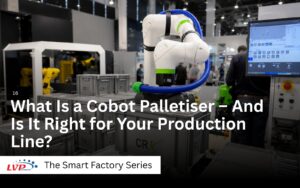
Cobot palletisers
A collaborative robot working at lower speed, often without full perimeter guarding depending on the risk assessment. Lower rate, smaller footprint, lower cost of entry — which is what brought palletising automation within reach of operations that could never justify a conventional cell.
Covered in detail in what is a cobot palletiser and five signs a line is ready for one.
Semi-automatic palletising
A lift assist, pallet positioner or turntable that removes the worst of the physical strain while an operator still places the product. Not automation in the full sense, but a legitimate step where volumes do not justify a machine and the concern is manual handling rather than throughput.
Choosing between these is its own subject — choosing the right palletiser works through it against output, space and product type.
What actually decides the specification
Rate
Cases or bags per minute, and whether that arrives steadily or in bursts. Rate is what first separates layer palletising from robotic, and a peak rate that only occurs for ten minutes a shift can drive the whole specification if it is not identified as a peak.
The gripper
This is the decisive technical choice and the one most often left until last. What holds the product determines what can be handled and how fast. Vacuum suits sealed cases and smooth surfaces; clamps and fork-style tools suit bags, unsealed cases and awkward loads; and combination tools handle slip sheets or layer pads as well as product.
A gripper that struggles with one product variant will define the reliability of the whole cell, which is why unusual products are worth proving before the rest of the design commits to them — that is what proof of concept development is for.
Pallet pattern
How cases are arranged per layer and how layers interlock. Pattern affects stability in transit, how well the load takes wrapping, and cube efficiency in the trailer. It is also where product dimensions and pallet size have to be reconciled, and where a few millimetres of case variation shows up as an unstable stack.
Infeed
Product has to arrive correctly oriented, correctly spaced and reliably. Most of the engineering in a palletising project is upstream of the robot: turning, aligning, grouping and buffering the product so the palletiser receives what it expects. Buffering matters because the palletiser stops while a full pallet is exchanged — see accumulation.
Pallet handling
Empty pallets have to be supplied and full ones taken away, and neither happens by itself. A magazine or dispenser for empties, and a conveyor or truck route for full pallets, are part of the cell rather than additions to it. This is the most commonly underestimated element of a palletising project.
Space and guarding
A robot cell needs its reach envelope plus safe access for pallet changes and maintenance. Guarding, interlocks and emergency stop provision are designed in from the outset under the same framework as any machinery — covered in conveyor safety requirements in Ireland.
Where palletising sits in the line
Palletising is rarely installed alone. What comes before and after it decides how much of the benefit is actually realised.
- Before — conveying, orientation and buffering, so product arrives in a state the palletiser can work with.
- After — pallet wrapping, labelling and transport to storage or dispatch. A palletiser feeding a manual wrapping station simply relocates the bottleneck.
- Onward transport — autonomous mobile robots or forklifts moving completed pallets to storage.
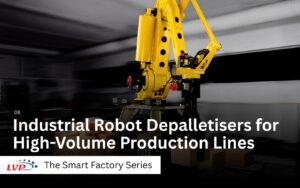
- At the incoming end — the same technology in reverse, as robot depalletisers breaking down inbound pallets.
Sequencing these matters. Automating palletising when wrapping is the real constraint moves the queue rather than removing it — the general point is covered in factory automation in Ireland.
Common questions
Is automated palletising viable for a smaller factory?
Yes, and that has changed in recent years. Cobot palletisers work at lower rates in a smaller footprint with a lower cost of entry, which put end-of-line automation within reach of operations that could never justify a conventional cell. Semi-automatic lift assists are a further step down where the concern is manual handling rather than throughput.
What does an automated palletiser cost?
It depends most on rate and on the gripper. A cobot cell handling a single case format at modest speed and a high-rate layer palletiser serving several lines are different orders of investment. The variables that move the number are throughput, how many product formats it has to handle, and how much of the infeed and pallet handling has to be built alongside it.
Can a palletiser handle more than one product?
Robotic and cobot systems generally can, within the limits of the gripper. Handling several formats is a gripper and pattern-programming question rather than a robot question, and it is worth stating every format the cell will see at specification stage rather than the main one.
Can it be integrated with existing equipment?
Usually. Most palletising projects are retrofits into an existing line rather than new builds. The work is in the handovers — how product arrives and how full pallets leave — which is where system design does most of its work.
How much floor space is needed?
More than the machine footprint. Allow for the robot reach envelope, the pallet positions, empty pallet storage, safe access for changeover and maintenance, and the guarded area around it. Space is often what decides between a layer palletiser, a robot cell and a cobot.
Does it replace people?
In most installations it redeploys them. The palletising station disappears; the work moves to running and supervising the line. On operations already struggling to fill those roles, that is usually the outcome that matters rather than a headcount reduction.
What is the most common mistake?
Specifying the palletiser carefully and the infeed and pallet handling loosely. The robot is rarely the part that limits a cell in service — product arriving inconsistently, or full pallets not being removed quickly enough, are far more common causes of a system underperforming.
Talk to us about palletising
LVP Automation designs and installs palletising systems for manufacturers in Ireland, from cobot cells to layer palletisers, including the conveying, buffering and pallet handling around them. The wider capability is on our automation services page.
We are based in Finglas, Dublin 11. Tell us your rate, your product and your pallet pattern and we will tell you what suits.