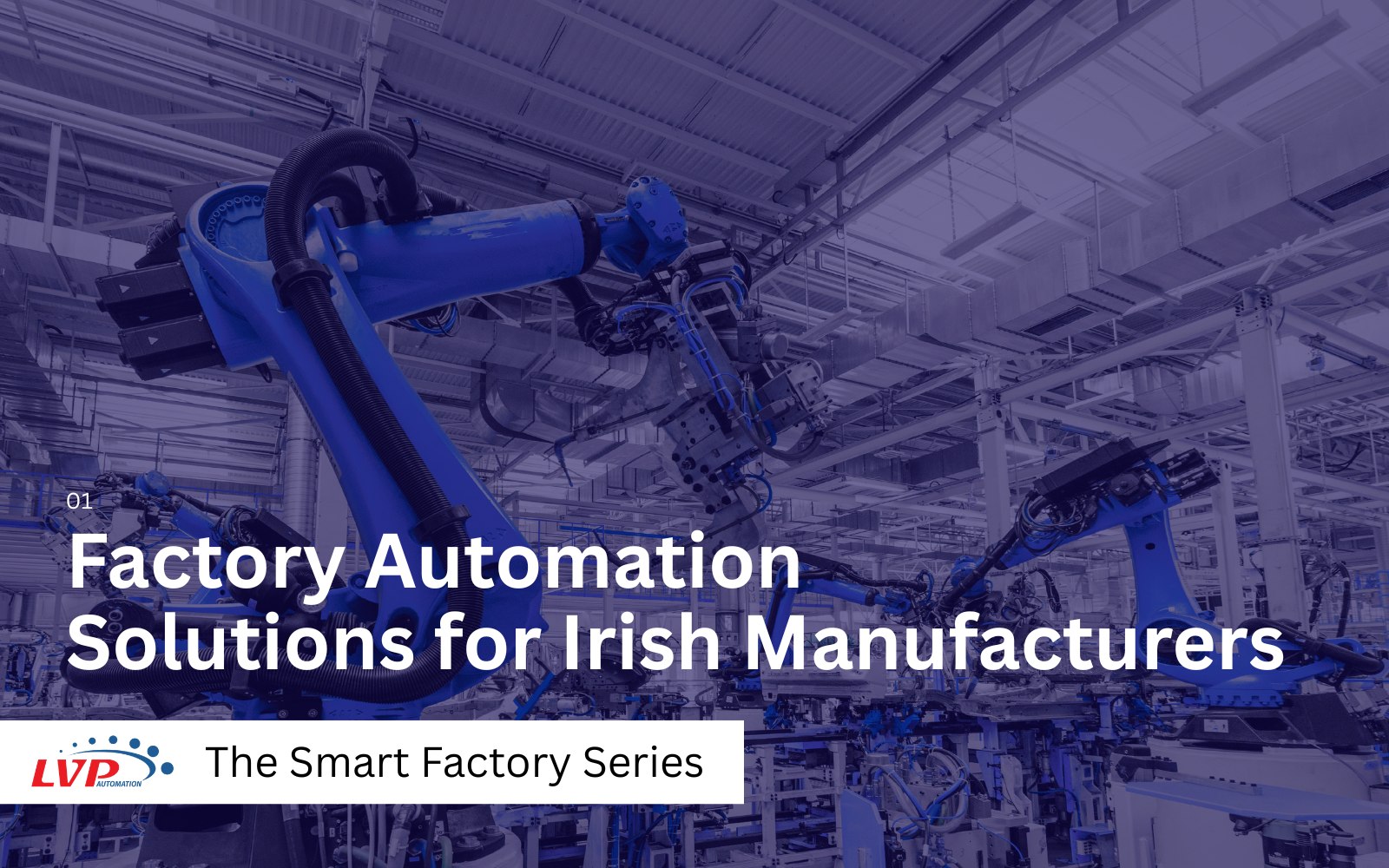
Factory automation covers a lot of ground — from a single robot at the end of a packing line to a warehouse that runs with almost nobody in it. Most of the material written about it stays at the level of “improves efficiency and reduces costs”, which is true and useless.
This is a practical guide to what factory automation actually involves, where Irish manufacturers typically start, what each area of the factory can be automated with, and how to approach a first project without buying the wrong thing. Where a topic has its own detailed guide, it is linked.
What factory automation actually means
Automation replaces a task a person was doing with equipment that does it the same way every time. That is the whole idea. Everything else — robots, conveyors, software, sensors — is a means to it.
The three layers
It helps to separate them, because projects go wrong when they get confused:
- The mechanical layer — what physically moves, holds, lifts or places the product. Conveyors, robots, wrappers, sealers.
- The control layer — the PLC, sensors and drives that decide when each thing happens and in what order.
- The information layer — what the system records and reports, and how it connects to whatever runs the business.
A great many automation disappointments are a well-built mechanical layer with a control layer that was treated as an afterthought.
It is rarely one purchase
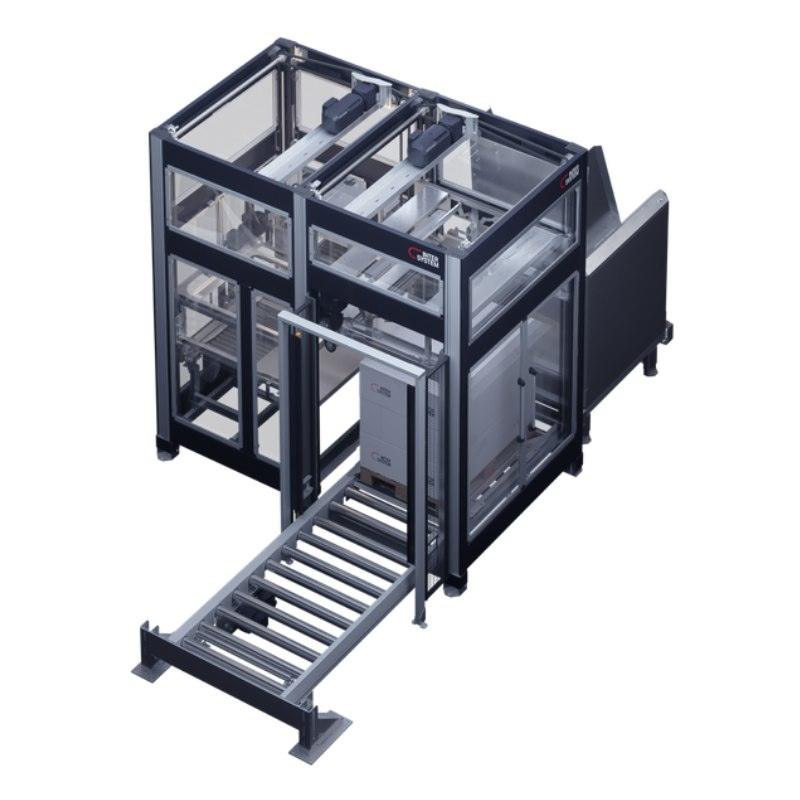
Automation is usually incremental. A line gets a palletiser, then a wrapper, then the conveyor between them, then the sensors that let the three talk to each other. Understanding it as a sequence rather than a project changes how the first step should be specified — the question is not only “does this work” but “what does this make possible next”.
Where automation usually starts
End of line, most of the time
The end of the line is where automation most often begins, and there are good reasons for it. The work there is repetitive and physically demanding, the product is already in its final form so handling is predictable, and the area is usually a bottleneck when it is manual.
It is also self-contained. Automating palletising does not require rebuilding the process upstream, which makes it a lower-risk first project than automating something in the middle of production.
The usual first three
- Palletising — stacking finished cases onto pallets. See also choosing the right palletiser.
- Pallet wrapping — and when it is time to automate it.
- Conveying and buffering between the two, so neither waits on the other.
The main areas of factory automation
Most factories automate in the same broad areas. Each has its own guide.
Palletising and depalletising
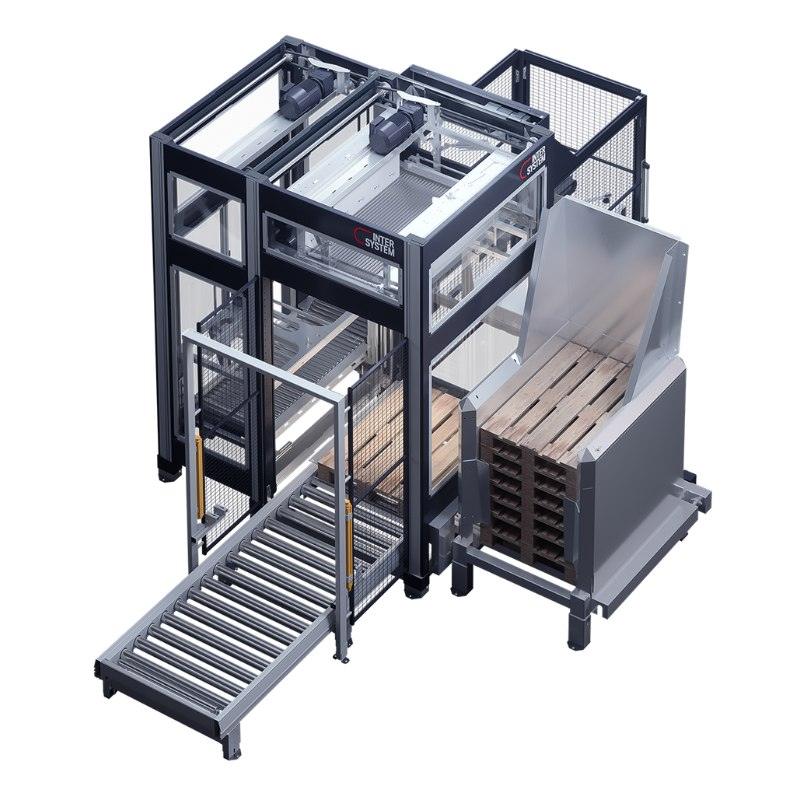
Building and breaking down pallets. Conventional palletisers handle high, steady throughput; cobot palletisers suit lower rates, mixed products and tight spaces, and there are signs a line is ready for one. At the incoming end, robot depalletisers do the reverse.
Packaging
Where product is put into its final format. Tray sealing covers traditional, MAP and vacuum skin formats; cartoning machines handle erecting, filling and closing cartons. These are the areas where product presentation and shelf life are decided, so specification tends to be driven by the pack rather than by throughput alone.
Internal transport
Moving material between areas without a person carrying or driving it. Autonomous mobile robots navigate open floor space and suit changeable routes; autonomous forklifts handle pallets at height. Fixed conveying remains the better answer where the route does not change — the comparison is in what is a conveyor system.
Storage and retrieval
Automated storage and retrieval systems increase storage density and remove the walking and searching from picking. They are among the larger commitments in this list, both in cost and in how much they constrain the building around them.
Picking and fulfilment
Automated picking systems address the accuracy and speed of assembling orders. This is usually where errors cost most, because a picking mistake reaches the customer rather than stopping the line.
Sorting
Sorting technology routes product to the right destination at rates no manual process reaches. Sortation is often what makes a distribution operation scale rather than simply run faster.
Machine tending
Automated machine tending has a robot loading and unloading a machine that would otherwise need an operator standing at it. It suits work that is repetitive, precise and unrewarding for a person to do.
Warehousing as a whole
Where several of the above combine, the subject becomes warehouse automation rather than a series of separate machines, and the integration between them matters more than any individual choice.
What actually drives automation decisions
Availability of people, more than cost of people
Automation is usually pitched as a labour saving. In practice the more common driver among Irish manufacturers is that the roles are hard to fill and harder to keep filled, particularly for repetitive physical work on shifts. A line that cannot run because nobody is available to run it is a different problem from a line that costs too much to staff, and it changes what a good solution looks like.
Manual handling exposure
This one is measurable. Manual handling accounted for 30% of non-fatal workplace injuries reported to the Health and Safety Authority in 2022, and it has been the most common trigger every year since 2018. Removing repetitive lifting is one of the few automation benefits that can be evidenced rather than asserted.
Automation introduces machinery hazards in exchange, which is why guarding, emergency stops and isolation are designed in rather than added later. That is covered in conveyor safety requirements in Ireland.
Consistency, not just speed
A machine does the same thing at 3am on a Friday as at 9am on a Monday. For many operations that repeatability is worth more than raw throughput, because it makes the output of one process predictable enough for the next one to be planned around.
How to approach a first project
Start with the constraint, not the technology
The useful question is not “what could we automate” but “what is limiting us”. If the line is limited by a slow filler, automating the palletiser will not increase output — it will simply move the queue. Identifying the actual constraint first is what stops money going into the wrong part of the line.
Establish the numbers before the specification
Product dimensions and weight range, rate and whether it surges, shift pattern, and what happens either side of the area in question. These decide almost everything downstream, and they are the questions any credible supplier will ask. The full list is in conveyor system requirements.
Prove the uncertain part first
Where a project rests on one assumption nobody is confident about — usually whether a particular product can be handled a particular way — test that before the rest of the design depends on it. That is what proof of concept development is for. Where the uncertainty is about flow and throughput rather than handling, simulation answers it more cheaply.
Design for the next step
The first automated area is rarely the last. Leaving space, capacity and control headroom for what comes next costs very little at design stage and a great deal to retrofit.
What automation does not fix
Worth saying plainly, because these come up repeatedly:
- An unstable process. Automating something inconsistent produces consistent output of the wrong thing. Process problems are solved before they are automated, not by automating them.
- Product that varies more than the spec admits. Machines handle the range they were designed for. A line that quietly runs three variants when it was specified for one will disappoint.
- A bottleneck elsewhere. Output is set by the slowest step. Automating any other step changes where product waits, not how much comes out.
- Poor data. Automation makes what you measure more visible. It does not make bad measurements good.
Whether the numbers justify a project at all is a separate question, covered in is factory automation worth the investment.
Common questions
Where should a manufacturer start with automation?
Usually at the end of the line, because the work there is repetitive, the product is in its final form and the area is self-contained enough to automate without disturbing production upstream. But the honest answer is: start at whatever is currently limiting output, which is not always the same place.
Is automation only viable for large manufacturers?
No, and that has changed considerably. Cobot palletisers in particular brought automated end-of-line handling within reach of lower-volume operations, because they do not need the throughput, the guarded floor area or the capital of a conventional palletiser to make sense.
How long does an automation project take?
It depends almost entirely on how much is bespoke and how much integration is involved. A standalone machine dropped into an existing line is a different order of project from a system that has to talk to equipment either side of it. The variable that moves the timeline most is how well defined the requirement was at the start.
What usually goes wrong?
In our experience it is rarely the equipment. It is a requirement that described the nominal product rather than the full range, a constraint that was somewhere other than where the investment went, or a control system specified as an afterthought to the mechanical design.
Do we need to automate everything at once?
No, and it is usually the wrong approach. Incremental automation lets each step prove itself and fund the next. What matters is that the first step is specified with the later ones in mind, so it does not become the thing blocking them.
Will automation reduce headcount?
Sometimes. More often it redeploys people from repetitive handling into work that needs judgement, which on lines that are already hard to staff is the more valuable outcome. Framing a business case purely on headcount reduction tends to make it fragile.
What about existing equipment?
Most automation projects integrate with machinery already on site rather than replacing it. The design work is in the handovers — how product arrives from the existing equipment and how it leaves — which is where system design does most of its work.
Which industries automate most in Ireland?
Food and beverage, pharmaceutical and medical devices, and logistics and distribution are where we see it most, though the driver differs: hygiene and traceability in one, throughput and accuracy in another. Our industry pages cover the specifics.
Where to start
LVP Automation designs, builds and integrates automation systems for manufacturers in Ireland — conveying, palletising, robotics, packaging and the control systems that tie them together. The commercial detail is on our automation services page.
We are based in Finglas, Dublin 11. If you know what is limiting your line but not what to do about it, tell us what the constraint is and we will tell you whether automating it is the right answer.