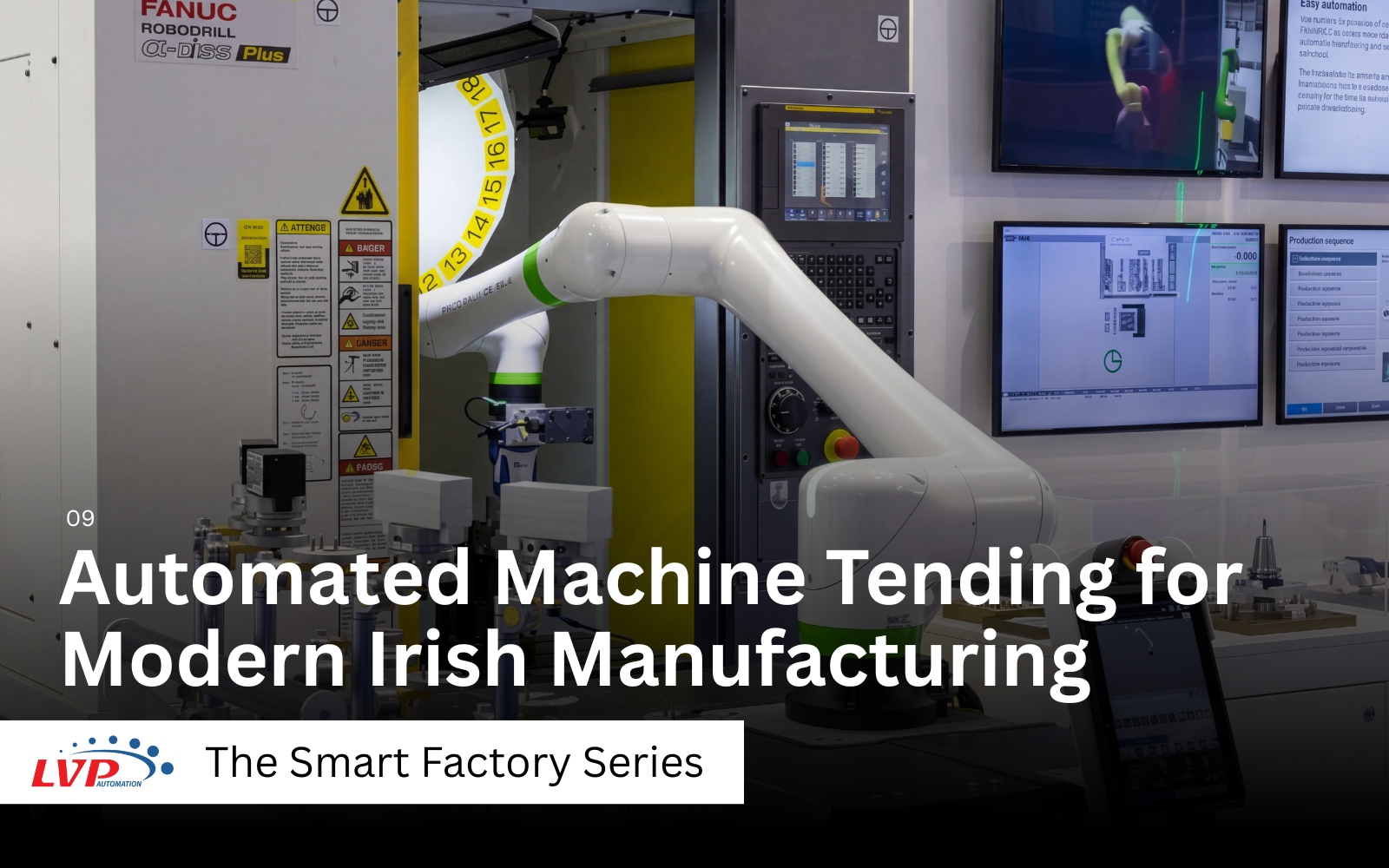
The robot is rarely the difficult part of a machine tending project. Loading a part into a chuck or a mould and taking the finished one out is well-understood work, and the equipment to do it is mature.
The difficult part is the question underneath: how long can the cell run before it needs a person? Everything that determines the return on a tending cell sits in that answer, and almost none of it is about the robot.
This guide covers what actually sets that limit, how attended and unattended running differ in practice, and where machine tending is the wrong answer. For the equipment itself, see our automated machine tending systems.
Start with utilisation, not cycle time
Most machine shops do not have a speed problem. They have a utilisation problem. A CNC that cuts for a fraction of the hours it is available is not slow while it is cutting; it is idle for everything around that, waiting to be loaded, waiting for the operator to come back from another machine, and standing still through breaks and the hours nobody is on site.
That is the gap machine tending buys back, and it is worth measuring before anything is specified. If a machine is genuinely cutting most of the time it is switched on, a robot will not add much. If it is cutting for a third of that time, the automation case is about the other two thirds, not about shaving seconds off a load.
The second effect matters just as much: one operator can supervise several automated machines rather than being tied to one. The value of that shows up as capacity gained on machines you already own, which is usually a stronger case than any headcount argument.
Two very different ambitions
Attended tending
The robot loads and unloads while an operator remains in the area, topping up parts, clearing finished ones, and handling anything unusual. The gain is the recovered load and unload window and the ability to run several machines from one person. It is straightforward to specify and forgiving of variation.
Unattended running
The cell keeps going through breaks, night shifts or a whole weekend with nobody present. The gain is far larger, and so is the requirement, because everything the operator quietly handled now has to be designed for.
The step between the two is not a bigger robot. It is buffer capacity, tolerance to variation, swarf management, tool life and error recovery. A cell that runs beautifully for eight attended hours can fail forty minutes into a night shift for a reason nobody noticed while a person was standing there.
What sets the unattended limit
Part presentation and buffer size
The robot needs a supply of parts it can find, and somewhere to put finished ones. How many parts fit in that buffer, multiplied by the machine cycle, is the run time. That arithmetic decides more about the project than the robot specification does, and it is the first thing to size.
Presentation options range from stacked trays and pallets through gravity and powered conveyor feeds with accumulation and indexing, to bin picking with vision. Cost and complexity rise in that order, and so does tolerance for parts that arrive in no particular arrangement.
Grip and part variation
Raw and finished parts are rarely the same shape, weight or surface, so a tending gripper often has to do two jobs. Castings vary more than billet. Parts coated in coolant behave differently from dry ones. Where a family of parts shares features, one gripper can cover the range; where it does not, changeover time reappears in a new form.
Swarf, coolant and the state of the machine
This is the most common thing left out of a specification. Chips build up on locating faces, coolant carries over on finished parts, and a chuck that is not clean will not seat the next part correctly. A person clears that without thinking about it. An unattended cell needs air blast, chip management or through-spindle cleaning designed in, and a way to detect when seating has failed rather than continuing to cut.
Tool life and in-process checking
Unattended running is limited by tooling as much as by parts. A cell with sister tooling and tool life monitoring can run through a tool change; one without it stops, or worse, keeps cutting with a worn tool and produces a batch of scrap nobody sees until morning. Some form of in-process gauging or probing is what turns a long unattended run from a risk into a plan.
What happens when something goes wrong
The realistic question is not whether a fault occurs but what the cell does when one does. Stopping safely and holding state is the minimum. Better is a cell that can quarantine a suspect part and carry on, and that can tell somebody what happened. Deciding this at design stage costs very little; retrofitting it after a lost weekend costs a great deal.
Robot or cobot?
Conventional industrial robots are faster, carry more and reach further, and they are guarded. That guarding takes floor space, but within it the robot can run at full speed, which for a short cycle repeated thousands of times is usually the deciding factor.
Collaborative robots trade speed and payload for a smaller footprint and easier redeployment. They suit lower volumes, larger part mixes, tight floor space, and shops that expect to move the cell between machines.
One thing worth being clear about, because it is widely misunderstood: a robot is not collaborative in itself. Safety is a property of the application, assessed for the specific cell, and depends on speed, payload, tooling, the part being handled and how close a person actually gets. A cobot holding a sharp casting at speed can require guarding just as a conventional robot does.
The standards landscape here changed recently and is worth knowing. ISO 10218, the industrial robot safety standard, was revised in 2025, and the collaborative content that previously sat in the separate technical specification ISO/TS 15066 is now absorbed into Parts 1 and 2 of the standard itself. The revision also brought in guidance on manual load and unload, end effectors, new robot classifications and cybersecurity requirements. If you have a specification or a risk assessment written against the older arrangement, it is worth revisiting. We cover the same territory for palletising in our guide to cobot palletisers.
Where machine tending does not fit
Genuine one-offs are the clearest case. Where every part needs new fixturing, a new program and a new gripper, the setup effort exceeds the machining and a skilled operator is faster.
Machines that are already fully loaded are the second. Automating a machine that runs flat out simply moves the constraint elsewhere, and the gain shows up on paper rather than in output.
The third is work that needs judgement mid-cycle: parts inspected by feel, adjustments made by ear, processes where the operator is compensating for material variation in real time. Some of that can be instrumented, but it should be a deliberate project rather than an assumption in a quotation.
Common questions
Do we have to change our fixturing?
Usually some of it. Fixtures designed for a person often rely on being able to see, feel and nudge a part into place. Robotic loading needs repeatable location and clear approach paths. The change is normally modest for a family of similar parts and significant where every job has bespoke workholding, which is why part family selection matters more than machine selection.
Can one robot serve more than one machine?
Yes, and it is often the better arrangement. A robot on a rail or positioned between two machines can keep both fed, provided the combined cycle leaves it enough time. It also spreads the cost across more machine hours. The limit is arrival timing: two machines finishing together means one waits, so the cycles need to be looked at in combination rather than individually.
What does the operator do instead?
In practice they supervise more machines, handle setups and first-offs, deal with exceptions and take on inspection or deburring work. This is worth planning honestly before installation, because a tending cell changes the shape of the role rather than removing it, and the shops that get the most from automation are the ones that decided in advance what the freed time is for.
How do we start without committing to a full cell?
Test the assumptions that carry the risk: whether the part can be gripped reliably in both states, whether presentation works, and how the cell behaves when something goes wrong. A proof of concept answers those on the actual parts, and simulation answers the timing questions before any steel is cut.
Where machine tending sits
A tending cell rarely stays isolated. Parts have to arrive and leave, which brings in conveyor and buffering, and often pick and place or mobile robots for movement between areas. Machine tending is frequently the first cell a manufacturer automates, which makes it a sensible place to set conventions for controls, safety and data that later projects inherit, as covered in our guide to factory automation.
If the question is whether the numbers work at all, our piece on whether factory automation is worth the investment covers how to build that case.
LVP Automation designs and integrates robot and cobot tending cells for manufacturers across Ireland, as part of our wider automation services. Tell us what your machines are running and how long you want them to run for, and we will tell you what it takes to get there.