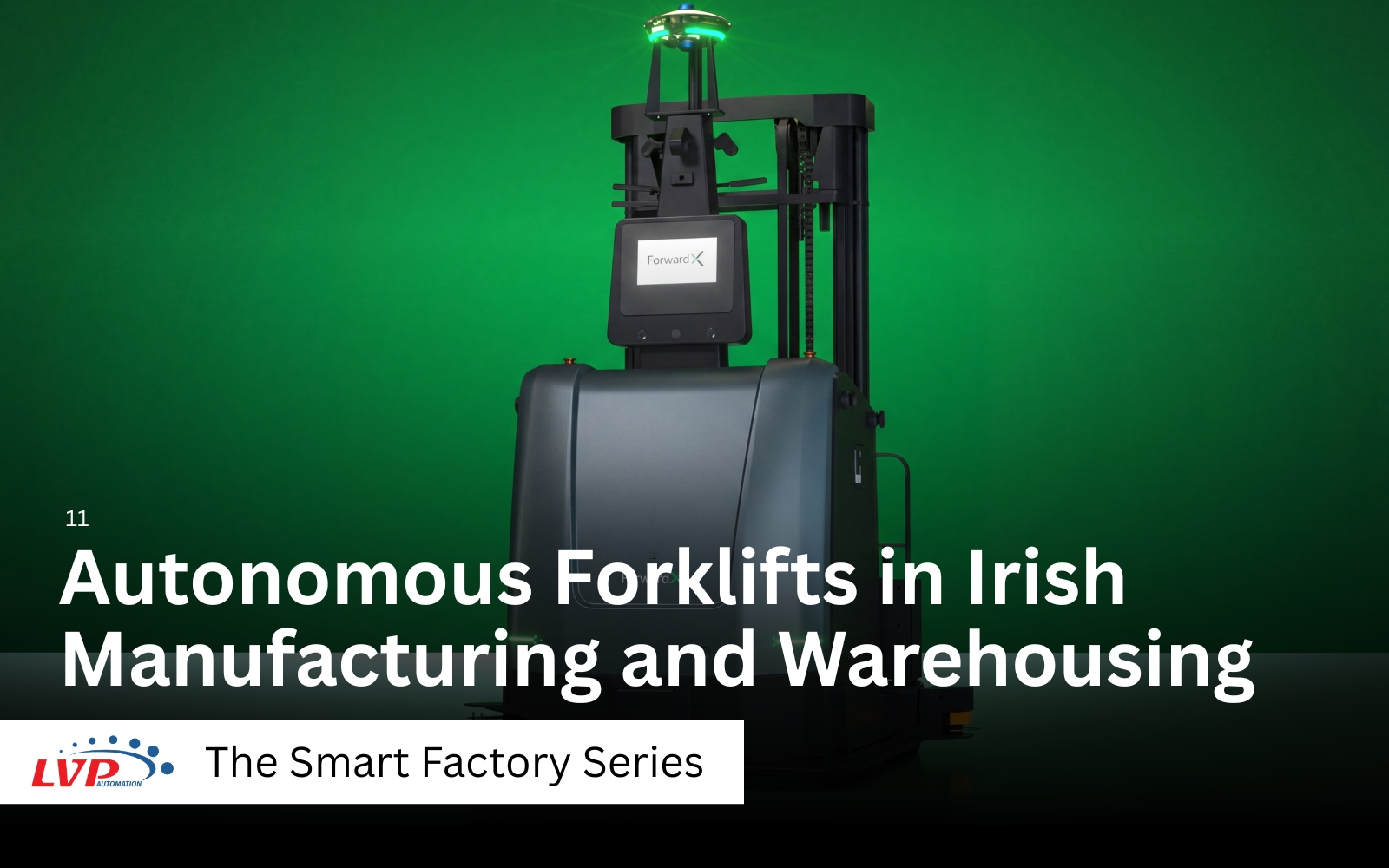
An autonomous forklift is judged on something a conveyor or a robot arm never has to deal with: the condition of a pallet somebody else built, sitting somewhere approximately right, in an aisle where people are working.
The navigation is the settled part of the technology. What decides whether a project works is whether your pallets, your floor positions and your traffic will let the truck do its job. This guide covers the truck types, what each one needs from the site, and the situations where a driver is still the better answer. For the equipment, see the Apex Series autonomous forklifts.
Where the line sits between this and an AMR
Both are driverless vehicles that navigate a building. The difference is the load. An AMR generally carries something on a deck or moves a cart or trolley. Once a pallet has to be picked up on forks, set down accurately, or placed at height, the requirements change enough that it becomes a different class of vehicle.
Plenty of sites run both, doing different work. The question is not which technology is better but which one matches the load and the movement.
The types, and what each one replaces
Pallet stackers and counterbalance trucks
The common starting point. These move pallets between floor positions, production lines, wrapping stations and dispatch lanes, and stack to modest heights. Most internal pallet movement in a factory falls into this category, and it is the work where automation is most straightforward because the drop points can be defined and repeated.
Reach trucks and high-level putaway
Working into racking rather than on the floor. This is a step up in requirement: the truck has to locate a beam level accurately, allow for mast deflection with a loaded fork at height, and place a pallet without clipping the upright or the pallet beside it. Where the racking is tight and the pallets are inconsistent, this is where a project either proves itself or stalls.
Tow tractors and tugger trains
Rather than carrying one pallet at a time, a tractor pulls a train of carts on a repeated route. For high-frequency line feeding this often moves more material per vehicle than individual pallet trips, and the loading and unloading stays manual at each end, which sidesteps most of the pallet-handling difficulty.
What the truck needs from your pallets
Pallet condition and fork entry
This is the single most common cause of trouble. A driver approaching a pallet with a broken bottom board, a split stringer or a blocked fork pocket adjusts without thinking. An automated truck detects a problem and stops, or worse, does not detect it and damages the load.
Sites with a mixed pallet pool, or with pallets that have been through several journeys, need either a pallet standard applied at goods-in or an accepted exception rate handled by a person. Deciding which of those it is, before installation, prevents a lot of frustration afterwards.
Load stability and overhang
Cases that overhang the pallet edge, loads that lean, and wrapping that has loosened all reduce the clearance a truck has to work with. In a racking application, where the clearance was calculated on a nominal pallet footprint, an overhanging load is the difference between a clean putaway and a collision. Where load quality varies, the fix usually sits upstream at palletising and wrapping rather than on the truck.
Where the pallet is, and how precisely
Automated trucks pick from defined positions. That does not have to mean fixed equipment, but it does mean a pallet placed roughly where it belongs rather than wherever there was space. Floor positions get marked or fixtured, and conveyor drop stations remove the question entirely by handing the pallet over at a known point, which is why pallet conveyor is so often paired with automated trucks at the busy transfer points.
Height changes the problem
Floor-level work is forgiving. A pallet that ends up fifty millimetres off centre on a floor position rarely matters. The same error at eight metres does.
High-level work brings in mast deflection under load, the accuracy of the truck position relative to the rack, and the consequences of getting it wrong: damage to the racking structure, to the load above, and a shutdown of that aisle. Where the storage is dense and the rates are high, it is worth comparing an automated truck against a fixed storage and retrieval system, which is designed for that work and does it faster, at the cost of flexibility.
Mixed traffic is the real design question
An automated truck yields. It slows for a person, stops for an obstruction, and waits for a blocked aisle to clear. A driver in a hurry does none of those things.
That asymmetry is what determines throughput in a shared building. A truck rated at a given number of moves per hour on a clear route will not achieve it in an aisle busy with manual trucks and pedestrians, and the shortfall is often larger than anyone allowed for.
There are three ways to deal with it, and most sites use a mixture. Separate in space, by giving automated routes their own aisles or lanes. Separate in time, by running automated movement through quieter shifts. Or accept the interference and size the fleet for the real conditions rather than the ideal ones. The mistake is to size on clear-route figures and discover the difference after installation.
Safety and the applicable standard
Driverless trucks are covered by ISO 3691-4, the safety standard for driverless industrial trucks and their systems, most recently updated in 2023. The wording of the title matters: the standard addresses the vehicle and the system it operates within, which is why the safety case is assessed for the installation rather than being a property the truck arrives with.
In practice that means the assessment covers routes, transfer points, interaction with people and manual trucks, and what happens at the edges of the automated area. It is also the reason a truck that is compliant in one building is not automatically compliant when the layout changes around it.
Where autonomous forklifts do not fit
Low move counts are the clearest case. A building with a handful of pallet movements an hour is not going to repay a truck plus the infrastructure around it, and a driver who also does five other jobs is better value.
Loading and unloading lorries is the second, and it is more often attempted than it should be. A trailer floor is uneven, moves as weight is added, offers no reliable references and is frequently loaded in a pattern nobody recorded. It is possible, but it is a specialised application rather than an extension of internal movement.
The third is any operation where the pallet supply is genuinely unpredictable and there is no appetite to standardise it. The technology will keep stopping on exceptions, and the exception handling becomes the job.
Common questions
Will they work with our existing racking?
Usually, if the racking is in good condition, correctly aligned and has the clearances the truck needs. Racking that has been struck, is out of plumb, or was set up to tolerances suited to a skilled driver may need survey and correction first. That survey is worth doing early, because it can change the cost of a project significantly.
What happens when a pallet is damaged?
The truck should detect it and stop rather than attempt the pick. What matters is the process after that: whether the exception is flagged to someone, whether the truck can move on to other work while it waits, and where damaged pallets go. A route that halts entirely on one bad pallet loses more time than the pallet was worth.
Do we have to remove manual trucks?
No, and most sites do not. Mixed operation is normal. What it needs is a considered layout, agreement on who yields where, and honest throughput expectations for shared areas.
How many trucks will we need?
It comes from move count, distance and the real cycle time including waiting, not from the number of drivers being replaced. Distance dominates in a large building, which is why two short routes can need fewer vehicles than one long one carrying the same volume. This is the kind of question simulation answers properly, using your own movement data.
Can we start with one truck?
Yes, and it is a sensible way in. One truck on one well-defined route proves the navigation, the transfer points and the pallet quality assumptions, and everything learned there applies to the wider fleet. It also surfaces the exception rate, which is the number most projects underestimate.
Where they sit in the wider operation
Automated trucks are the connective tissue between fixed systems: they bring pallets from goods-in to storage, from storage to the line, and from the line to dispatch. That makes them most valuable where the fixed parts already work well and the movement between them is the constraint, which is why they usually feature in a wider warehouse automation plan rather than as a standalone purchase.
If the underlying question is whether the numbers stack up, our piece on whether factory automation is worth the investment covers how to build that case.
LVP Automation supplies and integrates autonomous forklifts and mobile robots for manufacturing and logistics operations across Ireland, as part of our wider automation services. Tell us what moves and how often, and we will tell you whether an automated truck is the right way to move it.