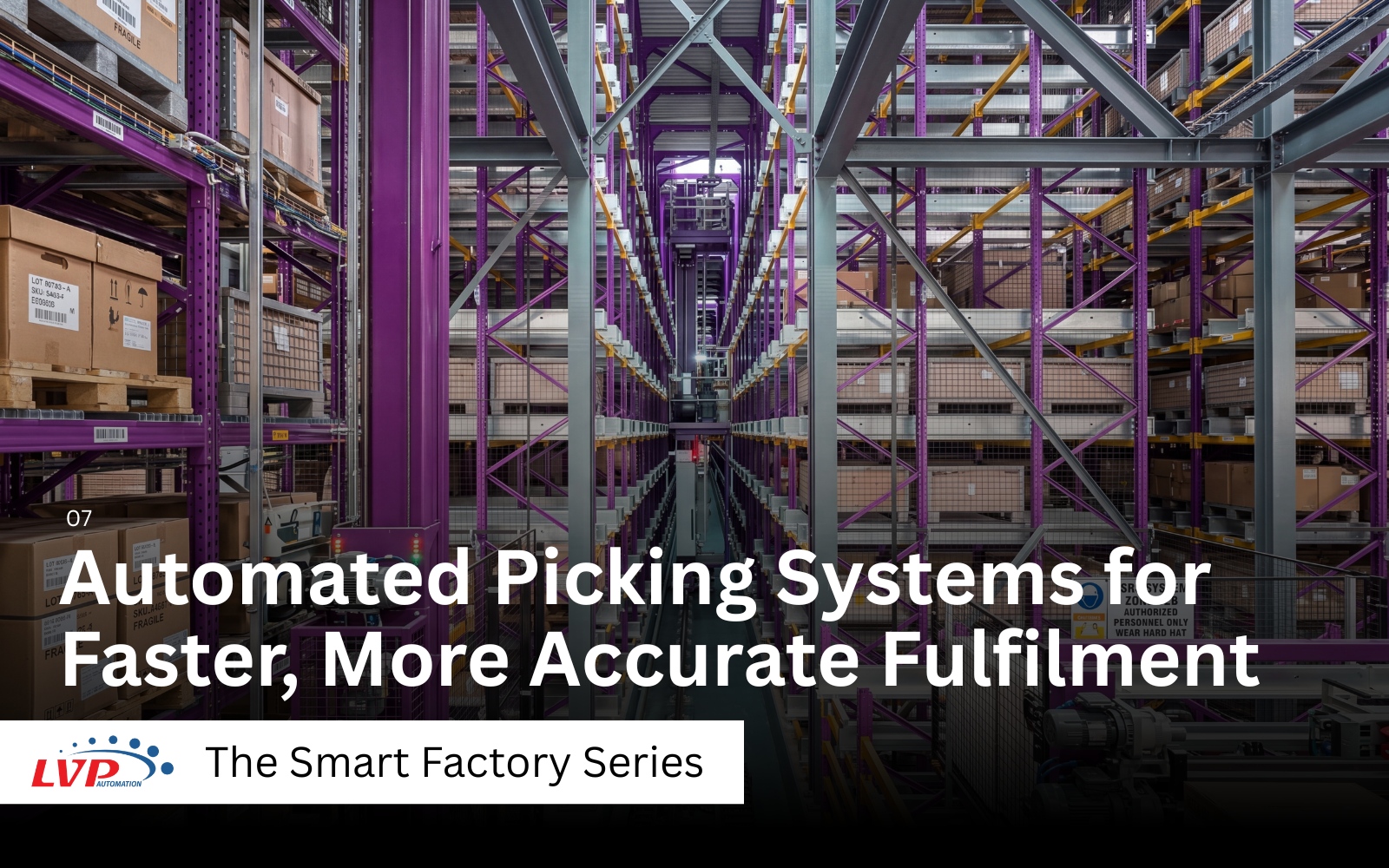
An automated storage and retrieval system is one of the few pieces of automation that the building ends up designed around. The racking is structural, the aisles are fixed, and the software deciding where every pallet or tote lives becomes embedded in how the operation runs. Getting the format wrong is expensive to undo.
This is a selection guide rather than a product overview. It covers the ASRS formats in common use, the four questions that narrow them down, and the situations where automated storage is the wrong tool. For the equipment itself, our automated storage and retrieval systems and shuttle systems pages carry the specifications.
What an ASRS actually changes
Conventional storage is person-to-goods. An operator, usually on a truck, travels to the location, picks or places, and travels back. Travel is most of the shift, aisles have to be wide enough for a truck to turn, and usable height is limited by what that truck can reach safely.
An ASRS inverts it. The machine travels and the operator stays at a fixed workstation while goods come to them. Two things follow, and only one of them is what people usually talk about.
The obvious gain is density. With no operator in the aisle, the aisle only has to be as wide as the machine and its load, and height is limited by the building rather than by a mast. The same footprint holds considerably more, though how much more depends entirely on format and load type.
The less obvious gain is parallelism. While the operator picks from one tote, the machine is already retrieving the next and putting the last one away. That overlap is where throughput actually comes from, and it is also why a system can have a fast machine and still run slowly: if the workstation cannot absorb loads at the rate the machine delivers them, the machine waits.
The main ASRS formats
Pallet cranes
A single storage and retrieval machine runs the length of a fixed aisle on a floor rail with a top guide, serving racking on both sides. It handles full pallets, reaches heights no truck can, and is the standard answer for palletised finished goods and raw material buffers.
One crane serves one aisle, and that is the defining constraint. Throughput per aisle is capped by the crane cycle time, so more throughput means more aisles and more machines. Density is excellent; retrieval rate per euro invested is not.
Mini-load cranes
The same architecture scaled to totes, trays and cartons rather than pallets. Mini-loads suit operations holding a large number of slow and medium-moving lines, such as spares, components and sub-assemblies, where the value is in removing search time and floor space rather than in raw speed.
Shuttle systems
Instead of one machine covering the full height of an aisle, shuttles run on every level, with lifts moving loads between levels at the aisle end. Because levels work in parallel, throughput scales with the number of shuttles rather than being fixed by one machine cycle.
This is the format to look at when retrieval rate is the problem rather than storage capacity. It costs more per location than a crane and earns that back only where the rate genuinely demands it. Shuttle systems can be configured single, double or multi-deep, which trades access against density.
Vertical lift modules and carousels
Self-contained units rather than building-scale systems. A vertical lift module is a column of trays with an extractor that brings the requested tray to an access opening; a carousel rotates bins or shelves past a fixed picking point. They occupy a footprint measured in square metres, install without redesigning the warehouse, and are usually the realistic entry point for a smaller operation or a single high-value store.
The limit is that each unit is its own island. Throughput is bounded by the unit and the operator standing at it, so scaling means adding units and eventually managing the queue between them.
Cube storage and warehouse robotics
Goods sit in stacked bins in a dense grid, with robots working across the top surface to dig out the bin requested and deliver it to a port. Density is the highest of any format because there are no aisles at all, and the system is modular: capacity and rate scale independently by adding grid or adding robots.
The trade-off is digging. A bin near the bottom of a stack means moving the bins above it first, so performance depends on whether fast-moving stock ends up near the surface. Systems reorganise for this automatically over time, but a store with no stable demand pattern gives them little to work with. Warehouse robotics sits alongside autonomous mobile robots, which move loads between areas rather than storing them.
Four questions that narrow the field
What is the storage unit?
Pallet, tote, carton or loose piece. That single answer eliminates most of the list before anything else is considered, and it pays to be honest about mixed cases. A store that is eighty per cent totes and twenty per cent awkward or oversized items usually needs a conventional area alongside the automated one, not a system stretched to cover both.
What is the peak retrieval rate?
Not the average. Systems are sized for the worst hour of the worst day, and the gap between average and peak in a warehouse is frequently a factor of three or more. Sizing on averages produces a system that works for eleven months and fails in the one that matters.
Separate inbound from outbound while you are at it. Putaway and retrieval compete for the same machine, and a system rated for a given number of retrievals per hour will not deliver that figure while it is also absorbing a container.
How many SKUs, and how flat is demand across them?
SKU count sets the number of storage locations required. The shape of demand across those lines decides which format suits. Where a small proportion of lines drives most of the movement, a format that can hold fast lines in the most accessible positions, such as the front of a double-deep bay or the top of a cube grid, will outperform its nominal specification. Where demand is genuinely flat across thousands of lines, that advantage disappears and raw machine rate matters more.
What will the building allow?
On a retrofit, clear height under the lowest obstruction is usually the binding constraint, together with floor flatness and loading. Rail-guided machines have tight tolerances on both. Sprinkler arrangement, and whether in-rack sprinklers are needed, changes racking cost and sometimes the layout itself. These belong early in the process rather than after a format has been chosen, and they are the reason a lower system on an existing slab sometimes beats a taller one that requires the floor to be replaced.
Where the throughput actually goes
Most ASRS projects that disappoint do so at the interfaces rather than in the aisle.
The workstation is the first place to look. A goods-to-person station that presents a tote and then waits for a confirmation scan runs at the operator pace, not the machine pace. Stations that present the next load while the current one is still being picked, and that put light or display guidance where the operator is already looking, recover time the machine has already saved.
Replenishment is the second. Every putaway is a cycle not being used for retrieval. Systems able to combine the two, dropping one load and collecting another in the same trip, get meaningfully more from the same hardware, and whether that is possible depends on layout decisions made at design stage.
The third is everything outside the system. Retrieved loads have to reach packing, dispatch or the production line, and empties have to come back. That is conveyor and accumulation work, and it needs buffer at the transitions. Without it, a stoppage downstream backs straight into the storage system.
What an ASRS will not fix
Inventory accuracy is the main one. An automated store knows precisely where it put something, which makes discrepancies more visible, but it does nothing about stock that was already wrong when it went in. Operations with loose goods-in discipline tend to find that automation reports the problem rather than removing it.
Packaging variability is the second. Totes and pallets have to sit within tolerance, and loads that sag, overhang or vary in height cause the rejects that quietly erode throughput. Resolving that before commissioning is cheaper than designing around it.
Capacity mismatch is the third. An ASRS is sized for a defined range of volume and rate. Growth beyond it is an expansion project rather than a setting, and volume well below it is capital sitting idle. Where the future is genuinely uncertain, formats that scale in increments, such as shuttles, cube storage or additional lift modules, are worth a premium over one that does not.
Is an ASRS realistic for a smaller facility?
Often, though not in the form people picture. A single vertical lift module replacing three bays of shelving in a spares store is an ASRS, and it is a project measured in days rather than months. A single-aisle mini-load serving one production area is an ASRS. Neither requires the building to change.
The question worth asking first is what the current storage arrangement costs: floor space that could hold production, time spent looking for stock, picking errors that reach a customer. Where those are small, automated storage is hard to justify at any scale. Where they are large, a modest system often deals with most of it.
Safety and structural standards
Rail-dependent storage and retrieval machines fall under EN 528, the European standard covering safety requirements for S/R machines, alongside the machinery legislation that applies to any equipment placed on the market in Ireland. Access for maintenance is the practical design point: a system that needs an entire aisle shut down and the machine driven to a service position for routine work will lose availability in a way that is hard to recover later.
Racking is a separate discipline with its own inspection and damage-reporting expectations, and it matters more in an automated aisle than a conventional one because there is no operator present to notice a struck upright. Whoever maintains the system should be inspecting the structure, not only the machine.
Common questions
How long does an ASRS take to install?
Self-contained units such as vertical lift modules are typically in and running within days. Building-scale systems are projects of several months from order, and the design and approvals phase is usually longer than the installation itself. Racking structure and machines are the long-lead items.
Can an ASRS be added to an existing warehouse?
Yes, and most are. The constraints are clear height, floor flatness and loading, sprinkler arrangement, and whether the operation can keep running while installation happens. Where shutting down is not an option, a phased approach automating one product group or one area first is common.
Does an ASRS need a warehouse management system?
It needs something deciding what goes where and what to retrieve next. That may be a WMS you already run with the ASRS controls beneath it, or the system own software doing the job. The boundary between the two is one of the more common places for a project to lose time, so agreeing early who owns which decision is worth the effort.
How does an ASRS compare with mobile robots?
They solve different problems. An ASRS stores densely and retrieves from a fixed structure, while autonomous mobile robots move loads between points without fixed infrastructure. Plenty of operations use both: automated storage as the buffer, mobile robots for transport between it and production.
Where automated storage fits
Storage is one element of a wider system. It connects to picking, to sortation and to palletising, and the case for it is normally made as part of a warehouse automation plan rather than on its own.
Where the choice is not obvious, simulation is the way to settle it before committing. Peak-hour profiles, aisle counts and workstation numbers can be tested against real order data instead of argued over.
LVP Automation designs, supplies and supports automated storage for manufacturing and logistics and e-commerce operations across Ireland, as part of our wider automation services. Talk to us about what you are storing and how fast it has to move, and we will tell you which formats are worth looking at.