An autonomous mobile robot moves material around a building without rails, wires or floor markings to follow. It maps the space, works out its own route, and goes round whatever is in the way.
That last part is the whole distinction, and it is what makes AMRs suited to buildings and routes that change. This page covers what separates an AMR from the alternatives, what they realistically carry, what decides whether one fits your site, and where they are the wrong answer.
What an AMR is, and what it is not
AMR and AGV
An automated guided vehicle follows a fixed path — a magnetic strip, a wire in the floor, or reflective markers. It is reliable, predictable and cheap to run, and it stops when something blocks the path because it has no way around.
An AMR builds a map of the building and navigates within it. Meeting an obstruction, it plans a way round rather than waiting. Changing its route is a software change rather than relaying infrastructure.
The trade-off is that AGVs remain the better answer where the route genuinely never changes and the traffic is predictable. Fixed guidance is not obsolete; it is just inflexible, and inflexible is fine when nothing moves.
AMR and autonomous forklift
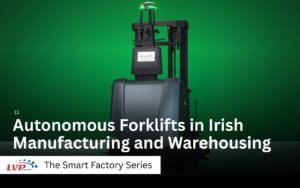
Largely a question of what is being carried and whether it has to be lifted. AMRs typically carry loads on a deck, in a tote rack, or by moving a trolley or cart. Once a pallet has to be picked from the floor or placed into racking at height, that is forklift territory — covered in autonomous forklifts.
Many sites end up with both, doing different jobs.
AMR and conveyor
A conveyor is the better answer when the route is fixed and the volume is continuous. An AMR is better when the route varies, the volume is intermittent, or a conveyor would obstruct floor space people need. Cost per movement favours conveying at high volume on a fixed path; flexibility favours AMRs everywhere else. The comparison is set out in what is a conveyor system.
What AMRs actually carry
The common applications are narrower than the marketing suggests:
- Line feeding — components and consumables delivered to workstations on a repeating cycle.
- Finished goods — moving completed product from the end of a line to storage or dispatch, often taking over from a forklift shuttle.
- Tote and carton movement — between picking, packing and dispatch areas.
- Cart and trolley towing — where existing trolleys can be moved rather than replaced, which is often the cheapest way in.
- Waste and returns — empty packaging, pallets and rejects travelling back the other way, which is easy to forget when calculating utilisation.
What decides whether an AMR fits
Payload and load type
Weight is the obvious one. Less obvious is how the load sits: something stable on a flat deck is straightforward, while tall, unbalanced or loose loads need a fixture or a cart. Acceleration and braking act on whatever is being carried, exactly as they do on a conveyor.
The handover at each end
This is the part most often underestimated. An AMR that arrives at a workstation has solved the transport problem and none of the loading problem. Something still has to put the load on and take it off — an operator, a lift table, a conveyor handover or a robot.
Where every stop needs a person anyway, the saving is smaller than the business case assumed. Automated handovers are usually what turns an AMR from a novelty into infrastructure, and they are the part that adds cost.
Floor and environment
Floor condition matters more than expected: joints, ramps, drainage channels and worn surfaces all affect navigation and load stability. Lighting, reflective surfaces, temperature and wash-down areas all bear on which sensing approach works.
Traffic and people
AMRs are designed to work around people, which is their principal advantage over guided vehicles. But a robot that stops every time someone crosses its path in a busy aisle will not achieve its cycle time. Route planning around pedestrian and forklift traffic is part of the design, not something to resolve afterwards.
Fleet size and charging
One robot rarely covers a route continuously once charging is accounted for. Working out how many are needed means looking at cycle time including waiting, loading and charging — not distance divided by speed. Charging points also take floor space and have to sit somewhere sensible relative to the routes.
The software layer
A fleet needs something deciding which robot does what, in what order, and what happens when two want the same aisle. On a single robot this is trivial; across a fleet it is the difference between a working system and an expensive one. It also has to connect to whatever tells it there is a job to do.
Where AMRs earn their place
- Routes that change. The clearest case. Where layouts are reorganised or product routes vary, re-teaching a route beats relaying infrastructure.
- Buildings that cannot be re-engineered. Leased premises, listed structures, or floors that cannot take fixed installation.
- Reducing forklift movements. Fewer forklift journeys means fewer of the interactions that cause the most serious warehouse incidents.
- Long, repetitive, low-value journeys. The transfer somebody spends half a shift walking or driving is the one worth automating first.
- Staged automation. One robot on one route proves the case without committing the building to anything.
Where an AMR is the wrong answer
- High continuous volume on a fixed route. Conveying costs less per movement and does not queue for a charger.
- Pallets in and out of racking. That is a forklift job, autonomous or otherwise.
- Very short distances. If someone can slide it across, a robot is expensive theatre.
- Every stop requiring a person anyway. Without automated handovers, the labour saving is often marginal.
- Congested aisles with unpredictable traffic. Achievable, but cycle times degrade and the business case degrades with them.
Common questions
What is the difference between an AMR and an AGV?
An AGV follows fixed guidance — a wire, magnetic tape or markers — and stops when the path is blocked. An AMR maps the building and plans its own route, going round obstructions and adapting when the layout changes. AGVs remain the better choice where the route never changes; AMRs suit everything else.
Do AMRs need changes to the building?
Usually very little, which is the main attraction. No floor wires, tape or rails. What they do need is a floor in reasonable condition, sensible charging locations, and thought given to how they interact with pedestrian and forklift traffic.
How many robots will we need?
Work from cycle time rather than distance. A full cycle includes travelling, waiting to be loaded, loading, travelling back, unloading and charging. Fleet size follows from that against your required movements per hour, and it is usually more than the first estimate.
Are they safe around staff?
They are designed to be, using sensing to detect and avoid people, and that is a genuine advantage over guided vehicles. As with any machinery, what matters is the risk assessment for your specific site and traffic, not the specification sheet.
Can AMRs work with our existing equipment?
Yes, and that is normally how they are deployed. The integration work is at the handovers — how the load gets on and off at each end — and in connecting the fleet software to whatever generates the transport requests.
Can we start with one?
Yes, and it is a sensible way in. A single robot on one well-chosen route proves the case, exposes the handover requirements, and commits nothing structural. What matters is choosing a route that is genuinely representative rather than the easiest one.
AMRs or a conveyor?
Volume and predictability decide it. Continuous flow on a fixed route favours conveying; intermittent movement on varying routes favours AMRs. Where the answer is not obvious, modelling both against real volumes is cheaper than guessing — that is what simulation is for.
Where AMRs fit in the wider system
AMRs are a transport layer. They collect from palletising at the end of a line, feed automated storage, and move product between areas within a warehouse automation system. They do not store, sort or stack — they move.
That is worth being clear about when scoping a project, because an AMR fleet solves transport and leaves everything either end of the journey exactly as it was.
Talk to us about internal transport
LVP Automation supplies and integrates autonomous mobile robots for manufacturers and distribution operations in Ireland, including the handovers and conveying at each end of the route. The wider capability is on our automation services page.
We are based in Finglas, Dublin 11. Tell us the journey you want to automate — what is carried, how often, and what happens at each end — and we will tell you whether an AMR is the right tool.