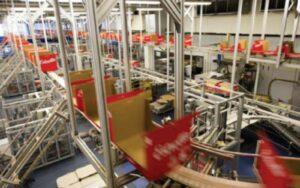
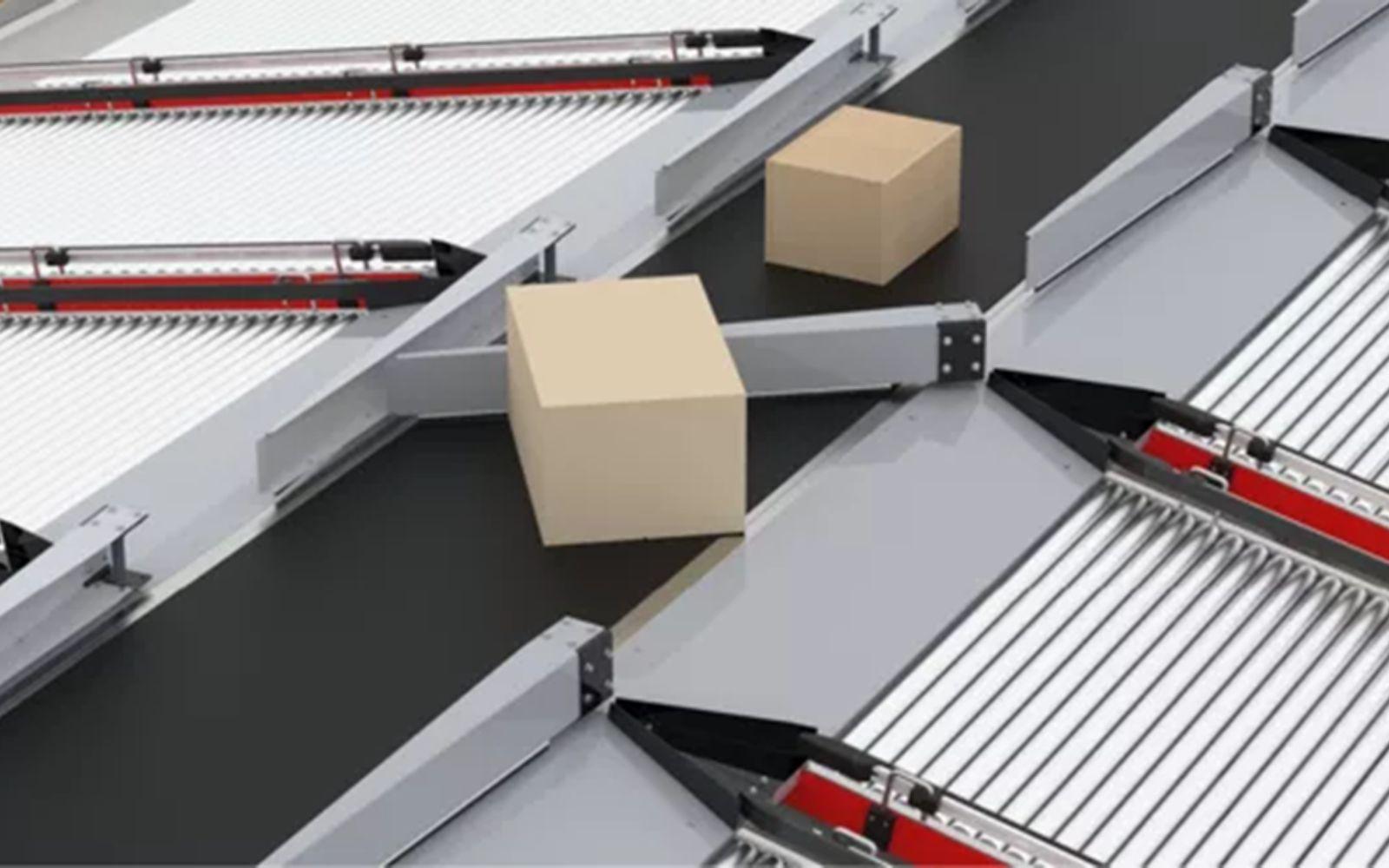
A conveyor system is equipment that moves material along a fixed route without someone carrying it. That covers everything from a two-metre run of unpowered rollers beside a packing bench to a driven network running the length of a distribution centre.
This page explains what a conveyor system is made of, the main types and what each one suits, the difference between handling unit loads and bulk material, and the fact that conveyors are often doing more than transport.
What a conveyor system is
Strip it back and a conveyor is a surface that carries product, a structure that holds the surface in position, and — on a powered system — something to drive it. What varies between types is the carrying surface and how it is driven, and those two choices follow from what is being moved.
The parts of a powered conveyor
- The carrying medium — a belt, a set of rollers, a chain, slats or a screw. This is what the product actually sits on and it is the decision everything else follows from.
- The frame — the structure holding everything in alignment, at the right height, and rigid enough not to flex under load.
- The drive — a motor and gearbox, usually with a variable frequency drive so speed can be set and changed.
- Rollers, pulleys and bearings — supporting and tensioning the carrying medium along its length.
- Controls — sensors, a PLC and a panel deciding when sections run, stop and interact with the machines either side.
- Guarding and safety devices — guards at accessible danger points, emergency stops, and a means of isolation for maintenance.
An unpowered conveyor drops the drive and the controls, which is why gravity lanes are so much cheaper to install and run.
Unit loads and bulk material
The first fork in any conveyor conversation is whether the product is a discrete item or a loose mass.
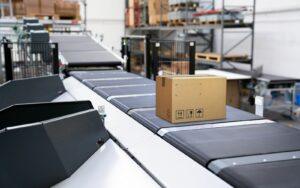
Unit loads are countable things: cartons, totes, trays, bottles, crates, pallets. They are handled on belts, rollers, chains and slats, and the specification is driven by their dimensions, weight and how stable they are.
Bulk material is powder, granules, aggregate, grain, liquid. It has no fixed shape, so it is handled by screw conveyors, pneumatic systems, or troughed belts, and the specification is driven by how the material flows, whether it is abrasive, and whether it generates dust.
The two need different equipment and different expertise. LVP Automation works in unit load handling.
The main types of conveyor
Belt conveyors
A continuous belt running over a bed or rollers, driven from one end. The most widely used type, because a flat belt will carry almost anything with a reasonably flat base, including items too small or too irregular to sit on rollers. PU and PVC belt conveyors cover most general handling.
Modular plastic belt
Interlocking plastic modules instead of a single belt. The advantage is that the belt can turn corners and change level in one continuous run, and a damaged section can be replaced without taking the whole belt off. It also washes down well, which is why it dominates food handling. Plastic belt conveyors and modular belt both work this way.
Slat and chain conveyors
Slats or chains carrying the product instead of a belt. Used where loads are heavy, hot, or where the product needs to sit on a hard surface rather than a flexible one. Slat chain conveyors are common on bottling and filling lines.
Roller conveyors
Product carried on a bed of rollers. Gravity roller lanes have no drive at all and rely on a hand push or a gentle fall; powered roller conveyors drive the rollers so movement can be controlled and product can be accumulated. Rollers need a flat, rigid base and enough length to span at least three rollers — more on that in gravity roller conveyors explained.
Pallet conveyors
Built for the weight and footprint of loaded pallets, usually chain or heavy-duty roller. A different class of equipment from carton handling, with frames and drives sized accordingly. Pallet conveyors typically sit at the end of a line feeding palletising, wrapping or dispatch.
Overhead and spiral conveyors
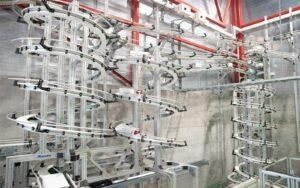
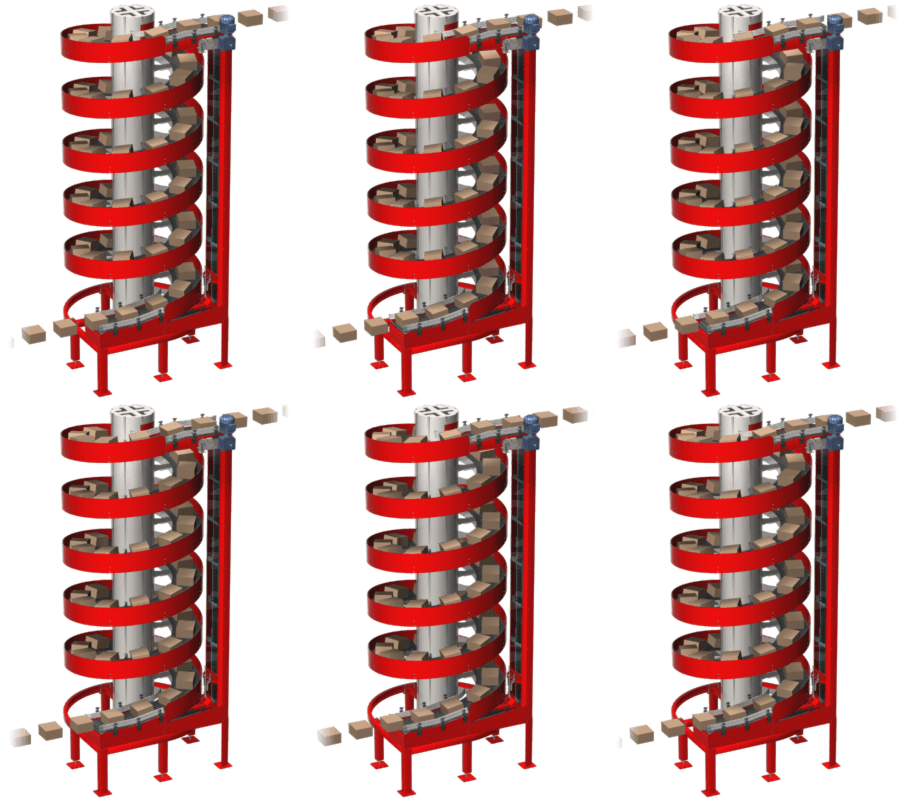
Where floor space is the constraint, product can travel overhead on a chain or track, or change level within a small footprint on a spiral. A spiral moves product between floors or over an obstruction in roughly the area of its own diameter, which is why they appear in buildings where a straight incline would not fit.
Screw and pneumatic conveyors
Both handle bulk material rather than discrete items. A screw conveyor turns a helical flight inside a trough or tube to push material along. A pneumatic system moves powder or granules through a pipeline on an air stream. Neither is used for unit loads, and both are specified around the behaviour of the material rather than its dimensions.
Conveyors do more than transport
The obvious job is moving product from one place to another. The less obvious one is that the conveyor is often where an operation happens rather than a link between operations.
Product can be washed, dried, cooled, cured, coated, inspected, weighed, labelled or assembled while it is on the conveyor. In those cases the conveyor is setting the dwell time and the position for the process itself, and its speed is dictated by how long the operation takes rather than by how fast product could travel.
That is also why indexing conveyors exist: where an operation needs the product stationary, the conveyor moves in measured steps and holds it still at each one.
The related function is buffering. A conveyor holding product between two machines lets each run at its own pace, which is accumulation, and where the order product arrived in has to be preserved, a FIFO lane.
How a conveyor system gets specified
Choosing a type is the easy part and usually follows from the product. The work is in the detail: the route and the heights at each end, the weight range from lightest to heaviest, the rate and whether it surges, the environment it has to survive, and what happens at the machines either side.
Those requirements are what determine belt or roller, driven or gravity, frame construction and drive sizing. We go through them in conveyor system requirements, and the case for automating a movement at all is covered in benefits of a conveyor system.
Common questions
What is the difference between a conveyor and a conveyor system?
A conveyor is a single run of equipment. A conveyor system is several of them working together with the controls that co-ordinate them, usually including merges, diverts, buffers and connections to other machines. Most industrial installations are systems rather than single conveyors.
Which type of conveyor is most common?
Belt, because a flat belt carries the widest range of product. Roller is the most common where product has a rigid flat base and accumulation is wanted, and modular plastic belt dominates anywhere that has to be washed down.
Do all conveyors need power?
No. Gravity roller lanes have no drive at all and move product by hand push or a gentle fall. They cost far less to install and run, but they cannot control when product moves, which is what a driven conveyor is for.
What is a unit load?
A discrete item handled as one thing — a carton, tote, tray, crate or pallet. It is the opposite of bulk material, which has no fixed shape and is handled by different equipment entirely.
Can conveyors handle corners and changes in level?
Yes, in several ways. Modular plastic belt turns corners within a single run, curved roller sections handle bends, inclines and declines change level over a distance, and spirals do it within a small footprint. Which suits depends on the product and the space available.
How long does a conveyor last?
The frame outlives everything else, often by decades. Belts, rollers, bearings and drives are wear items on a replacement cycle that depends on duty and environment. That is why maintenance matters more to whole-life cost than initial build quality alone — see conveyor faults and maintenance.
Talk to us about your line
LVP Automation designs, builds and installs conveyor systems for unit load handling. The full range is on our conveyors page, and system-level work is covered by conveyor system design.
We are based in Finglas, Dublin 11 and work with manufacturers across Ireland. Tell us what you need to move and we will tell you what suits.