Moving product along a floor is straightforward. Moving it to a different level is where conveyor layouts get difficult, and it is usually the constraint that decides how the rest of the line is arranged.
This page covers the three ways of changing level on a conveyor line — inclining, spiralling and lifting vertically — what each one costs you in floor space, and how to work out which suits a given product and building.
Why changing level is the hard part
A conveyor that climbs has to do it gently enough that the product stays where it is put. Too steep and cartons slide, bottles tip, and anything with a smooth base starts travelling backwards relative to the belt. The gentler the climb, the longer the run needed to gain the same height.
That relationship is the whole problem. A modest rise at a shallow angle can consume a surprising length of floor, and that floor is usually in the middle of a working area rather than conveniently spare. The steeper alternatives all involve holding the product rather than just resting it on a surface, which means different equipment.
The three approaches
Inclined conveyor
The simplest option: run the conveyor up a slope. It works where the rise is small, the run is available, and the product is stable enough to stay put on the gradient. Cleated or textured belting extends how steep you can go by giving the product something to sit against.
The limits are floor space and product behaviour. Once the required angle exceeds what the product tolerates, an incline stops being an option regardless of how much room there is.
Spiral conveyor
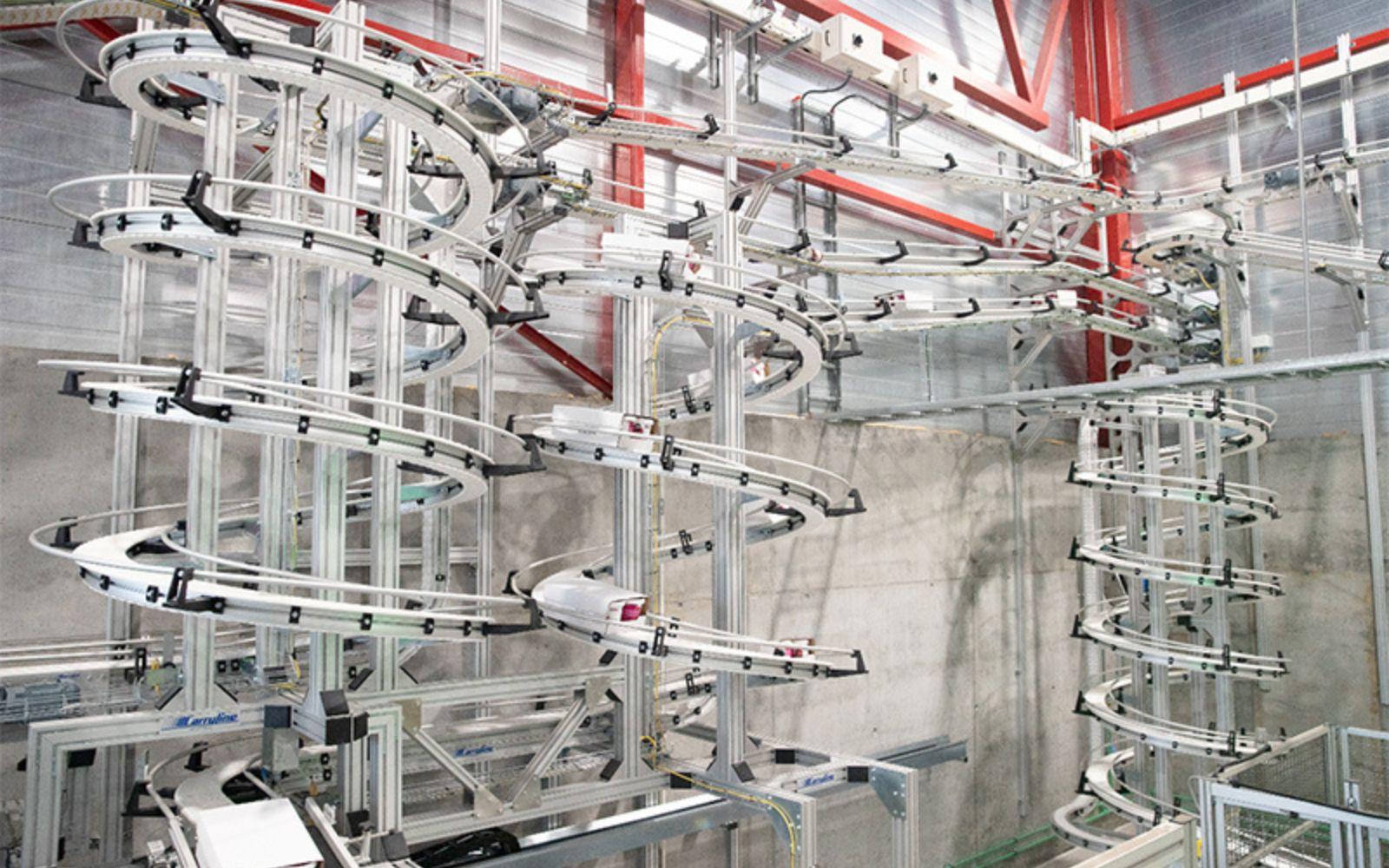
A spiral takes the same gentle gradient and wraps it around a column, so the run happens vertically instead of across the floor. The product stays at a shallow angle the whole way, but the footprint is roughly the diameter of the spiral rather than the length of the climb.
That is the entire argument for one: it buys height without buying floor. Flow is continuous, so a spiral does not interrupt the line the way a lift does, and product stays in order through it.
Vertical conveyor
Where the rise is large or the footprint has to be smaller still, a vertical conveyor moves product straight up. Because the product cannot simply rest on a surface at that angle, it is either gripped between two chains or carried on flights, depending on what it is.
Vertical slat conveyors come in side-grip and friction chain configurations for exactly this reason: side-grip holds the product from both sides for items that would not stay upright, friction chain suits stable flat-based products on shallower rises.
What decides which one
Five things, and they are worth establishing before anyone draws a layout:
- How much rise. A small change of level is often an incline problem. A floor-to-floor move rarely is.
- How much floor you can give up. This is usually the binding constraint, and it is what pushes designs from incline to spiral.
- How the product behaves on a slope. Base friction, height, centre of gravity and whether it is rigid all decide the steepest angle available before anything has to hold it.
- Whether flow has to stay continuous. A spiral keeps product moving and in order. A lift that cycles introduces a stop, which may or may not matter depending on what is downstream.
- Throughput. Continuous methods scale with belt speed; cycling methods are limited by how fast the cycle repeats.
Spirals in practice
Footprint is the reason, not speed
A spiral does not move product faster than an incline. It moves it through the same gentle gradient in a fraction of the floor area. If floor space is not tight, an incline is usually simpler and cheaper; when it is tight, nothing else does the same job.
Product has to cope with a constant curve
On a spiral the product is turning the whole way up. Tall or narrow items, anything top-heavy, and loads that are not centred need more thought than they would on a straight incline. This is where the carrying surface matters: a slat chain gives a rigid, guided surface through the turn.
Up and down
Spirals work in both directions. Descending has its own consideration, because product is now being helped along by gravity rather than resisted by it, and the design has to control the descent rather than simply permit it.
The Carryline spiral
The Carryline spiral slat conveyor is the system we supply for this. It is built from the same modular components as the rest of the Carryline slat range, available in aluminium or stainless steel, and specified around input and output heights, chain type and chain width to suit the product being carried.
Because it uses common components rather than a bespoke build, it can be altered later if the layout or the product changes — which, on the kind of line that needed a spiral in the first place, it usually does.
Common questions
How much floor space does a spiral need?
Roughly its own diameter, which is set by the product size and the gradient the product tolerates. That is the comparison worth making: the diameter of a spiral against the length of an inclined run achieving the same rise.
Can a spiral go down as well as up?
Yes. Descending needs the design to control the rate rather than resist gravity, but it is a normal application — feeding a lower-level packing area from an upper-level process, for instance.
Spiral or vertical lift?
Spiral where flow has to stay continuous and in order. Vertical where the rise is large, the footprint has to be minimal, or the product needs holding rather than resting. Spirals maintain sequence throughout, which matters if you are relying on FIFO downstream.
What products suit a spiral?
Stable, reasonably rigid items with a flat base — cartons, trays, crates, bottles and cans in packs. Very tall, narrow or top-heavy products need assessing, as do anything unstable enough to shift on a continuous curve.
Does a spiral slow the line down?
Not inherently. It runs at the speed the rest of the line runs at. What changes is the time an individual item spends in transit, which matters only where something downstream is timed against it.
Can a spiral be added to an existing line?
Usually, provided there is floor space for the footprint and the infeed and outfeed heights work with what is already there. Those two heights are the first things to establish.
Working out the level change
Which approach suits comes down to your product, your rise and the floor you can spare. That is part of conveyor system design, and where flow through the level change is the uncertain part, a simulation can test it before anything is installed.
We are based in Finglas, Dublin 11 and work with manufacturers across Ireland. Tell us the rise and the space you have and we will tell you what fits.