There are two ways to put a conveyor into a factory. One is to have it fabricated for the layout it is going into. The other is to assemble it from a standard component system. Both produce a working conveyor, and the difference between them only becomes obvious two or three years later, when something about the line changes.
This page sets out what separates the two approaches, what modularity actually buys you, and where a fabricated conveyor is still the better answer.
Two ways to build a conveyor
Fabricated
A fabricated conveyor is designed and made for one installation. Frames are cut and welded to the dimensions of that layout, and the result fits the space exactly because it was made to.
The strength is that nothing constrains the geometry. Awkward spans, unusual heights, heavy loads and non-standard shapes are all achievable because the conveyor is being made rather than assembled. The weakness shows up when the requirement changes: modifying a welded frame means cutting and re-welding, and the drawings that describe it are specific to that one machine.
Modular
A modular conveyor is built from a catalogue of standard parts — beam sections, bends, drive units, legs, guide rails, chain — that connect in defined ways. The layout is a combination of parts rather than a bespoke design.
The constraint is that the geometry has to be achievable with the components available. The advantage is everything that follows from parts being standard.
What modularity actually buys
Changing the layout is assembly work
This is the main one. When a line moves, a machine is replaced, or a new product needs a different route, a modular system is unbolted and rebuilt using the same parts plus whatever new sections are needed. There is no fabrication, no welding on site, and often no need to take the rest of the line out of service for long.
On a fabricated conveyor the same change is a manufacturing job with a lead time attached.
Spares are stock items
A worn component on a modular system is a part number. On a fabricated one it may be a drawing, and if the original drawings are missing — which after a decade they often are — it becomes a measuring and manufacturing exercise before anything can be replaced.
That difference is what decides how long a line is down when something fails. It is worth thinking about at purchase rather than at failure. We hold spare parts for the systems we supply for exactly this reason.
Installation and changeover are faster
Modular systems assemble with hand tools. That matters most in facilities where installation has to happen inside a shutdown window, and where the alternative is site welding in a working production area with everything that involves.
Extending is normal rather than exceptional
Adding ten metres to a modular run is more of the same components. Adding ten metres to a fabricated conveyor is a new conveyor that has to match the old one. Lines that grow incrementally tend to end up modular for this reason alone.
Where fabricated is still the right answer
Modular is not automatically better, and it is worth being clear about where it is not:
- Heavy loads. Pallet handling and anything with substantial weight per metre often needs frame sections a modular catalogue does not carry.
- Awkward geometry. Where a conveyor has to thread through an existing structure, span an obstruction or meet an unusual height, being able to make it to fit is worth more than being able to change it later.
- Harsh or specialised environments. High temperature, aggressive chemicals or specific finishes may require construction outside what a standard system offers.
- A layout that genuinely will not change. Where the line is fixed and the product will not vary, the flexibility premium buys nothing.
Most real installations end up mixed: modular through the areas that change, fabricated where the duty or the geometry demands it.
How to tell which you need
Four questions usually settle it:
- How likely is the layout to change? If the honest answer is “it already has, twice”, that points one way.
- How heavy is the product? Light unit loads suit modular systems; pallets and heavy assemblies often do not.
- How long can the line be down for a repair? Shorter tolerance argues for stocked, standard components.
- Is the geometry ordinary? Straight runs, standard bends and normal heights are what modular systems are built for.
What a modular system looks like in practice
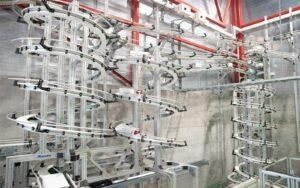
The Carryline slat range we supply is a working example. It is built from a common set of aluminium and stainless components, with acetal chain in standard widths from 24 mm to 220 mm, and the same parts appear across horizontal, spiral and vertical configurations.
The practical consequence is the one described above: a section can be added, a route changed, or a worn length of chain replaced without any of it being a manufacturing job. Systems assemble with hand tools, which is what makes installation inside a shutdown window realistic.
Whether that suits your line depends on the questions above rather than on the system itself.
Common questions
Is a modular conveyor cheaper than a fabricated one?
Not necessarily on day one, and that is the wrong comparison. The difference shows up over the life of the line, in what it costs to change, extend and repair. A fabricated conveyor can be cheaper to buy and considerably more expensive to live with.
Can a modular system handle heavy loads?
Within the limits of the components. Modular slat and belt systems are designed around light to medium unit loads. Pallet handling and heavy assemblies generally call for pallet conveyors built for that duty.
What happens if the manufacturer discontinues a component?
A fair question and worth asking any supplier. It is one of the arguments for systems built on widely used standard profiles and chain, rather than on a proprietary design with a single source.
Can modular and fabricated conveyors be mixed on one line?
Yes, and most lines are. The design work is in getting the transfers between them right, which is part of conveyor system design.
Does modular mean I can reconfigure it myself?
Mechanically, often yes. What usually needs revisiting is the control system and the guarding, because moving a section changes what the sensors see and where people can reach. Those are worth checking before a reconfigured line runs.
How does this affect maintenance?
Standard components mean predictable wear parts and a stockable spares list. The maintenance itself is the same work either way — covered in conveyor faults and maintenance.
Deciding which suits your line
The right answer depends on your product, your building and how settled the layout is. That is part of what we work through in specifying a conveyor system and in conveyor system design.
We are based in Finglas, Dublin 11 and work with manufacturers across Ireland. Tell us what the line has to do and how likely it is to change, and we will tell you which approach fits.