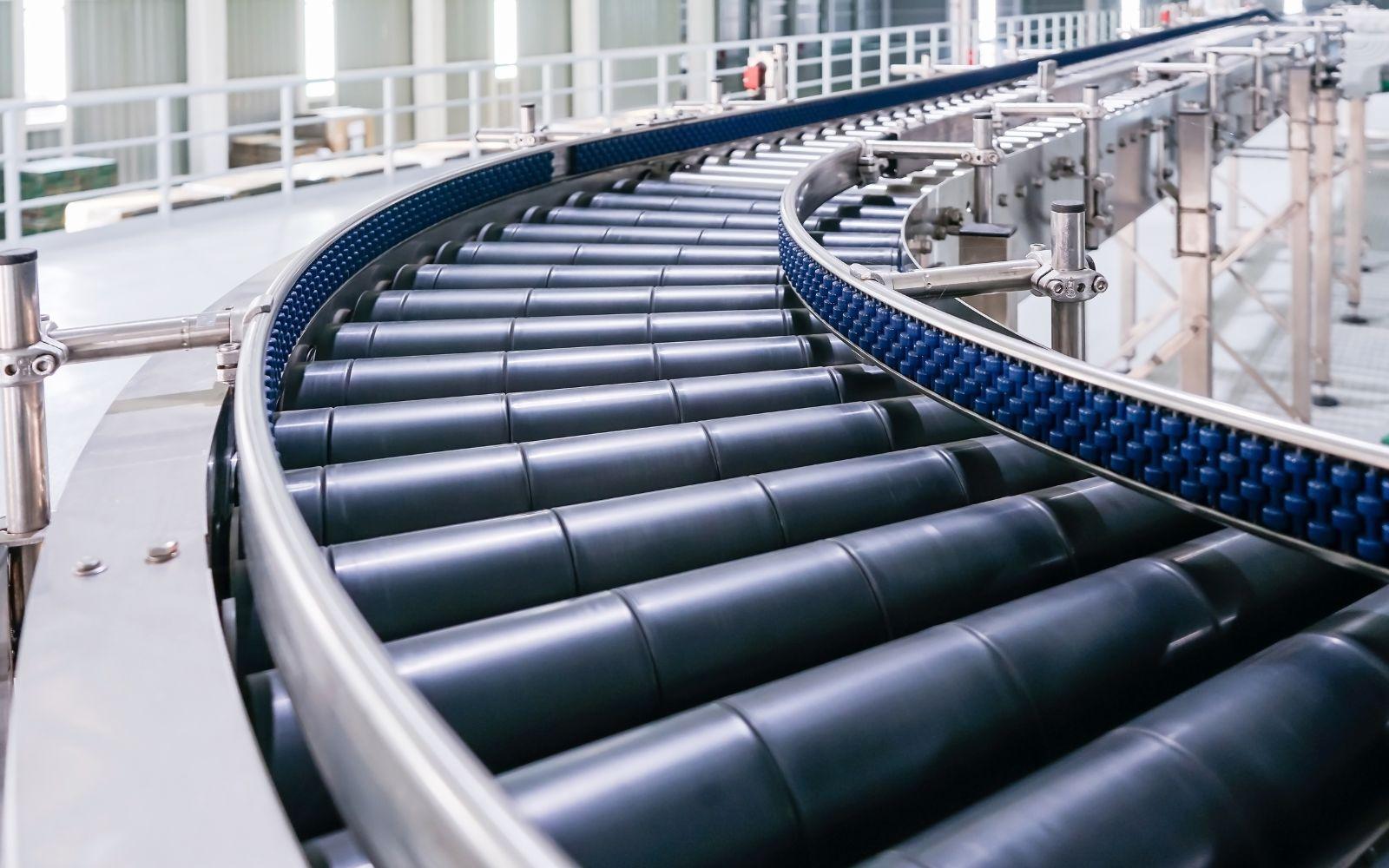
Most conveyor projects go wrong in the specification rather than the build. The equipment does what it was asked to do; it was asked for the wrong thing. Nearly always that traces back to a handful of questions nobody settled properly at the start.
This page covers what has to be established before a conveying system is designed: the space it has to fit, the load it has to carry, the rate it has to run at, what the product is actually like, and how it will be driven and controlled.
Space and layout
The building comes first. A conveyor has to fit not only its own footprint but the clearance to work alongside it, the height product needs to arrive and leave at, and every obstruction between the two ends — columns, doors, existing plant, overhead services and the routes people take through the space.
Where a conveyor crosses a walkway, that crossing is part of the design rather than something to resolve later. So is access for cleaning and maintenance: a conveyor that cannot be reached will not be maintained.
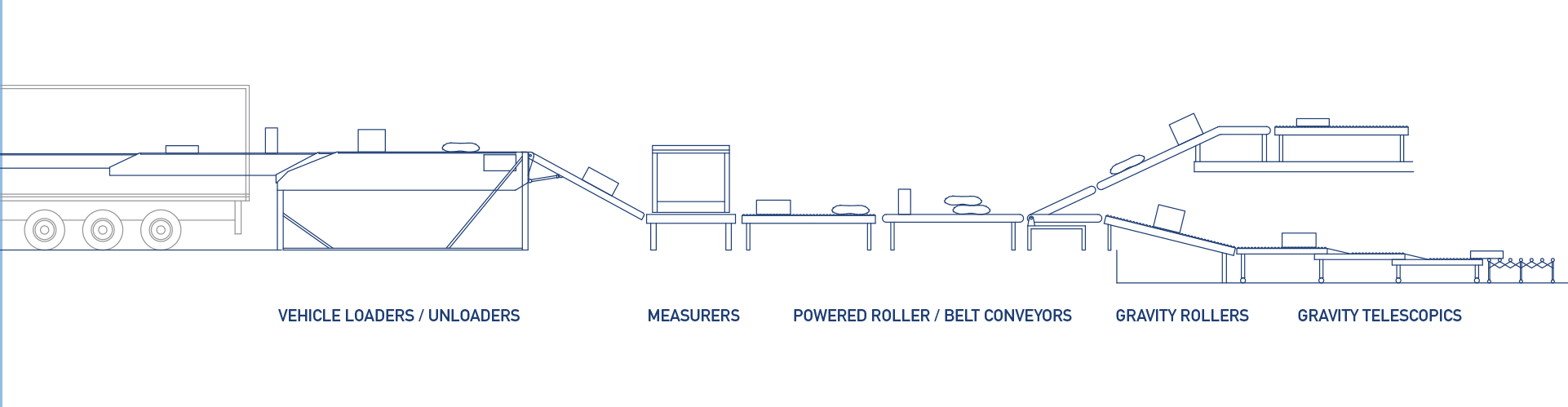
Conveyor System Design (from newland-engineering.com)
This is also where the question of manual versus driven gets answered. A short transfer that an operator is standing at anyway may not need a drive at all — see gravity roller conveyors for where that applies.
Load and capacity
Two different numbers matter here and they are often confused. One is the weight of a single item; the other is the total weight sitting on the conveyor when it is full. The second is what sizes the frame, the rollers and the drive, and it is the one that gets underestimated when a line backs up and the conveyor fills in a way nobody planned for.
Overloading does not usually announce itself as a failure. It shows up as premature bearing wear, a motor running hot, or a belt that will not track. Establishing the worst realistic case at specification stage is cheaper than diagnosing it later.
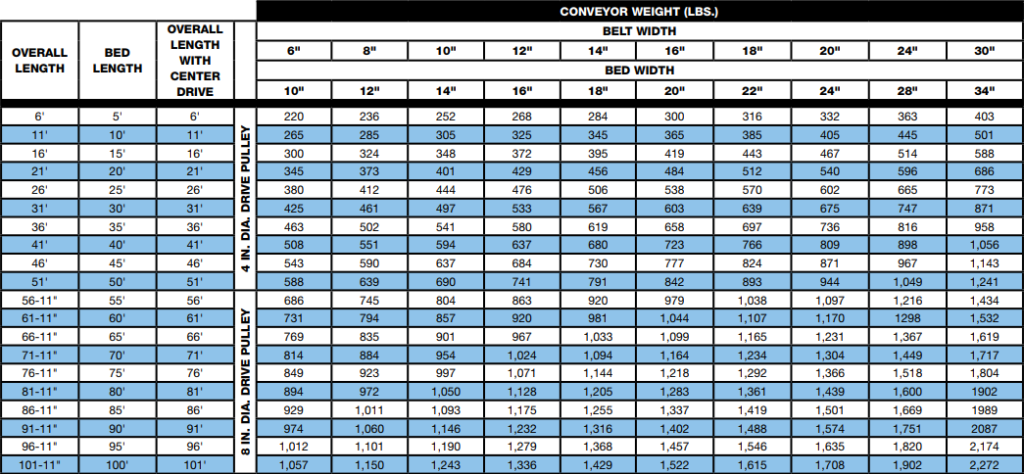
(from condrives.com)
Speed and throughput
Conveyor speed is rarely the constraint. What sets it is the process at either end: how fast product arrives, and how fast the next operation can accept it. A conveyor running faster than the machine it feeds simply creates a queue, and a conveyor running slower starves it.
Speed also interacts with the product. Faster running means more energy in every start, stop and transfer, which matters for anything unstable, fragile or awkwardly shaped. Where the rate has to vary, that points to a driven system with speed control rather than a fixed-speed one.
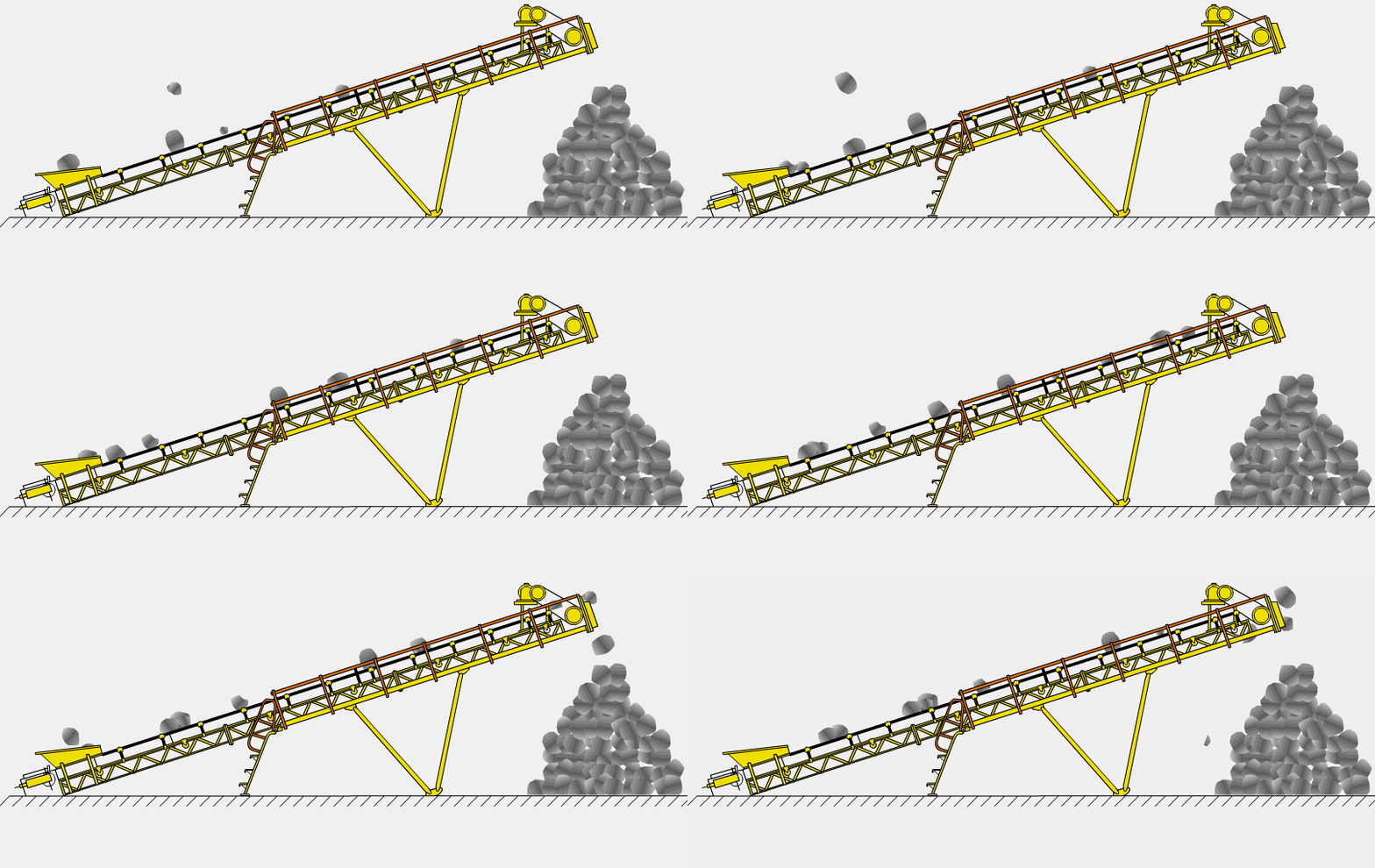
Belt Conveyor (from pkmachinery.com)
What the product is actually like
More conveyor problems come from product characteristics than from any other single factor, and it is the area most often described too loosely at enquiry stage.
Unit loads
For cartons, totes, trays and pallets the questions are dimensional and physical: the base size and whether it is flat and rigid, the weight range across everything that will use the line, the height and stability of the load, and whether the surface is likely to be wet, dusty or coated with anything.
The base dimensions matter more than people expect, because they set roller pitch and belt width. Where several product sizes share a line, the smallest one usually governs.
Powders, granules and liquids
Bulk materials change the problem entirely. A system handling powder or liquid has to be sealed well enough that nothing escapes, and dust generation may require extraction or filtration as part of the design rather than as an addition to it.
Material behaviour is what drives the specification: how it flows, whether it bridges, whether it is abrasive, whether moisture changes how it moves. Two powders that look similar can need entirely different systems.
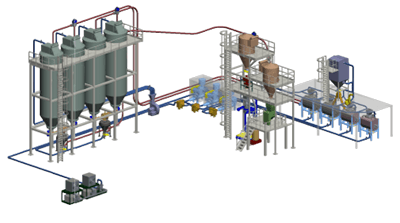
Pneumatic Powder Conveying System (from pneupowders.com)
Configuration
Conveyors run horizontally, on an incline or decline, around curves, vertically, and in combinations of all of those. They can be flat belt, modular belt, roller, slat, chain or pocket, and the right answer follows from the product and the layout rather than from preference.
Incline is worth singling out. The angle a product will climb without sliding back depends on the product and on the belt surface, and where a steep rise is unavoidable it usually means cleated belting or a different conveyor type. It is a common late discovery on projects where the level change was treated as a detail.
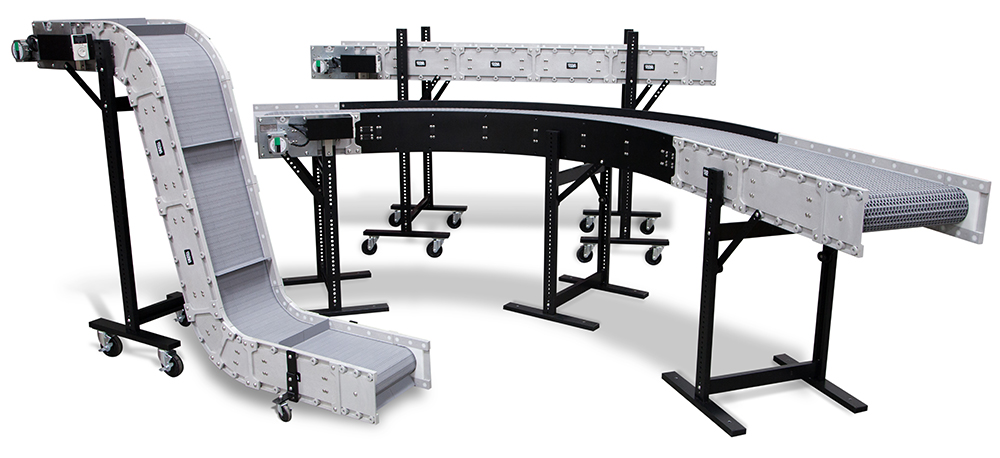
Different Conveyor Configurations (from dynamicconveyor.com)
Drive and controls
The drive
The drive is what moves the product, and its position on the conveyor is a design decision — head, centre or tail, depending on the layout and how the belt is tensioned. Overhead and chain systems are typically sprocket driven; bulk systems may use screw or pneumatic conveying instead of a belt at all.
Sizing the drive means accounting for the full load, the friction in the system, any incline, and the duty cycle. A motor chosen on running load alone will struggle to start a conveyor that has filled while stopped. That calculation is what motor sizing and selection exists to do properly.
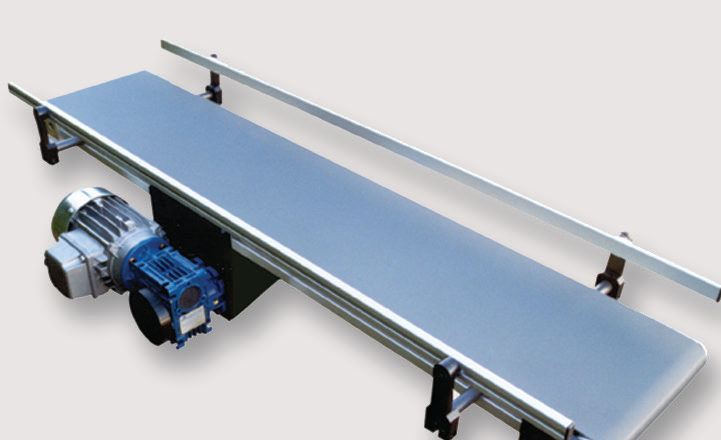
Flat Belt Conveyor with Central Drive (from elcom-automation.com)
Controls and safety
The control system decides when sections run, how they interact, and what happens when something goes wrong. On anything more than a single stretch of belt that means a PLC co-ordinating sensors, drives and the machines either side, housed in a control panel built for the environment it sits in.
Emergency stop provision, isolation for maintenance and guarding at accessible danger points are part of this from the outset, not additions afterwards. What that involves under Irish and EU law is covered in conveyor safety requirements in Ireland.
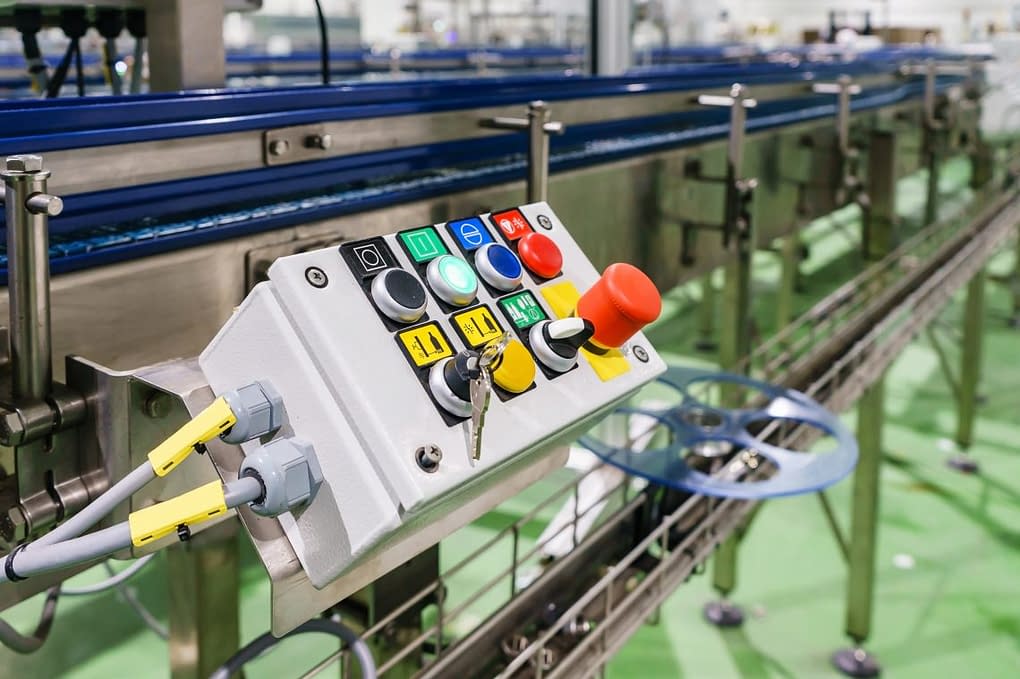
Conveyor Controls (from cc-efi.com)
What to have ready before you enquire
A specification conversation goes a lot faster when these are known. None of them require an engineer to establish:
- Product — base dimensions, weight range from lightest to heaviest, height, and whether the base is flat and rigid.
- Rate — how many items or how much material per hour, and whether that is steady or comes in surges.
- Route — where product starts, where it has to end up, and the height at each end.
- Obstructions — what is in the way, and where people need to cross.
- Environment — wash-down, temperature, dust, and any hygiene requirement that applies.
- What happens either side — the machine or process feeding it and the one taking product away.
Common questions
What is the most common specification mistake?
Describing the product too loosely. A conveyor specified for a nominal carton size that then has to handle three variants, or one sized for running load that fills up when the line stops, will disappoint regardless of how well it is built.
How much space does a conveyor need?
More than its own width. Allow for working clearance along its length, access for cleaning and maintenance, and designed crossings anywhere people need to get past it. A run that fits on the drawing but cannot be reached is a maintenance problem waiting to happen.
How fast should a conveyor run?
Fast enough to keep up with the process feeding it and no faster than the one receiving it can accept. Speed is set by the line rather than chosen in isolation, and where the rate varies, a driven system with speed control is the answer rather than a compromise fixed speed.
Can one conveyor handle several different products?
Often, within limits. Roller pitch, belt width and drive sizing all end up governed by the most demanding item in the range — usually the smallest base and the heaviest load. The wider the range, the more the design is a compromise, and at some point separate lines cost less than one that suits nothing well.
Do we need to know all of this before making an enquiry?
No. Bring what you have. The point of listing it is that these are the questions that will come up, and the more of them that are settled, the closer a first proposal will be to what you actually need.
Getting the specification right
LVP Automation works through these requirements as part of conveyor system design. Where throughput or flow is the uncertain part, a simulation can test the design before anything is built, and where the uncertainty is about whether an approach works at all, that is what a proof of concept is for.
We are based in Finglas, Dublin 11 and work with manufacturers across Ireland. Tell us what you are moving and we will tell you what it needs.