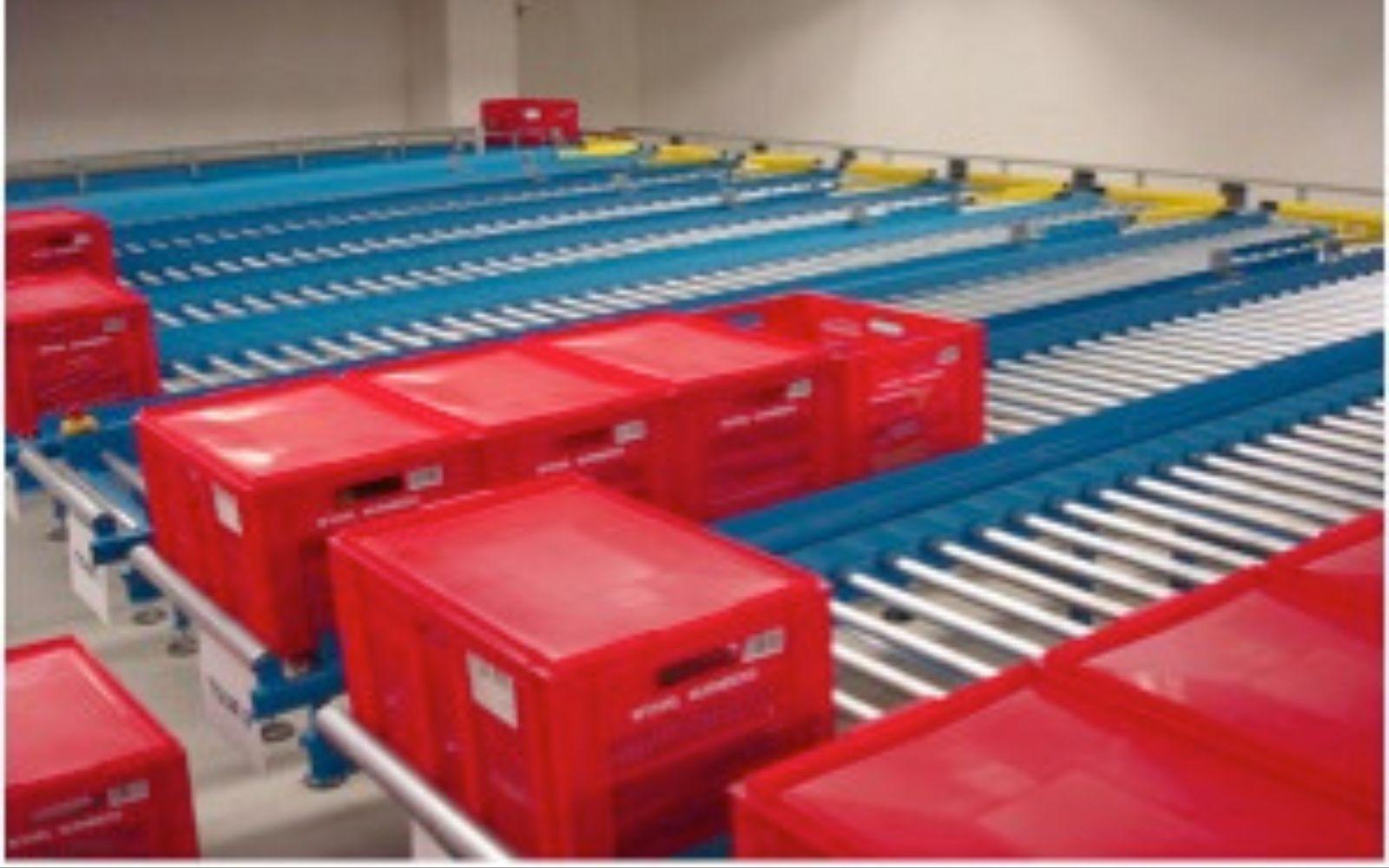
A gravity roller conveyor has no motor. Product sits on a bed of free-running rollers and moves either because someone pushes it or because the bed falls gently towards the far end. That is the whole mechanism, and it is why a gravity lane costs a fraction of a driven one to install and almost nothing to run.
It is also why it does not suit everything. This post covers where the saving actually comes from, what your product has to be like for gravity to work at all, what makes a lane difficult to get right, and when you should be specifying a driven conveyor instead.
Where the efficiency actually comes from
The saving is in what you do not install
The gain is rarely speed. A gravity lane will not move product faster than a driven one. What it removes is everything around the movement: no drive to power, no motor to fail, no control panel, no inverter to configure, no cable run to the point of use.
The practical effect is that a gravity lane can go where a driven conveyor could never be justified. A two-metre run between a packing bench and a pallet station is not worth motorising, but sliding cartons along it still beats carrying them. Multiply that by every short transfer in a building and the handling time adds up.
A full lane is a buffer that holds itself
The second gain is queueing. Product standing on a lane is waiting somewhere useful instead of in someone’s hands. Where the order it came in has to be the order it leaves, that queue is a FIFO lane. Where you only need somewhere for product to wait while the next process catches up, it is accumulation. Both come free with the lane itself.
What your product has to be
Gravity rollers carry the load on its base, so the base decides whether the idea works at all. Two things matter: how rigid it is, and how long it is.
Flat and rigid
The base has to bridge the gap between rollers without sagging into it. That splits most product cleanly into two groups.
- Runs well: cartons, totes, plastic crates, trays, tote boxes on a rigid base, and pallets on a lane pitched for them.
- Does not run: sacks and soft bags, shrink-wrapped bundles, anything with a domed or ribbed bottom, and part-filled containers that flex under their own weight.
Where the product itself will not run, the usual answer is to put it in something that will — a tote, a tray or a slave board — and convey that instead.
Long enough for three rollers
The working rule is that at least three rollers should be under the load at all times. That is what stops an item pitching forward into a gap as it hands over from one roller to the next.
It also means the roller pitch is decided by the shortest dimension of your product base, not by what is cheapest to build. Get it wrong and product stalls mid-lane, or tips as it leaves the end. If you run several product sizes down the same lane, the smallest one sets the pitch for all of them.
Gradient, weight and where it gets difficult
One slope has to serve two extremes
On a sloped lane the fall has to be steep enough that the lightest item still overcomes rolling resistance and keeps going, and shallow enough that the heaviest does not arrive at the end faster than anyone can catch it. A single fixed gradient has to satisfy both.
That is straightforward when everything on the lane weighs roughly the same. It gets difficult the moment a line sends a full carton and a nearly empty one down the same slope. Weight variation, not weight itself, is what makes a gravity design awkward.
Length compounds the problem
The longer the run, the more distance there is for the difference between the lightest and heaviest item to show up, and the more speed a heavy item can build. Long gravity runs are perfectly possible, but they stop being a catalogue choice and become a design exercise.
Brake rollers buy back control
Brake rollers hold the descent speed down to something predictable, which widens the range of weights a single lane can handle. They are the standard answer to a lane that runs fine loaded and too fast empty. They also add cost, so they are worth specifying deliberately rather than discovering you need them after installation.
When a driven conveyor is the right call instead
Gravity is the wrong tool in a few situations, and it is cheaper to know that at the drawing stage:
- Product has to move uphill, or across a floor with no usable fall between the two ends.
- Arrival has to be timed against a machine, rather than happening whenever the product gets there.
- The base is soft and cannot be put into a tote or onto a slave board.
- The lane has to start and stop with the rest of the line, under the same control system.
- Weight varies widely across the same lane and brake rollers cannot cover the full range.
It is worth being honest about this early. A gravity lane that ends up needing brake rollers, a stop, a sensor and someone watching it has quietly stopped being the cheap option.
Specifying a gravity lane
What decides the design
Most of the work is measurement rather than engineering. Five things settle roller pitch, frame width, gradient and whether braking is needed:
- Product base dimensions — particularly the shortest one, which sets roller pitch.
- Weight range — the lightest and heaviest items that will use the lane, not the average.
- Run length and the drop available between the two ends.
- What happens at the outfeed — an operator lifting product off, a stop holding it, or a hand-off to another conveyor.
- How full the lane needs to get, which is really a question about how long the process at the end can be stopped.
Where it fits with the rest of the line
Gravity lanes rarely stand alone. They tend to sit between driven sections, at pick faces, at packing benches, and anywhere product needs to wait. Working out which sections should be driven and which can be gravity is part of conveyor system design rather than a decision to make one lane at a time.
Common questions
Do gravity roller conveyors need any power?
No. There is no drive and nothing to wire, which is most of the reason they cost so little to run. Brake rollers, where a lane needs them, are mechanical rather than powered, so a braked lane still needs no electricity.
Can a gravity lane be installed level?
Yes, and plenty are. A level lane needs someone to push the product along it, which is fine at a packing bench or a pick face where an operator is standing there anyway. The fall is only needed where product has to travel on its own.
What will not run on gravity rollers?
Anything without a flat, rigid base: sacks, soft bags, shrink-wrapped bundles, and containers that flex when they are part-filled. The usual workaround is to carry the product in a tote, tray or slave board and convey that instead.
How is roller pitch decided?
By the shortest dimension of the product base, working back from the rule that at least three rollers should be under the load at all times. If several product sizes share a lane, the smallest one sets the pitch for all of them.
Can one lane handle products of different weights?
Within limits. A single gradient has to move the lightest item and still control the heaviest, so the wider that range gets, the harder the lane is to set. Brake rollers widen the range a lane can cope with. Beyond that, a driven conveyor is the more honest answer.
What is the difference between a gravity lane and an accumulation conveyor?
A gravity lane is a way of moving product without a drive. Accumulation is a function — holding product in a controlled queue — and it can be built on gravity or driven conveyor. A full gravity lane accumulates, but it releases product in the order it arrived, which makes it a FIFO lane as well.
What maintenance do they need?
Very little, because there is no drive to service. The wear items are the roller bearings and, on a braked lane, the brake rollers themselves. A roller that has seized is usually obvious — product slows or stops at the same point every time.
LVP Automation supplies gravity roller conveyors and the wider roller conveyor range, and builds them into complete systems. We are based in Finglas, Dublin 11 and work with manufacturers across Ireland.
If there is a transfer in your building still being done by hand, tell us the product and the distance and we will tell you whether gravity will do it.