A tray sealer is usually bought on speed and judged on seals. Everything that goes wrong with one — leakers, short shelf life, packs rejected on the line or at a customer — comes back to a seal that was not made properly, and almost none of that is visible in a specification.
This covers the three sealing environments, the machine formats, the cost most buyers do not see coming, and the packaging regulation that started applying this month and changes what you will be sealing.
What a tray sealer does
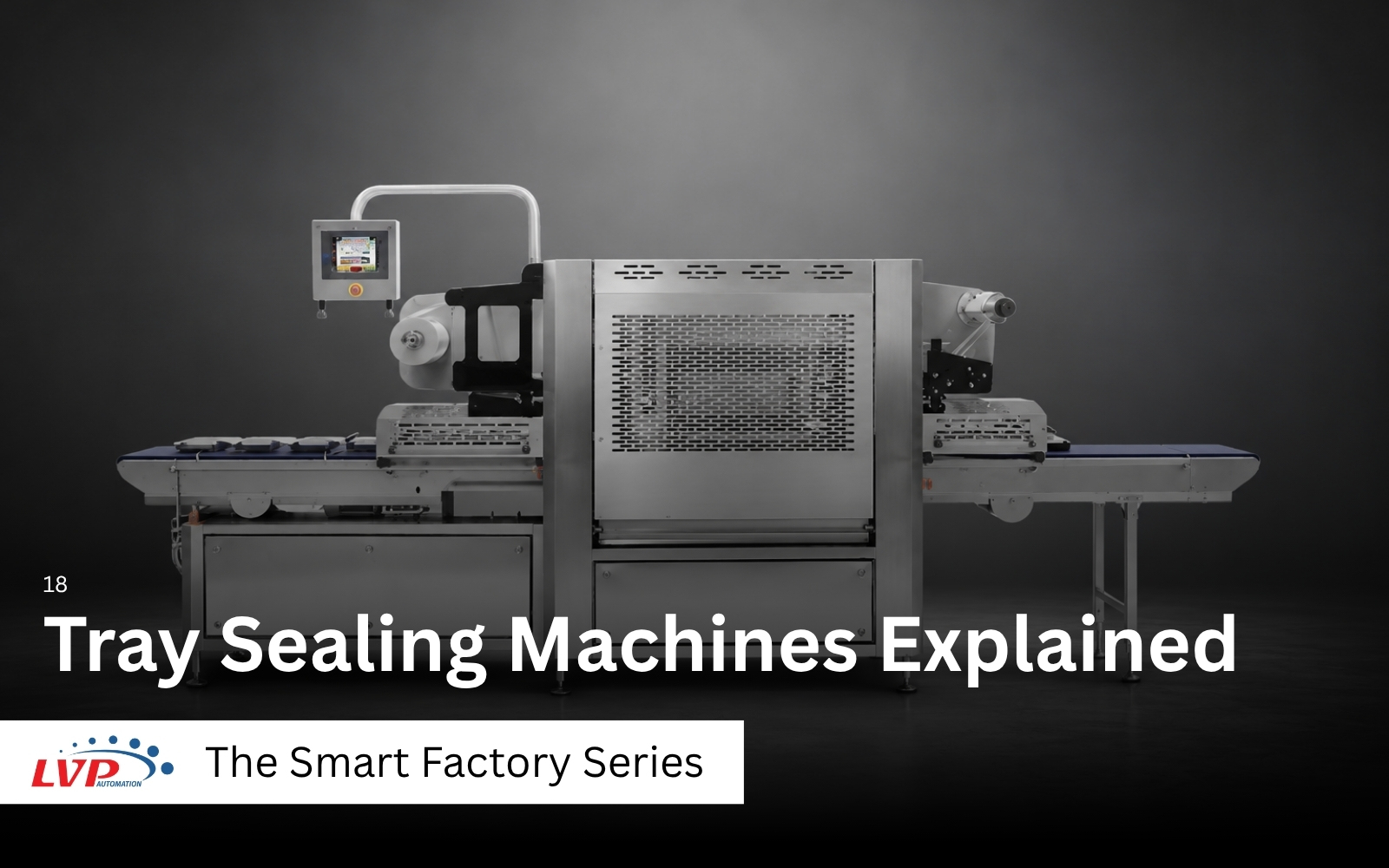
A tray is indexed into a tool, the air inside is left alone or replaced, film is sealed to the tray flange under heat and pressure, and the film is cut. The seal is the product: it is what holds the atmosphere in, keeps contamination out, and determines whether the pack survives distribution.
Three variables make that seal — temperature, pressure and dwell time — and they interact. A machine running faster has less dwell, which has to be recovered through temperature or pressure, and both have limits set by the tray and the film. This is why speed and seal quality are not independent choices.
The three sealing environments
Ambient air
The tray is sealed with the air already in it. Simplest, fastest and cheapest to run, and entirely adequate where the product moves quickly through a short supply chain or does not depend on atmosphere for shelf life.
Modified atmosphere packaging
Air is evacuated and replaced with a gas mixture before sealing, typically to slow oxidation and microbial growth. What matters commercially is not that the machine “does MAP” but the specification it holds: the gas mix for your product and the residual oxygen level achieved in the finished pack.
Residual oxygen is the number to ask about and to measure, because it is what shelf life is actually built on. A machine that reaches the target on a test run and drifts at production speed has not solved the problem.
Vacuum skin packaging
Film is drawn down over the product and sealed to the tray so it forms a skin around it. It gives strong presentation, holds the product still in the pack, and can extend shelf life further than MAP for some products. It is slower and the film is more expensive, so it tends to be chosen for premium lines rather than volume.
Machine format
Linear or rotary
Linear machines move trays through in a straight line and change format relatively easily, which suits mixed production and shorter runs. Rotary machines carry trays on a turret through fixed stations, reach higher speeds, and are less flexible about changing tray size.
The choice usually follows from how many formats you run rather than from speed alone. A high-speed machine that is tied up in changeovers can produce less in a week than a slower one that changes in minutes.
Semi-automatic or inline
Semi-automatic machines are loaded and unloaded by an operator and suit low volume, high variety, or trialling a product before committing. Inline machines take trays from upstream and hand them onward, which means indexing and accumulation have to be designed with the sealer rather than added afterwards.
Tooling is the cost people miss
A tray sealer seals the tray its tool was made for. Every tray footprint you run needs its own tool, and tools are not trivial: they carry a real cost each, a lead time measured in weeks, and a physical storage requirement, and they have to be changed and set every time you switch format.
This is where the lifetime cost of a tray sealer is actually decided. An operation running eight tray sizes needs eight tools, and the difference between two machines’ purchase prices is frequently smaller than the difference in what it costs to tool them.
The practical move is to rationalise tray formats before buying rather than after. Consolidating eight sizes to four halves the tooling, shortens changeovers, simplifies purchasing and usually costs nothing but a conversation with the packaging supplier. Do it first, then specify the machine.
Seal integrity, and what actually causes leakers
Almost every leaking pack traces to the same cause: something in the seal area that should not be there. Sauce, brine, fat, product fibres or a stray piece of the product itself sits on the flange, the film seals over it rather than to the tray, and the pack fails hours or days later.
That makes leakers a product-presentation problem more often than a machine problem. Filling accuracy, drip control, flange width and how gently product is placed all matter more than the sealer’s specification. Tray condition matters too: flanges that are warped, contaminated in storage or out of tolerance will not seal consistently no matter what the machine does.
Whatever you specify, decide how seals will be checked. Inline options include vision and leak detection, and offline methods include burst testing and residual oxygen sampling. Deciding the method and the frequency before purchase is what turns seal quality into something managed rather than discovered at a customer.
The packaging rules changed this month
Regulation (EU) 2025/40, the Packaging and Packaging Waste Regulation, began applying on 12 August 2026, replacing the 1994 Packaging Directive. Restrictions on PFAS substances in food-contact packaging take effect from that date. Recyclability grading and minimum recycled content requirements follow from 1 January 2030, with the thresholds tightening again later.
That matters for a machine you are buying now, because it will still be running in 2030. Mono-material and recyclable tray and film combinations, which is the direction the regulation pushes, generally seal in a narrower process window than the multi-layer laminates they replace: less tolerance on temperature, less forgiveness on contamination.
So specify against the materials you expect to be using, not only the ones you use today, and ask any supplier to trial your candidate recyclable materials on the actual machine before you commit. A sealer that performs beautifully on a laminate and marginally on a mono-material is a problem you will inherit later.
Hygiene and cleaning
For food production this belongs in the specification rather than in the options list. The questions worth asking are how the machine is rated for washdown, whether it drains properly rather than holding water, how quickly tooling can be removed and refitted for cleaning, and what a full allergen changeover involves in practice.
Cleaning time is production time. A machine that seals faster but takes an extra hour to clean down between allergen runs may produce less across a week.
Common questions
How many tray formats should we settle on before buying?
As few as the product range genuinely requires. Every additional format is another tool to buy, store, fit and set. Reviewing the range before specifying almost always finds sizes that exist for historical reasons rather than product ones.
What causes leaking packs?
Most often contamination on the tray flange, so that film seals to product residue rather than to the tray. Tray flange damage or distortion, and seal parameters drifting at production speed, account for most of the rest. It is worth investigating in that order, because the first is upstream of the sealer.
Will our current trays and films still be compliant?
That depends on the material and the timeline, and it is a question for your packaging supplier alongside the machine supplier. The point for equipment selection is to know now whether the sealer will handle the materials you are likely to move to, rather than establishing it later.
Can we start semi-automatic and go inline later?
Often, and it is a sensible way to prove a product. The condition is that the layout allows for it: leaving space and a route for infeed and outfeed conveyor at the outset costs nothing and makes the later step straightforward.
Where the tray sealer sits
Sealing sits between filling and whatever comes next, usually coding and labelling, inspection, then cartoning or case packing and palletising. It is worth specifying as part of that sequence, since a faster sealer feeding an unchanged downstream simply moves the queue. Where the balance is uncertain, simulation shows where the line will actually back up.
If you are also evaluating suppliers, our guide to choosing a packaging automation partner covers the questions worth asking, and building an automation business case covers the numbers.
LVP Automation supplies and integrates tray sealing machines and complete primary and secondary packaging lines for manufacturers across Ireland, as part of our wider automation services. Tell us what you are sealing, in what tray, and at what rate, and we will tell you what fits.