
First In First Out (FIFO) Conveyor Systems

A FIFO conveyor takes product in at one end and delivers it at the other in the same order it arrived. First in, first out. Nothing overtakes, nothing gets buried at the back, and the oldest stock is always the next thing available.

That makes it a storage method as much as a conveying one: a lane holds a run of pallets or totes between two processes so the line either side can work at its own pace. This page covers how FIFO lanes are built, how they compare with LIFO, and what decides the specification — lane length, gravity or driven, gradient and braking, and how product enters and leaves. LVP Automation designs and builds FIFO lanes as part of conveyor system design, using roller conveyors and pallet conveyors. We are based in Finglas, Dublin 11 and work with manufacturers across Ireland.
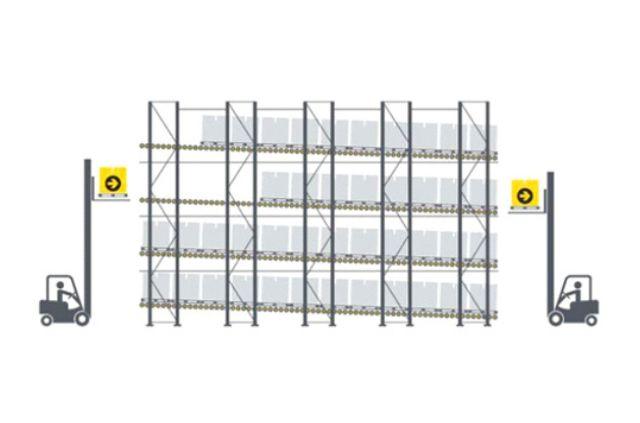
What is a FIFO Conveyor System?

A First In, First Out (FIFO) conveyor stores and moves product in the order it arrives. Product is loaded at the infeed end, travels straight through the lane, and is taken off at the outfeed end. Because there is one way in and one way out, the sequence cannot change on the way through.

The lane can be gravity-fed or driven. Gravity lanes sit on a slope and use braked rollers to control the descent. Driven lanes use powered rollers and are chosen where the product is heavy or fragile, or where a gradient is not practical. Pallets, totes and cartons are the usual loads.

Common Applications

First In First Out (FIFO) Conveyor Systems

FIFO or LIFO?

The alternative to FIFO is LIFO — last in, first out — where product is loaded and unloaded from the same end. LIFO lanes are simpler and use less floor space, because they only need access on one side.

The trade-off is rotation. In a LIFO lane the newest item is always nearest the front, so the oldest can sit at the back indefinitely. That is fine for product with no shelf life and no batch order to maintain. Where date order or batch order matters, the lane has to be FIFO, because the sequence is then enforced by the layout rather than by procedure.

What FIFO costs is space and access. It needs an infeed at one end and an outfeed at the other, which usually means two aisles rather than one. That is worth settling at layout stage, since it is difficult to change once the lane is installed.

Key Considerations for FIFO Conveyors

A FIFO lane is a simple idea that gets awkward at the extremes. Too long and product at the back takes too long to reach the outfeed. Too steep and it arrives faster than the outfeed can take it. Too shallow and the lightest loads stop moving altogether. Most of the specification work is balancing lane length against how the product actually behaves on it.

What Decides the Specification

Common Questions

What does FIFO mean on a conveyor? First in, first out. Product leaves the lane in the same order it entered, because the lane is loaded at one end and unloaded at the other.

What is the difference between FIFO and accumulation? FIFO is about order; accumulation is about buffering. A FIFO lane does accumulate product, but not every accumulation conveyor preserves the order it came in.

Does a FIFO lane need power? Not necessarily. A gravity lane uses a gradient and braked rollers instead of a drive. Power is needed where the product is too heavy or too delicate to run on a slope, or where the floor has to stay level.

How long can a FIFO lane be? Long enough is set by the buffer you need; too long is set by the product. On a gravity lane a longer run means more rollers for the load to overcome and more variation between the first and last item, so length and gradient have to be worked out together.

Can pallets and totes share the same lane? Usually not. Roller pitch and lane width are set by the footprint of the load, and a tote that is short enough to fall between rollers pitched for pallets will not run. Mixed loads normally mean separate lanes.

How do I know what capacity to specify? Work back from the outfeed. How long can the process at that end be stopped, and how much product arrives in that time? That is the buffer the lane has to hold.

Where do you cover? We are based in Finglas, Dublin 11 and work with manufacturers across Ireland.

Let's Connect

Have a question about our conveyor systems or need a tailored automation solution for your business? Our team at LVP Automation is here to help. Fill out the form below with your details, and we’ll get back to you as soon as possible. Whether you need a quote, technical support, or more information on our products, we’re ready to assist.

Need more help?

Free Consultation

+353 1 864 3838