The question usually arrives as “turntable or rotary arm”. That is the third decision, not the first, and answering it early is how operations end up with a machine that wraps well but does not fit the way pallets actually move through the building.
This guide takes the decisions in the order that matters: what level of operator involvement the operation needs, how the pallet and film should move relative to each other, and the specification details that decide running cost and performance. If you are still deciding whether to automate wrapping at all, that is covered in five signs your operation is ready.
What the machine is actually doing
A wrapper applies film to a load at a controlled tension, in a controlled pattern, the same way every time. What it is producing is containment force, which is wrapping force multiplied by the number of film layers, and that is what holds a load together in transit.
Everything that follows is a means to that end. The machine type decides how the film gets around the load. The film delivery system decides how much film it takes to get there. The controls decide whether it happens identically on every pallet.
Decision one: how much operator involvement
Semi-automatic
The operator brings the pallet to the machine on a truck, starts the cycle, and cuts or secures the film at the end. The machine does the wrapping.
This is a standalone purchase. It needs floor space and power, it can usually be running within a day of delivery, and it can be moved later. For most operations wrapping in the tens of pallets a day, it is the right answer, and the capital difference against a fully automatic line is substantial.
Fully automatic
Pallets arrive and leave by conveyor. The machine detects the load, wraps it, and cuts and clamps the film without anyone touching it.
The important thing to understand is that this is not simply a better machine. It is an integration project: it needs pallet conveyor in and out, controls that talk to whatever feeds it, space for accumulation either side, and a decision about what happens when something downstream stops. The wrapper is often the smaller part of that cost.
The step is worth taking when wrapping has become the constraint on dispatch, when the operation runs shifts where nobody is available to load a machine, or when palletising upstream is already automated and the pallet has no reason to be touched.
Decision two: how the pallet and film move
Turntable wrappers
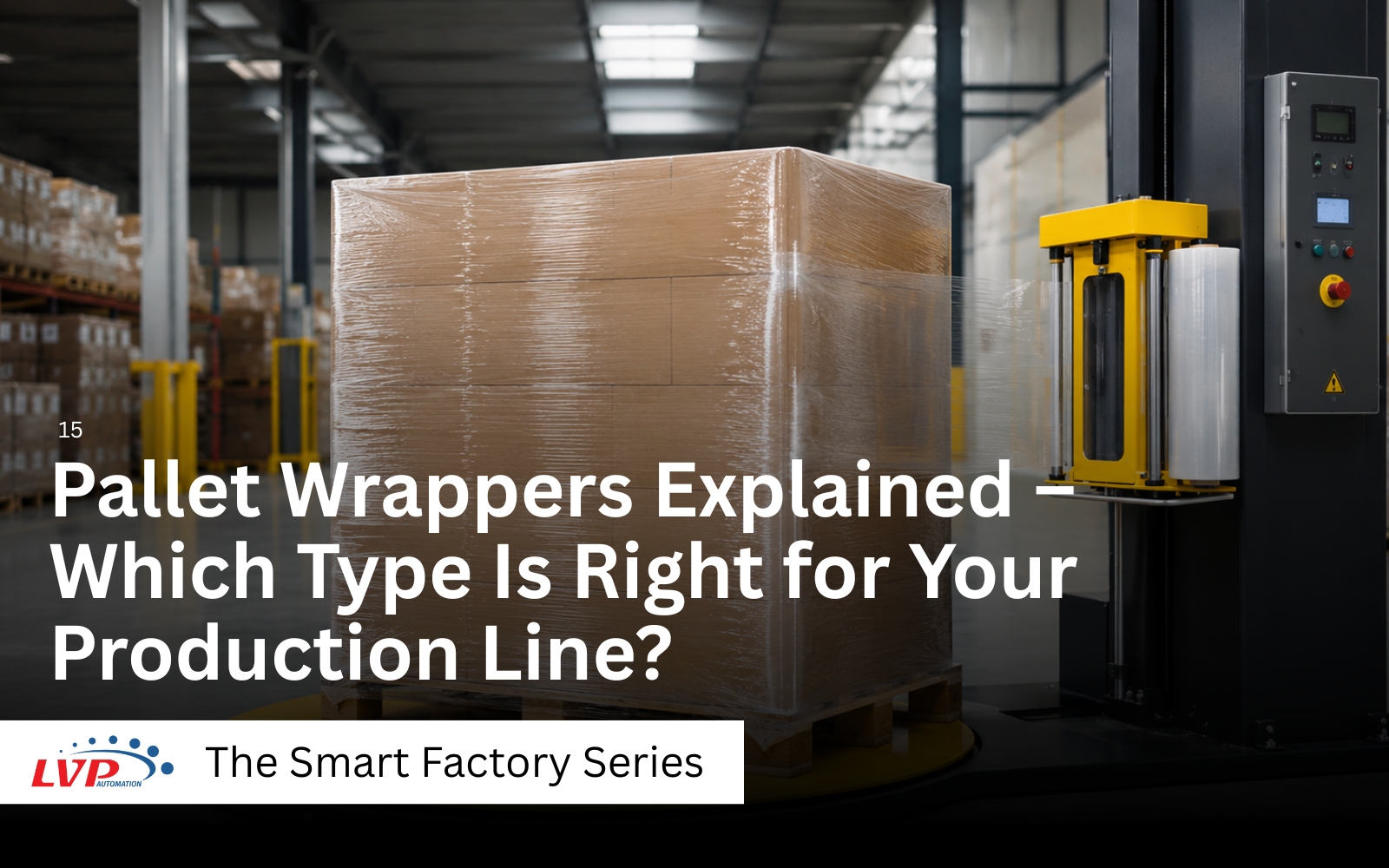
The pallet sits on a turntable and rotates while the film carriage travels up and down a mast. It is the most common configuration, the most compact, and the least expensive.
Its limitation follows directly from how it works: the load is being accelerated, rotated and stopped. Loads that are light, tall, top-heavy, fragile or poorly built can shift on the table, and the machine has to be slowed to keep them stable, which erodes the throughput advantage. Turntable machines are generally quoted in the region of up to forty loads per hour, and stable, evenly distributed pallets are where they perform best.
The turntable also has to carry and turn the full pallet weight, so load weight is a real specification limit rather than a detail.
Rotary arm wrappers
The pallet stays still and an arm carrying the film carriage rotates around it. Because nothing accelerates the load, the constraints that limit a turntable largely disappear.
That makes rotary arm machines the answer for unstable, light, tall or fragile loads, and for heavy pallets that a turntable would struggle to turn. They also run faster, because arm speed is not limited by whether the product will stay where it was put.
The cost is space. A rotary arm needs floor area for the arm to sweep, clearance around it, and height above the tallest load. On a retrofit into an existing building, that clearance is often the deciding factor rather than the price.
Orbital wrappers
A different machine for a different problem. Orbital wrappers pass a long product through a rotating ring, wrapping along its length rather than around a pallet. They suit profiles, timber, pipe, doors, panels and furniture, where the item is long and the pallet is not the thing being secured.
If your product is long and awkward rather than cubic, this is the category to look at, and comparing it against pallet wrappers is comparing two different jobs.
Matching type to operation
| Operation | Usually points to |
|---|---|
| Low volume, stable pallets, tight floor space | Semi-automatic turntable |
| Light, tall, fragile or unstable loads | Rotary arm |
| Heavy pallets a turntable would struggle to rotate | Rotary arm |
| Wrapping is limiting dispatch, or shifts run unattended | Fully automatic, conveyor-fed |
| Palletising upstream is already automated | Fully automatic, integrated |
| Long products rather than cubic pallets | Orbital |
| Very mixed load types on one machine | Rotary arm with multiple programmes |
The specification details that decide cost and performance
Film delivery and pre-stretch
This is the largest running-cost variable and the one most often left as a line on a quotation. A powered pre-stretch carriage stretches film mechanically before it reaches the load, typically in the range of 150 to 300 per cent, so each metre off the roll covers two and a half to four metres of pallet. Machines without powered pre-stretch use considerably more film for the same result.
Over the life of a machine, the difference in film consumption frequently outweighs the difference in purchase price. It is worth pricing the two together rather than separately.
Containment force, not number of turns
Specify the outcome rather than the method. Two machines applying the same number of wraps can produce very different containment forces, and a load that travels by road and sea with several handling points needs more than one going across town. Establishing what your loads actually need makes it possible to compare machines on something real.
Load pattern and film placement
Where the film goes matters as much as how much of it there is. Reinforcing the top layers, tying the load to the pallet at the base, and adjusting the pattern for different products are all programme decisions, and the range of programmes a machine supports is what determines whether one machine can handle a mixed product range.
How pallets arrive and leave
Hand pallet truck, forklift or conveyor. This decides whether you are buying a machine or specifying a system, and it is the single question that most often changes the shape of a quotation.
Common questions
At what volume does fully automatic start to make sense?
Less a volume threshold than a question of whether an operator can keep up without wrapping becoming the queue. Where pallets wait to be wrapped while the line keeps producing, or where shifts run without someone free to load a machine, the case is usually there. Below that, a semi-automatic machine achieves the same wrap quality for a fraction of the investment.
Can one machine handle very different load types?
Often, through multiple stored programmes, but the machine has to be specified for the most difficult load rather than the typical one. An operation that is mostly stable pallets with a minority of light unstable ones is usually a rotary arm application, because the minority is what sets the requirement.
Do we need a conveyor?
Only for a fully automatic installation. A semi-automatic machine works with a pallet truck or forklift. Where a conveyor is needed, it is worth designing in buffer either side, so a stoppage downstream does not immediately back up into wrapping.
Does the environment affect the choice?
Yes, and it is easy to overlook. Film behaves differently at low temperatures, so cold store applications need the film and the settings specified for it. Washdown environments and dusty or wet storage bring their own requirements, including whether a top sheet is needed to cover the load. These belong in the enquiry rather than being discovered at commissioning.
How does wrapping relate to strapping?
They solve different problems and are often used together. Film contains a load; strapping secures it to the pallet or holds heavy items that film alone will not restrain. Which you need depends on the product and the journey.
Where wrapping sits
Wrapping is one step in an end-of-line sequence that runs from palletising through wrapping and labelling to dispatch. Decisions at one step constrain the others, which is why it is worth looking at the sequence rather than the machine, particularly if palletising is also under review. If the question is whether the investment stacks up, our guide to building an automation business case sets out how to work it through.
LVP Automation supplies pallet wrappers, strappers and wrappers and integrated end-of-line systems for manufacturers and logistics operations across Ireland, as part of our wider automation services. Tell us what your loads look like and how many you ship, and we will tell you which type suits.