A robot palletiser is one arm, a gripper and a stacking pattern. That is genuinely all it is, and it is why the technology has aged so well. The interesting part is not the robot. It is the three decisions around it that decide whether a cell runs at the rate you were quoted or sits at two thirds of it, and those decisions get made before anyone orders anything.
This guide covers the industrial robot cell specifically. If you are still deciding what type of palletiser you need at all, start with how to choose a palletiser, which works through the question in order. If you already know you want something that works beside people without fencing, read what a cobot palletiser is instead.
What an industrial robot palletiser actually is
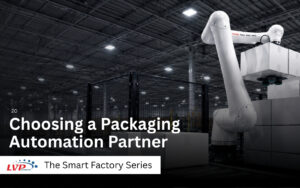
A jointed arm sits at the end of your line, picks cases off an infeed conveyor and places them onto a pallet in a programmed pattern. When the pallet is full it goes to wrapping or strapping and an empty one takes its place. The arm does not know what it is handling in any meaningful sense. It knows where the case will arrive, where the pallet is, and where case number forty-three belongs in the stack.
That predictability is the whole advantage. Because the robot decides where every case goes, it always knows where every case is. Nothing has to be worked out on the fly. Compare that with the inbound side of a building, where pallets arrive built to somebody else’s standard, and you can see why palletising is usually the more straightforward automation project of the two.
The Okura A Series, model by model
The industrial robot palletisers we supply are built around the Okura A Series, a four axis multi articulated polar coordinate robot in four versions. The differences are narrower than you might expect.
The A700V, A1600V and A1800V all carry 140 kg. The A1800V-W carries 350 kg, which is where you go for heavy cases or full layer tooling. Rated handling is 700 cycles an hour on the A700V, 1,600 on the A1600V, 1,800 on the A1800V and 500 on the heavy payload A1800V-W.
Reach is shared across the range apart from the vertical. D-axis is 2,300 mm, T-axis sweeps 440 degrees and the R-axis turns a full 360 degrees, which is the specification that matters most in practice: it is what lets a single arm serve up to six pallet positions. The O-axis is 1,518 mm on three models and 1,750 mm on the A700V. Power is 6.5 kVA, or 2.5 kVA on the A700V, and all four are rated 0 to 40 C at 35 to 85 per cent relative humidity.
Okura say two things in their own literature that are worth repeating, because both get glossed over in sales conversations. The handling rate depends on layout and on the hand. And maximum payload is not the same thing as capacity.
Why the gripper decides whether the cell works
If a palletising cell disappoints, the gripper is the first place to look, not the robot. Grip is the only point where the machine touches your product, and it is the part most often specified against a photograph of neat cardboard cases rather than against what actually comes down the line on a wet Friday.
Vacuum suits sealed cartons and smooth trays. Clamp tooling suits crates, totes and anything that will not hold vacuum. Fork and blade tooling handles bags and sacks. Combination heads take a mixed case list on one arm. Full layer tooling lifts an entire tier at once, and that is where the higher throughput figures in any brochure come from.
The rule we work to is that tooling gets specified against the worst packaging you run, not the best. A cell tuned around your strongest case will crush your weakest one, and the first instinct when that happens is usually to slow everything down, which costs you the throughput you bought the robot for.
Patterns are software, not tooling
This is the part most people are surprised by. Changing from one case size to another is not a mechanical changeover. Patterns are built in the cell palletising software and stored as recipes, so each case size and pallet type has its own programme and an operator selects it from the screen.
On Okura cells that software is OXPA, running on the Gen V controller with an 8.4 inch touch screen and an integrated SICK safety PLC. The controller handles up to six axes and comes as an RC810 or RC820 in either JIS or CE panel versions. Stacking programmes, pattern edits and diagnostics are all done at the cell.
That last point has a commercial consequence worth stating plainly. If day to day pattern changes can be made by your own people at the machine, you are not paying for a call-out every time you add a case size. If they cannot, you are. It is a fair question to ask any supplier before you sign.
What really sets your throughput
Rated cycles an hour tell you what the arm can do. They do not tell you what your cell will do.
In practice, single pick rates land somewhere around 8 to 20 picks a minute depending on case weight, grip and the distance the arm travels. Multi pick and full layer tooling go higher. Both numbers matter, and the gap between them is almost entirely layout.
A shorter path is worth more than a faster robot. Moving the infeed two metres closer will usually buy you more cases an hour than stepping up a model, and it costs a great deal less. This is why we ask for a target throughput rather than a model number at the start of a conversation. The model falls out of the layout, not the other way round.
The other constraint is almost never the arm. A cell that can build 20 cases a minute feeding a lane that only clears 12 is a 12 case a minute cell with an expensive robot on the front. The wrapper, the conveyor and the pallet transfer need sizing at the same time as the robot, not after it.
Guarding, footprint and the floor space question
An industrial arm moves fast and carries real weight, so it runs inside guarding. That is the honest trade against a collaborative cell, and it is usually the thing that decides the answer for a tight factory floor.
Compact cells are possible. The footprint depends on pallet infeed and outfeed, slip sheet stations and conveyor layout rather than on the robot itself, which is why a layout drawing comes before any commitment and, where the job warrants it, a simulation before that.
Where a single arm is not the right shape, the SA-F Series twin cell is the alternative we supply. Published figures are a maximum load of 50 kg including the gripper and up to 15 cycles a minute depending on load and pallet matrix. It takes EURO 1200 x 800 mm and UK, CHEP and industry 1200 x 1000 mm pallets to a maximum build height of 2,000 mm. Services are 24V DC control, 400V 50Hz three phase with neutral and earth, and a minimum of 6 bar clean dry air with a local isolation valve.
Industrial robot, cobot or layer palletiser?
Three honest distinctions, and none of them is about preference.
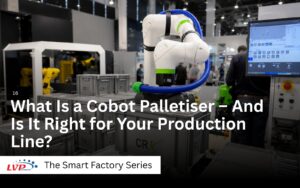
A cobot cell works beside people without full fencing. Our cobot palletiser handles 10 kg including the gripper at 5 cycles a minute in collaborative mode or 10 in robot mode, to a 1,500 mm build height. If your cases are light and the rate is modest, this is usually the cheaper and simpler answer, and the lack of guarding is often worth more than the speed you give up.
An industrial robot cell carries far more, builds higher and runs faster, at the cost of guarding and the floor space that goes with it. It is the right answer when case weight or required rate rules the cobot out.
A layer palletiser is a different machine entirely. It builds a full tier at a time mechanically rather than placing cases individually, and on high volume single format work it will beat a robot comfortably. It is less flexible when your case list changes often.
Case weight, required build height and throughput decide it between them. If you want to work through it properly, our guide to choosing the right palletiser takes the questions in the order that actually matters.
What to have ready before you enquire
The conversation goes faster, and the quote comes back more accurate, if you can bring the following.
- Your case list with real dimensions and weights, including the worst packaging you run, not just the standard one
- A target throughput in cases per minute or pallets per hour, rather than a robot model
- Pallet types and the maximum build height you need
- A layout drawing or a measured sketch of the space, with the infeed position marked
- What happens immediately downstream, whether that is wrapping, strapping or straight to despatch
- How often your case list changes, since that is what decides how much the pattern flexibility is worth
Common questions
How fast can a robot palletiser actually run? Rated cycles are 700 to 1,800 an hour depending on model. Real single pick rates are usually 8 to 20 picks a minute, with layer tooling higher. Layout moves that number more than the robot does.
Can one robot serve more than one line? Yes. The 360 degree R-axis lets a single arm serve up to six pallet positions, which is what makes multi-line palletising practical without buying a second robot.
Can it build mixed pallets? Yes. Vision and pattern software identify each case and coordinate the placing order, so several SKUs can go onto one pallet or be sorted to separate pallets.
How much floor space do I need? It depends on pallet infeed and outfeed, slip sheet stations and conveyor layout rather than on the arm. That is a layout drawing question, and it is worth doing properly before committing.
What maintenance does it need? Industrial palletising robots are mature technology with few consumable parts. The gripper and any vacuum generation are the items that see wear, because they are the parts doing the work on your product.
Talk to us about palletising
LVP Automation supply robotic palletising cells built around Okura and Fanuc robots depending on the application, and we size them from your throughput and your layout rather than from a catalogue. If you want to see the full specification first, the industrial robot palletisers page carries the model by model detail and both brochures.