Very few manufacturers set out to buy a cobot palletiser. They set out to solve a problem: an operator has left and the role is hard to fill, the line runs faster than the end of it can cope with, or a safety review has put manual palletising on a list.
This covers what a cobot palletiser actually is, how one works, the five situations where it is usually the right answer, and the cases where a conventional fenced robot remains the better choice.
What a cobot palletiser is
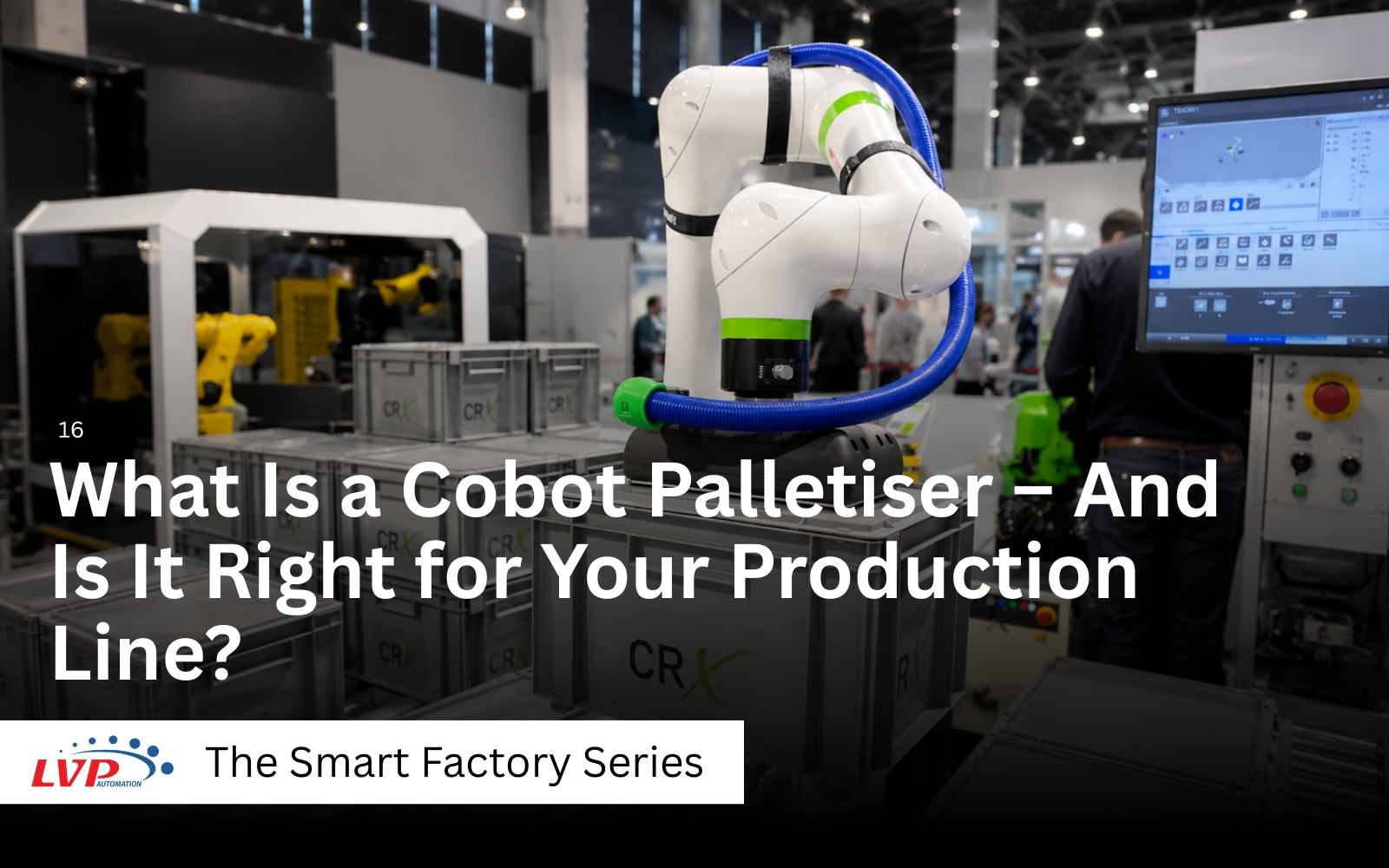
A collaborative robot mounted at the end of a line, taking cases, trays or bundles off a conveyor and building a pallet to a taught pattern. What separates it from a conventional palletising cell is that it is designed to work in the same space as people, using force sensing, speed control and safety scanners to slow or stop when someone is close.
LVP Automation’s CPF-10 Series is built on the FANUC CRX-10iA/L collaborative robot, which lets an operator step in to swap a completed pallet without shutting down the line.
One point worth being precise about, because it is widely misunderstood: a robot is not collaborative in itself. Safety is a property of the application, assessed for the specific cell, and it depends on speed, payload, the tooling and what is being handled. ISO 10218, the industrial robot safety standard, was revised in 2025 and the collaborative requirements that previously sat in the separate technical specification ISO/TS 15066 are now part of the standard itself. A cobot handling a heavy or sharp product at speed can still require guarding.
How one works
Grippers
Vacuum, mechanical or hybrid, chosen by what the product is. Vacuum suits sealed cases with a clean flat top; mechanical suits bags, trays and anything vacuum cannot hold; hybrid tooling covers a range where a single method will not. Multi-pick tooling takes more than one item per cycle, which is the main way throughput is raised without increasing robot speed.
Pattern programming
Patterns are created on a teach pendant rather than written as code, so an operator can build a new one without specialist programming. This matters more than it sounds: on a line with frequent SKU changes, the cost of automation is usually changeover time rather than cycle time, and a pattern that takes minutes to set up rather than a service call is what makes a mixed-product line viable.
Single or twin station
A single station stops while a full pallet is removed and an empty one positioned. A twin station lets the robot keep building on one side while the operator clears the other, which removes that stoppage from the cycle. On a line running continuously, that difference is usually what decides between the two.
Speed and safety monitoring
Scanners monitor the working area. With someone nearby the robot runs at collaborative speed; when the area is clear it can move to industrial speed. That gives a genuinely useful middle ground, though it also means quoted throughput depends on how often people are actually in the area.
CPF-10 specification
- Compatible with EURO and UK/CHEP pallets
- Up to 10 kg payload per cycle
- Up to 5 cycles per minute in collaborative mode
- Up to 10 cycles per minute in industrial mode
- Maximum pallet height 1,500 mm
Those four numbers are the ones to check your application against first. Case weight above ten kilos, a sustained rate above ten cycles a minute, or a required pallet height beyond 1,500 mm all point towards a conventional palletiser instead.
Five signs your line is ready for one
1. Manual palletising is producing injuries or near misses
Palletising by hand is repetitive lifting between floor level and above shoulder height, at pace, for a full shift. In Ireland, manual handling duties sit under the Safety, Health and Welfare at Work (General Application) Regulations 2007, which are built on risk assessment and on avoiding hazardous manual handling where reasonably practicable. Palletising is the kind of task that assessment tends to flag, and near misses are the signal that arrives before the claim does.
2. The line has outgrown the people available to run it
Where output has increased but the end of the line has not, palletising becomes the queue. The same applies when a role cannot be filled: an operation that only works when a specific person is present is carrying a risk that has nothing to do with throughput.
3. Product changeovers are frequent
This is the sign that points specifically at a cobot rather than at automation generally. A conventional cell handles changeovers through programming and sometimes tooling changes. A cobot palletiser is designed for an operator to add a pattern themselves, so a line running many SKUs in short runs suits it better than a faster machine would.
4. There is no floor space for a fenced cell
A guarded robot cell needs the robot envelope plus fencing, access gates and safe clearance around it. Where that space does not exist without moving something else, a collaborative installation that works in the footprint already available is frequently the only practical option.
5. Manual palletising runs across multiple shifts
The case strengthens with every shift the task is performed on, because both the exposure and the labour hours multiply. An operation palletising by hand on two or three shifts is usually well past the point where the numbers work.
Cobot or conventional industrial robot?
They are not competitors so much as answers to different questions. Payload and sustained rate decide it more than anything else.
| Cobot palletiser | Fenced industrial robot | |
|---|---|---|
| Footprint | Fits within an existing line | Robot envelope plus fencing and access |
| Guarding | Scanners; fencing optional for full-speed running | Full guarding required |
| Payload | Up to 10 kg per cycle (CPF-10) | Well beyond, into full layers and pallets |
| Rate | Up to 10 cycles per minute | Considerably higher |
| Programming | Teach pendant, operator-led | Usually specialist |
| Changeovers | Minutes, done in-house | Longer, often supported |
| Suits | Mixed products, tight space, moderate rate | High volume, heavy cases, stable product mix |
The wider comparison across conventional, layer, robotic and collaborative palletising is covered in choosing the right palletiser.
Where a cobot palletiser is the wrong answer
Case weight is the first limit and the least negotiable. A product above the payload is simply a different machine, and multi-pick tooling makes that arithmetic tighter rather than looser because the gripper carries several at once.
Sustained high rate is the second. Collaborative operation is slower by design, and a line that needs full industrial speed all day is not getting the benefit that justifies the format.
The third is products that cannot be gripped reliably. Loose bags that deform, unsealed trays, wet or dusty surfaces that defeat vacuum, and cases with inconsistent print or flap alignment all need to be tested rather than assumed. A proof of concept on the actual product settles that before anything is ordered.
What to have ready before you enquire
Five things shorten the conversation considerably: case weight and dimensions, cases per minute at peak rather than average, pallet type and the height you need to build to, how many different patterns are involved, and how pallets arrive and leave the cell. That last one determines whether you are buying a machine or specifying a system with pallet conveyor around it.
Common questions
Do we need safety fencing?
Not necessarily. The CPF-10 can operate using safety scanners alone. Fencing is available and is worth having where you want the robot running in full industrial mode, since it can then switch to higher speed automatically when the area is clear. The decision comes out of the risk assessment for your specific cell rather than from the robot itself.
Can operators reprogram it for new products?
Yes. The FANUC CRX teach pendant is designed for pattern creation and editing without specialist programming, which is the main reason the format suits lines with frequent changeovers.
How long does installation take?
Shorter than a fenced cell, because there is no guarding design, no access-gate interlocking and far less civil work. The project still runs through application review, system design, manufacture, installation, commissioning and operator handover, and the lead time usually sits in the manufacturing stage rather than in the installation itself.
What maintenance does it need?
The CPF-10 Series is designed for straightforward maintenance and cleaning, and the FANUC CRX is a low-maintenance robot. The parts that need attention in service are the ones that touch product: grippers, vacuum cups and seals wear with use, and keeping spares of those matters more than anything on the robot.
Can one cobot serve more than one line?
Sometimes, where two lines converge or the rates are low enough that one cell can absorb both. More often the answer is to bring product together on conveyor and palletise at a single point, because moving the robot between positions costs more time than it saves.
Where it fits at end of line
Palletising sits between production and dispatch, with wrapping after it and often depalletising at the other end of the building. A change at one point moves the constraint to another, so it is worth looking at the sequence: our guides to automated palletising systems, pallet wrappers and when to automate wrapping cover the neighbouring decisions. If the question is whether the investment stands up, building an automation business case sets out how to work it through.
LVP Automation supplies and integrates cobot palletisers and industrial robots and cobots for manufacturers and logistics operations across Ireland, as part of our wider automation services. Tell us your case weight, rate and pallet height, and we will tell you whether a cobot is the right fit.