A carton is the last thing that happens to a product before it goes into a case, and for some products it is a regulated item rather than packaging. That makes cartoner selection unusually consequential: the machine sets your line speed, your changeover time, and in regulated sectors, whether the pack is compliant at all.
This guide takes the decisions in the order they should be made, covers what actually limits a cartoner once it is running, and sets out what changes if you make prescription medicines.
What a cartoning machine does
Three operations, in sequence: it erects a flat carton blank into a box, loads the product into it, and closes it. Everything else, including every difference between machine types, is a variation on how those three are performed and in what orientation.
That framing helps, because it makes clear where problems come from. Most cartoner faults are not the machine failing to do its job; they are blanks that do not erect squarely, product arriving out of position, or a closure that does not hold.
The decisions, in order
How the product goes in
End-load machines push the product in through the open end of a carton lying horizontally. Top-load machines drop or place it into a carton stood open at the top.
End-loading suits products that slide cleanly and are reasonably rigid: tubes, blister packs, cartridges, bottles in a sleeve. Top-loading suits products that are fragile, awkwardly shaped, or need to be placed rather than pushed, and it is the natural choice where a robot is doing the loading. This decision comes first because it constrains everything after it.
Machine orientation
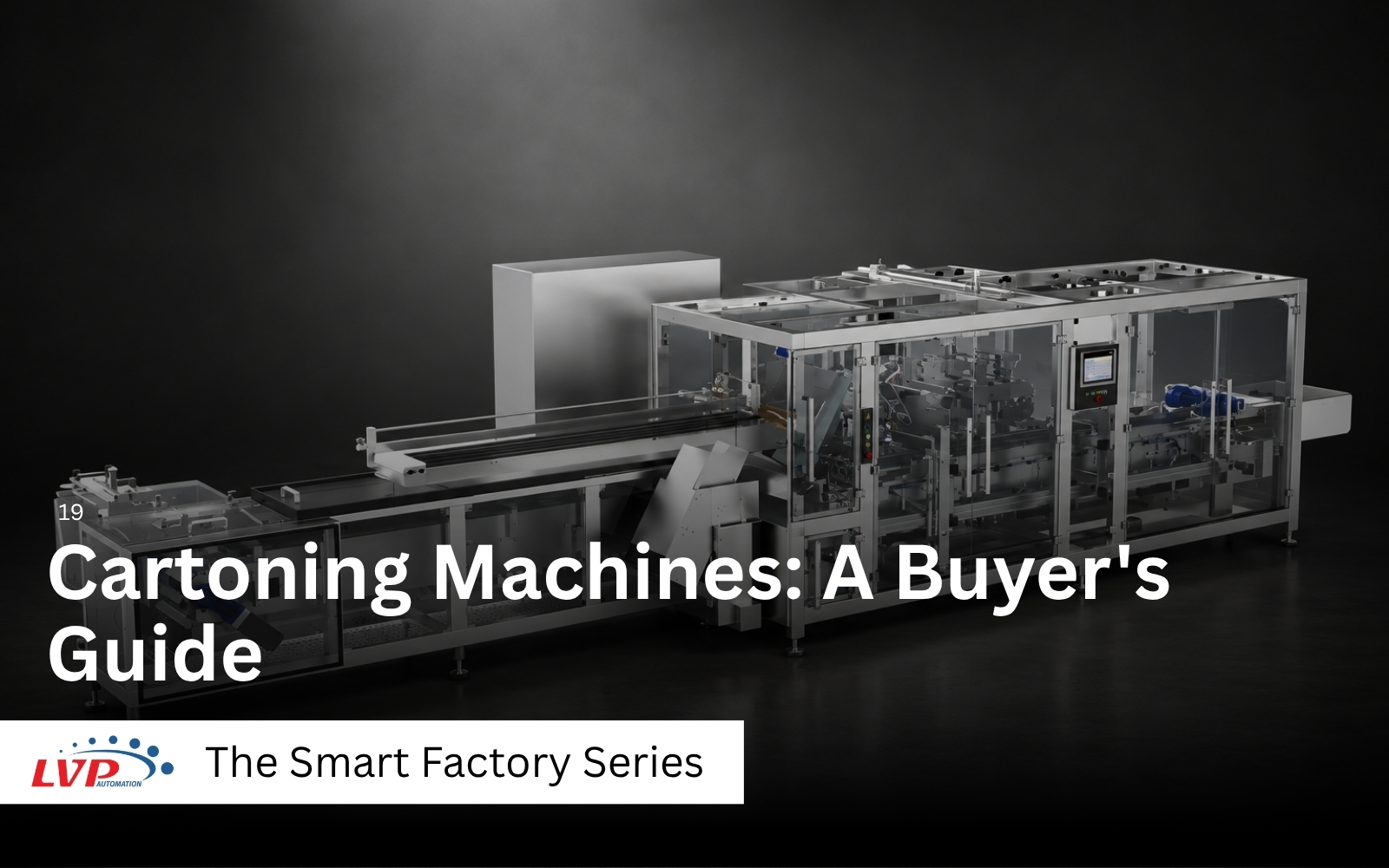
Horizontal cartoners run the carton along the machine on its side and are the most common configuration for end-loading at speed. Vertical cartoners handle the carton upright, which suits top-loading and products that must stay the right way up, including anything that could settle or spill.
Our own cartoning machines are horizontal side-load units for pre-glued cartons, which covers the majority of pharmaceutical, personal care and food applications.
Motion type
This is the decision that sets your ceiling on speed, and it is the one most often missed in a first specification.
An intermittent-motion machine stops the carton at each station, performs the operation, then advances. It is mechanically simpler, gentler on product, and easier to set up, and it suits lower and moderate speeds. A continuous-motion machine keeps the carton moving while operations happen around it, which removes the start-stop cycle and allows considerably higher rates. Multiple-pitch machines sit between the two, advancing several cartons per cycle.
Because the difference is architectural rather than a setting, a machine bought on intermittent motion cannot later be pushed to continuous-motion speeds. Specify against the rate you will need in a few years, not this year.
Level of automation
Semi-automatic machines erect and close while an operator loads. They suit low volumes, high variety and short runs, and they are a reasonable way to remove the hardest part of manual cartoning without committing to a full line. Fully automatic machines take product from upstream and need it presented correctly, which usually means indexing and accumulation designed alongside the cartoner rather than after it.
What actually limits a cartoner in service
Carton blank quality
The most underestimated variable on the list. Blanks that vary in board weight, are cut or scored inconsistently, or have absorbed moisture in storage will not erect squarely, and a carton that is out of square jams downstream rather than at the point of failure. Machine suppliers specify board and tolerance for a reason, and a cheaper carton that costs you uptime is not cheaper. Agree the spec with your carton supplier and the machine supplier together.
Changeover time, measured properly
Ask for changeover time and you will be told a number. Ask how it is measured and the number often changes. What matters is line-stop to first good carton, performed by your operator rather than by a commissioning engineer, including any adjustment needed to get the first cartons running cleanly. On a line with frequent format changes that figure affects output more than the headline speed does.
Leaflet and insert feeding
If your product carries a leaflet, this is where downtime concentrates. Leaflets vary in paper weight and folding, static builds up, and a misfeed either stops the machine or produces a pack that fails inspection. Test with your actual leaflets, folded as they will be supplied, rather than with samples.
Reject handling
Decide what happens to a carton that fails a check before you buy, not after. Where rejects go, whether the line stops or continues, whether a rejected carton can be reworked, and whether anyone is notified are all design decisions. A reject station that fills up unnoticed is a common way to lose a shift.
If you make prescription medicines
The carton is where compliance happens, which makes the cartoner a regulated piece of equipment rather than a packaging machine.
Under the Falsified Medicines Directive and its delegated regulation, most prescription medicine packs placed on the EU market have required two safety features since February 2019: an anti-tamper device, and a unique identifier carried in a 2D barcode containing product code, serial number, batch and expiry. In Ireland, packs are verified against the Irish Medicines Verification Organisation system before supply.
For the machine, that means several things at once. The closure has to be tamper-evident. The unique identifier has to be printed and then verified by vision on the same pass, since an unreadable code is a failed pack. Serial numbers have to be managed so that a rejected carton does not leave a live serial unaccounted for, and aggregation to case and pallet has to be handled if your customers require it. Coding and marking is part of the specification rather than an accessory.
Raise this at the enquiry stage. Retrofitting serialisation to a machine that was not specified for it is one of the more expensive corrections in packaging.
Questions worth answering before you enquire
- Product dimensions, weight and rigidity across your full range, not just the main line
- Cartons per minute at peak, and what the rate needs to be in three to five years
- Number of carton formats and how often you change between them
- Whether leaflets, inserts or coupons are involved
- Closure method required: glue, tuck or tamper-evident
- Floor space including maintenance access, not just machine footprint
- What feeds the cartoner and what takes cartons away
That last one decides whether you are buying a machine or specifying a line. A cartoner bought in isolation frequently becomes the constraint on an otherwise balanced line, which is the single most common mistake in this category.
Common questions
How do we work out the speed we actually need?
From peak output rather than average, and with allowance for the time the line is not running. A machine sized on average daily volume will be short on the days that matter. It is also worth checking the rate against the slowest machine on the line, since buying a faster cartoner than the filler can supply achieves nothing.
What happens to product when the cartoner stops?
Whatever you designed for. Without buffering, an upstream process has to stop with it, and on a line with a filler or a sealer that can mean scrap rather than just lost time. Accumulation either side of the cartoner is usually the cheapest availability you can buy.
Do we need case packing and palletising as well?
Not necessarily at the same time, but the sequence should be planned together. Cartons then go into cases and onto pallets, and automating the cartoner alone often just relocates the manual work. Our guide to automated palletising covers the end of that sequence.
Should we buy for today’s output or for growth?
For where you are heading, within reason. Motion type in particular cannot be changed later, so the cost of under-specifying is a replacement machine rather than an upgrade. Where future volume is genuinely uncertain, simulation lets you test scenarios against real data before committing.
Where the cartoner sits
Cartoning sits between primary packaging and secondary packaging, connected by conveyor to whatever fills or forms the product and to case packing and palletising after it. Specifying it as part of that sequence, rather than on its own, is what keeps the line balanced. If you are also evaluating suppliers, our guide to choosing a packaging automation partner covers the questions worth asking, and building an automation business case covers the numbers.
LVP Automation supplies and integrates cartoning machines, tray sealers and complete packaging lines for manufacturers across Ireland, as part of our wider automation services. Tell us what you are cartoning and at what rate, and we will tell you what fits.