Automated Picking – Max Series

Heavy-duty automated picking for high-volume warehouses. The Max Series combines the modular Flex platform with coordinated swarming to handle case, pallet and fast piece-picking, boosting throughput, accuracy and safety while scaling easily across zones.

Models
Max 1500-L, O2500-L
Maximum payload
Up to 2,500 kg
Robot footprint
From 1,250 x 850 mm
Lifting height
60 mm lift
Endurance
About 7 hours
Zone mapped and missioned before scale-upSpecified, installed and supported from Dublin 11
Heavy loads
Up to 2,500 kg for case and pallet moves
No floor works
Laser SLAM and visual navigation, no reflectors
Scales with peaks
Add robots and aisles without re-engineering
Ireland-wide support
Specification, install and service from Dublin 11

Heavy-duty automated picking explained

What swarming actually does

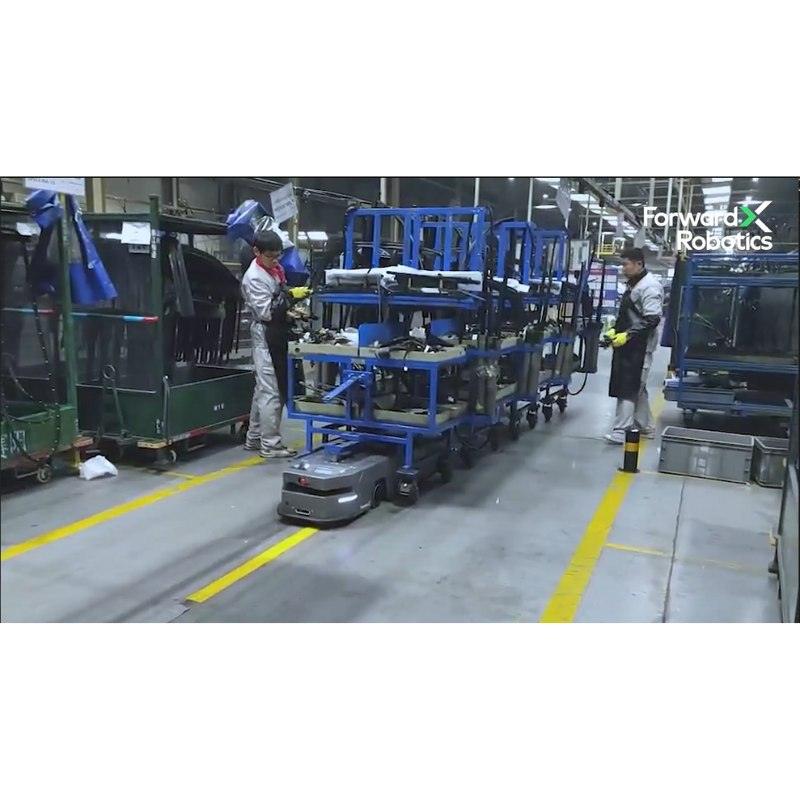
A single robot moving one tote at a time just relocates the bottleneck. Swarming assigns several units to the same wave and reallocates tasks between them as the picture changes, so a slow aisle or a heavy batch does not hold the whole order back. The practical effect is that throughput scales with the number of robots rather than with how fast any one of them can drive.

01

Payload is the dividing line

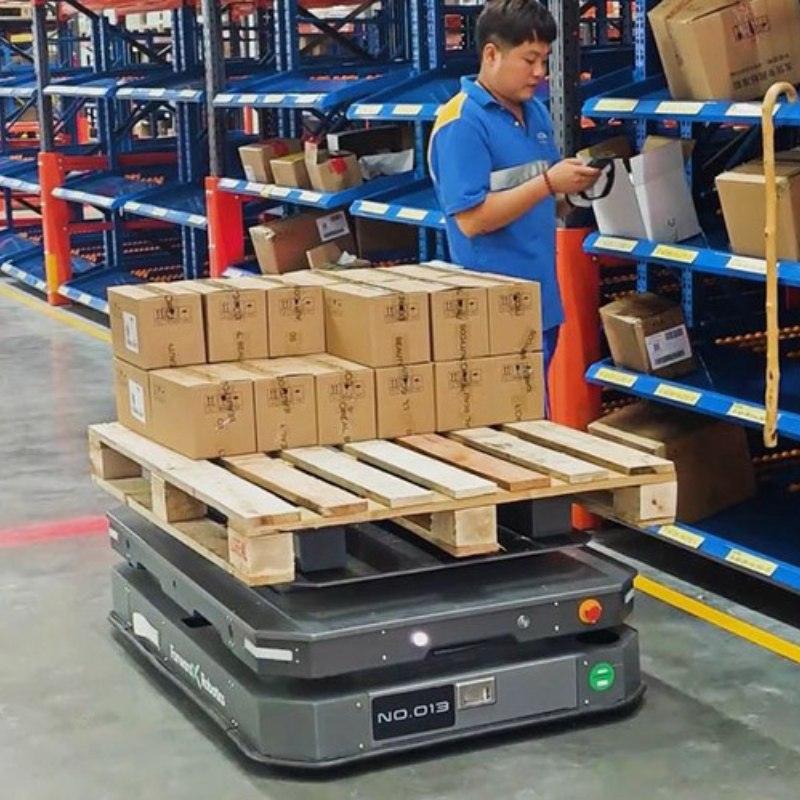
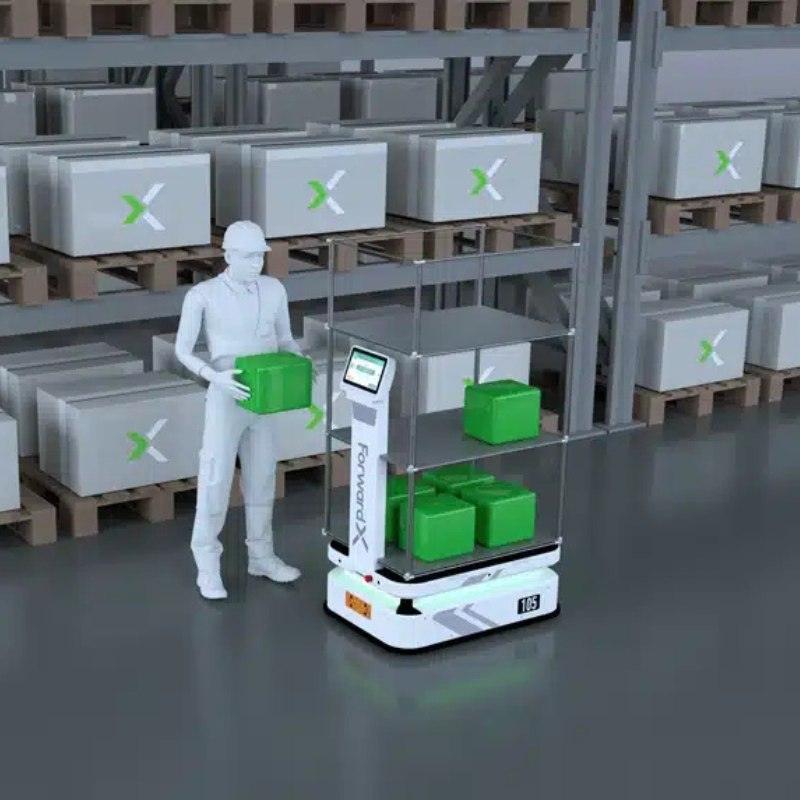
The Max Series exists because case and pallet moves are heavier than tote work. The Max 1500-L carries up to 1,500 kg on a 1,250 x 850 mm footprint with a 60 mm lift, and the Max O2500-L takes up to 2,500 kg, customisable, on a 2,100 x 1,100 mm chassis. If the loads are lighter, the Flex Series covers 300 kg and 600 kg on a smaller footprint and shares the same modules.
02

Navigation without floor infrastructure

Laser SLAM and visual navigation mean no magnets, no reflectors and no tape to cut into the floor. That matters more than it sounds in a leased building or a live warehouse, because it removes the shutdown, the civils and the argument with the landlord. It also means a route change is a mapping job rather than a construction job, which is what makes adding an aisle realistic mid-season.

03

Batteries and uptime

The Max O2500-L runs around seven hours between charges, and the fleet uses DC CC-VC auto-dock opportunity charging between missions rather than scheduled downtime. The fleet manager balances charge cycles across the robots, so the practical question at design stage is not runtime but how many dock positions the layout needs to keep a given number of units working through a shift.

04

Safety in mixed traffic

These aisles usually still have people and manual forklifts in them. Safety-rated LiDAR and vision with dynamic protective fields and zone speed limits meet CE requirements for that mixed traffic, with speed reduced in defined zones rather than relying on everyone staying out of the way. Getting the zone map right is part of the design, not a commissioning afterthought.

05

Talking to your WMS

Integration is by API: orders become missions, and confirmations, exceptions and KPIs come back in real time for dashboards and labour planning. Vision checks item presence and position, and barcode or ID validation and optional weight checks cut mispicks. Fleet orchestration runs on f(x) Fleet Manager, which spans cloud, edge control, a dashboard and a mobile view.

06

Where it sits in the range

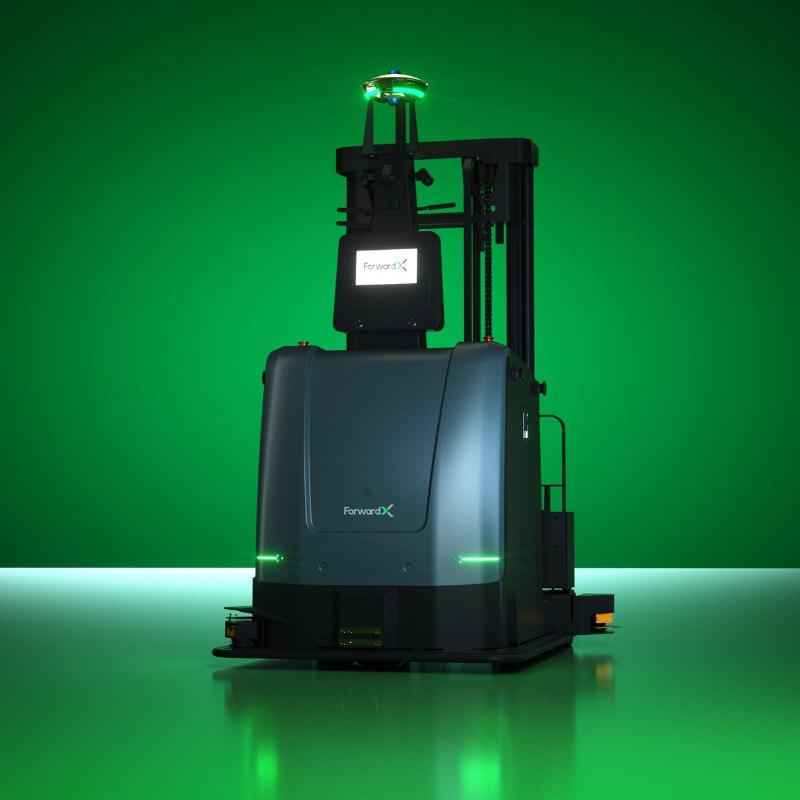
Max is the heavy end of the ForwardX range. The Lynx Series tows rather than lifts, at 1,000 kg and 1,500 kg. The Flex Series handles lighter tote, shelf-lift and tugger work. Where the job is pallets in and out of racking at height, that is the Apex Series autonomous forklifts rather than an AMR.

Deployment, scaling and support

Start with one zone mapped and missioned, then layer in aisles and robots without major infrastructure, including temporary units through a peak. Maintenance is routine checks on wheels, sensors and grippers, plus software updates and remote diagnostics. LVP Automation specifies, integrates and supports warehouse robotics from Finglas, Dublin 11 as part of our wider automation services.

Specification

Models
ForwardX Max 1500-L and Max O2500-L
Maximum payload
1,500 kg on the Max 1500-L and 2,500 kg on the Max O2500-L, customisable
Robot footprint
1,250 x 850 x 245 mm on the Max 1500-L, 2,100 x 1,100 x 310 mm on the Max O2500-L
Lifting height
60 mm lift deck on the Max 1500-L
Endurance
Around 7 hours between charges on the Max O2500-L
Charging
DC CC-VC, auto-dock opportunity charging between missions with fleet-balanced charge cycles
Navigation
Laser SLAM and visual navigation, no floor magnets, reflectors or tape
Connectivity
Wi-Fi, 4G and 5G
Fleet software
f(x) Fleet Manager: f(x) Plus cloud, f(x) Core edge control, f(x) Dashboard and f(x) Mobile
Safety
Safety-rated LiDAR and vision with dynamic protective fields and zone speed limits, CE compliant for mixed traffic

Where the Max Series Excels

Heavy Case & Pallet Picking

Orchestrated robots pull full cases and pallets from reserve or forward pick zones, balancing lanes to hit service levels during peaks.

High-Velocity Piece-Picking

Swarming assigns multiple units to the same batch/wave, share-loading totes or carts and auto-rebalancing to eliminate bottlenecks.

Flexible Layouts & Fast Scale-Up

Start in one aisle, then expand to new zones. Reuse Flex modules (tugger, tote deck, shelf-lift, conveyor-top) to adapt to changing SKUs and routes.

FAQs about Automated Picking – Max Series

Quick answers on payloads, speed, software, safety, scaling and integration.

What makes the Max Series “heavy-duty”?

Higher payload ratings and reinforced modules for consistent performance in case/pallet moves and high-throughput picking.

How does swarming improve throughput?

Multiple robots collaborate on the same orders/waves, dynamically reallocating tasks so no single aisle or picker becomes a bottleneck.

Can Max handle both case and piece-picking?

Yes—configure missions for case/pallet moves and add piece-picking with vision and appropriate end-effectors or tote handling.

How does it integrate with our WMS/WES?

Via APIs: orders → missions, with confirmations, exceptions and KPIs returned in real time for dashboards and labour planning.

What accuracy can we expect?

Vision checks item presence/position; barcode/ID validation and weight checks (optional) reduce mispicks and defects.

Is it safe around people and forklifts?

Yes—safety-rated LiDAR/vision, dynamic protective fields and zone speed limits meet CE requirements for mixed-traffic aisles.

How fast can we deploy?

Pilot zones are mapped and missioned quickly (SLAM). Additional aisles/robots are layered in without major infrastructure.

What about peak seasons?

Add temporary robots, extend missions or enable denser batching. Swarm logic prioritises lanes to protect SLAs.

How are batteries managed?

Auto-dock opportunity charging between missions maintains uptime; the fleet manager balances charge cycles.

What maintenance is required?

Routine checks on wheels, sensors and grippers; software updates and remote diagnostics. Preventative schedules keep OEE high.

Downloads

Similar Products

Let's Connect

Have a question about our conveyor systems or need a tailored automation solution for your business? Our team at LVP Automation is here to help. Fill out the form below with your details, and we’ll get back to you as soon as possible. Whether you need a quote, technical support, or more information on our products, we’re ready to assist.