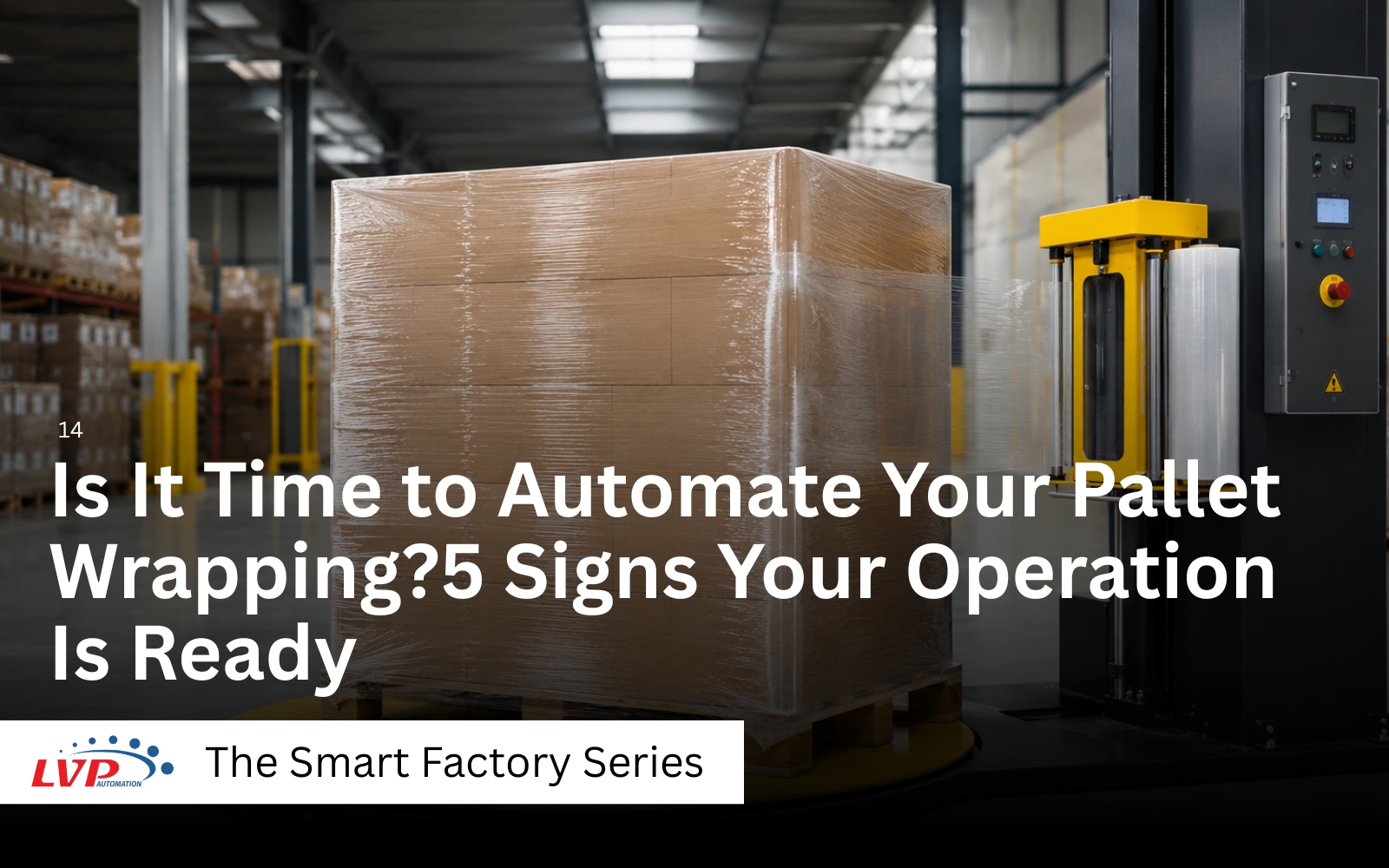
Pallet wrapping is the last thing that happens to a load before it leaves, and usually the least examined. It has no cycle time anyone reports, no quality metric anyone tracks, and it tends to stay manual long after everything around it has been automated.
That is fine until it is not. Here are five signs an operation has reached the point where hand wrapping is costing more than it appears to, what automating actually changes, and what to measure before specifying anything.
1. A risk assessment has flagged it, or is about to
Hand wrapping is repetitive work at the worst possible heights. The operator walks backwards around a load, bends to the base, reaches over the top, and applies film under tension, several hundred times a shift. Walking backwards while holding tension is the part that produces slips and falls.
In Ireland, manual handling duties sit under the Safety, Health and Welfare at Work (General Application) Regulations 2007, which work on risk assessment and on avoiding hazardous manual handling where it is reasonably practicable to do so. Wrapping is a task that tends to be flagged precisely because it is repetitive, awkward and easy to observe. If it has come up in an audit, that is a signal rather than a formality.
2. Film cost is higher than it should be
This is the sign most operations miss entirely, because film is bought by the roll and never costed per pallet.
A powered pre-stretch wrapper stretches film before it reaches the load, typically in the range of 150 to 300 per cent, so every metre off the roll covers two and a half to four metres of pallet. Hand wrapping has no powered pre-stretch at all: whatever stretch occurs comes from the operator pulling against the roll, and it is neither consistent nor anywhere near those figures.
The practical result is that a hand-wrapped pallet uses considerably more film than a machine-wrapped one for the same protection. Work out your film spend divided by pallets shipped and compare it against what a pre-stretch machine would use. For operations shipping in volume, film alone can carry a meaningful part of the case.
3. Loads are arriving damaged, or being rejected
Wrap quality is not the number of turns, and this is where most manual wrapping goes wrong. Load security comes from containment force, which is the wrapping force multiplied by the number of film layers. Two loads can carry the same containment force with thin film and many layers or thicker film and fewer, and the same operator can produce very different results on consecutive pallets without knowing it.
Manual wrapping has no way to hold a containment force. A machine repeats the same programme every time, which is why the first thing most operations notice after automating is not speed but that transit damage stops varying.
If you are seeing loads shift, corners crush, or a customer reject deliveries on presentation, that is a containment problem before it is a packaging problem.
4. Wrapping sets the pace of dispatch
Watch where pallets queue. If completed loads sit waiting to be wrapped while the line keeps producing, wrapping has become the constraint at the end of the line, and every improvement made upstream is being absorbed there.
This shows up most clearly at peak. An operation that copes on an average day and needs overtime on a busy one is usually constrained at the point where one person is doing a fixed-duration task on every pallet.
5. You are already changing something else at end of line
Wrapping connects directly to palletising before it and to dispatch after it. If a palletiser, a pallet conveyor or a change to the loading bay is already planned, the marginal cost of including wrapping is far lower than doing it later as its own project.
The reverse is also true and worth saying: installing an automatic wrapper into a line that will be reconfigured next year usually means paying for the same integration twice.
What automating actually changes
Consistency first. Every pallet gets the same programme, which is what removes the variability behind transit damage and customer rejections.
Film second. Powered pre-stretch reduces consumption per pallet, and unlike labour this shows up directly in a purchase ledger where it is easy to demonstrate.
Labour third, and usually as redeployment rather than removal. On a semi-automatic machine an operator still loads and starts the cycle. The gain is that they are not walking around a pallet for the duration.
What it does not change is worth stating plainly. A wrapper will not stabilise a badly built pallet, will not fix overhang, and will not compensate for a load that was unstable before film touched it. Where those are the real problem, the fix is upstream at palletising, not at wrapping.
What to measure before specifying anything
Pallets per hour at peak
Not the daily average. Wrapping equipment is chosen on the busiest hour, and the difference between the two figures is what separates a turntable from a rotary arm machine.
Load types and stability
Weight, height, footprint, overhang, and whether loads are rigid, light, unstable or top-heavy. Light and unstable loads are the ones that rule certain machine types out, so they matter more to the specification than the typical pallet does.
Film currently used per pallet
Roll spend divided by pallets shipped. It is a five-minute calculation and it is frequently the strongest single line in the business case.
How the pallet arrives and leaves
Hand pallet truck, forklift or conveyor. This decides whether a standalone machine is enough or whether the wrapper needs to sit in line, and it is the difference between a straightforward installation and an integration project.
Then choose the machine
Only once those four are known does machine type become a useful conversation. Turntable and rotary arm suit different throughputs and load types, semi-automatic and fully automatic suit different levels of operator involvement, and orbital wrappers handle long or awkward products that a turntable cannot. That comparison is covered in Pallet Wrappers Explained, and the equipment itself sits under pallet wrappers and strappers and wrappers.
Common questions
Do we have to change the film we use?
Usually yes. Hand film and machine film are different products, and a pre-stretch machine needs a film specified to stretch to those ratios without failing. This is normally a cost reduction rather than an increase, but it should be priced as part of the project rather than discovered afterwards.
Will an automatic wrapper handle light or unstable loads?
It depends on the machine and the programme. Light loads can be pushed or lifted by wrapping force, and unstable ones can shift on a turntable during acceleration. Both are solvable with the right machine type and settings, which is exactly why load stability belongs in the specification rather than being raised at commissioning.
Can a wrapper be added without redesigning the line?
A standalone semi-automatic machine needs floor space and power and little else. A fully automatic machine needs pallets delivered and removed by conveyor, which is a bigger piece of work. Many operations start standalone and integrate later, which is a reasonable path provided the space allows for it.
What about loads going for export?
Longer journeys, more handling and more transfers mean containment force matters more, not less. If loads travel by road and sea, or get handled by several parties, it is worth establishing what containment force those loads actually need rather than adding turns and hoping.
Where wrapping sits
End of line runs palletising, wrapping, labelling and dispatch, and a change to any one of them affects the others. Wrapping is often the easiest place to start because the machine is self-contained and the benefit is measurable, which also makes it a useful first project when a wider automation plan is being considered. If the question is whether the case stands up at all, our guide to building an automation business case sets out how to work it through.
LVP Automation supplies and integrates pallet wrapping, strapping and end-of-line systems for manufacturers and logistics operations across Ireland, as part of our wider automation services. Tell us how many pallets you ship and what they look like, and we will tell you what suits.