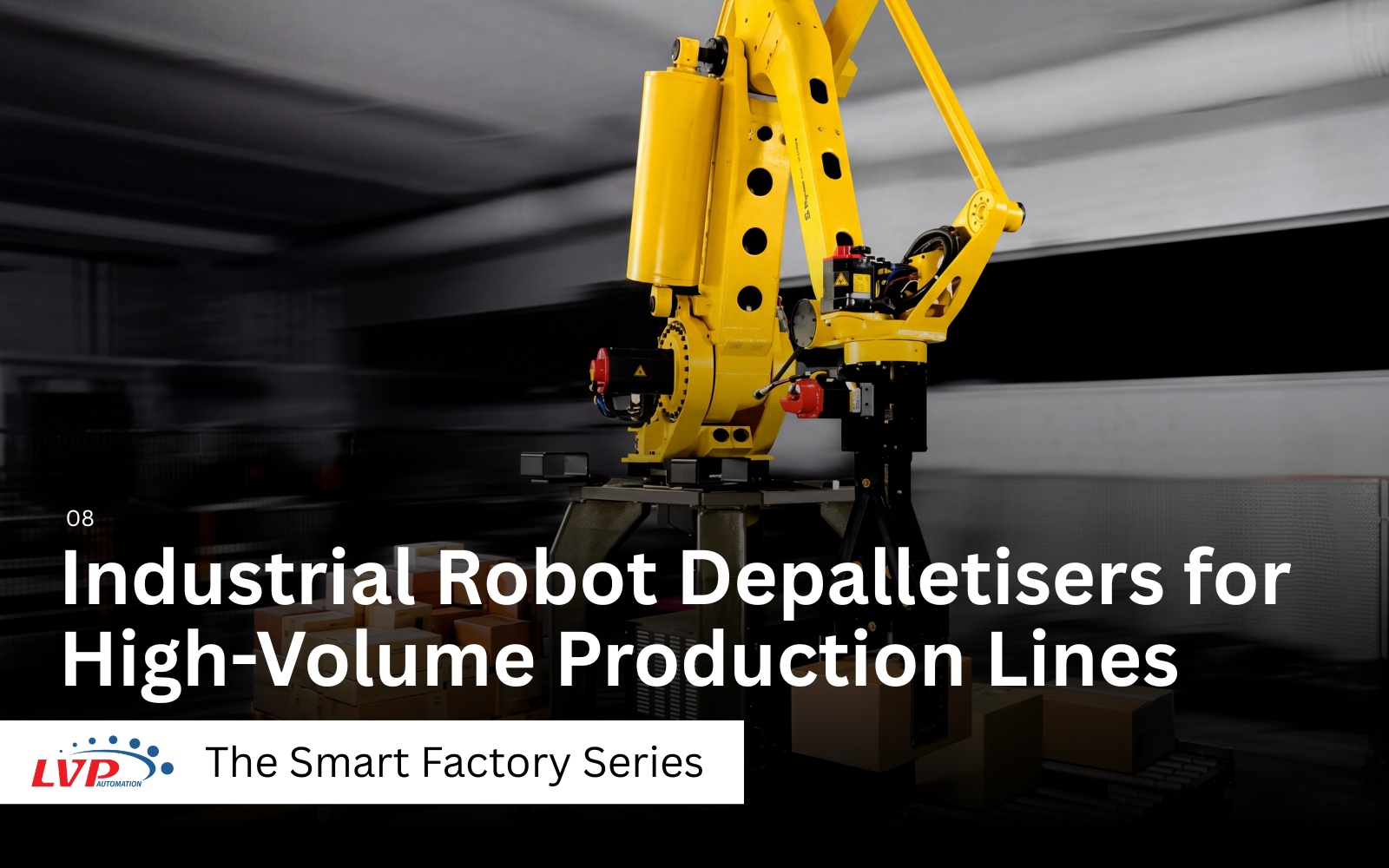
Depalletising looks like palletising in reverse. It is not, and the difference is the reason projects that work on paper struggle on the floor.
When you palletise, you control everything upstream. Cases arrive in a known orientation, in a known condition, in a pattern your own system decided. When you depalletise, the pallet was built somewhere else, by someone else, possibly by hand, and it has since been wrapped, moved, stored and driven across the country. The system has to cope with whatever turns up at goods-in.
This guide covers the depalletiser types in use, what decides which one fits, and the things that actually stop them mid-shift. For equipment specifications, see our industrial robot depalletisers.
What a depalletiser has to do
Three jobs, and each one can be the limiting factor.
First, it has to know what it is looking at: how many layers remain, where the cases sit, whether the load has shifted. Second, it has to pick without disturbing what is left, because a case pulled out of a partially interlocked layer can bring neighbours with it. Third, it has to hand off in a form the downstream line can use, which usually means single file, correctly oriented and correctly spaced.
That third one is quietly the most common source of disappointment. A depalletiser that lifts a full layer in one motion is fast, but a layer of thirty cases arriving at once is not a production line feed. Something has to turn it into a stream, and that something is conveyor, accumulation and indexing work sized for the peak the depalletiser can produce, not the average the line consumes.
The main types
Layer depalletisers
A head sweeps or clamps an entire layer at once and transfers it to a stripper plate or an outfeed table. Because a full layer moves in a single cycle, the rate is high and consistent, and it stays high regardless of how many cases are in a layer.
The requirement is uniformity. Layers have to be complete, square and of a known pattern, because the head grips the layer as one object. Uniform single-SKU pallets coming from a bottling, canning or packing operation are the natural fit. A layer with a gap in it, or a pattern the machine has not been taught, is where this format stops.
Robotic case and bag depalletisers
A robot arm removes cases individually or in small groups, using vacuum, clamp or fork tooling depending on the product. Slower per case than a layer machine, but far more tolerant: it can work around a missing case, adapt to a leaning stack, and handle several patterns without mechanical changeover.
This is the format that suits mixed production, frequent SKU changes, and anything unstable. Bags, sacks and shrink-wrapped bundles almost always land here, because they have no rigid geometry for a layer head to grip against.
Vision-guided mixed-load depalletising
Where incoming pallets carry more than one product, or arrive with no defined pattern at all, the robot needs to work out the pick sequence for itself. Vision and 3D sensing build a model of the stack, identify individual cases and decide what can safely be lifted next.
This handles inbound that nothing else can, and it is the right answer for distribution receiving where supplier pallets are unpredictable. It is also the most demanding to specify: performance depends on case appearance, contrast, surface finish and how tightly the load is packed, and those are properties of your suppliers products rather than of the machine.
The question that decides it
Everything narrows once you answer one thing honestly: are your inbound pallets uniform, or are they not?
Uniform means single SKU, consistent pattern, complete layers, same case dimensions, built by a machine. If that describes your goods-in, a layer depalletiser will be faster and cheaper than a robot and there is little reason to look further.
Anything else, and the practical choice is a robot. The follow-up question is how much variation: several known patterns that can be taught, or genuinely unpredictable loads that need vision to interpret. The gap in cost and complexity between those two is large, so it is worth checking what actually arrives rather than what the specification says should arrive. Photographing a week of inbound pallets tells you more than any amount of discussion.
What actually stops a depalletiser
Rarely the robot. Almost always the load.
Wrap and strapping. Every pallet has to be de-wrapped before anything can be picked, and if that is still a person with a knife, the manual step you were removing has simply moved. Automatic de-wrapping exists, but it needs to be in the scope from the start rather than added later.
Slip sheets and tier sheets. Cardboard or plastic sheets between layers have to be detected, removed and stacked somewhere. Systems that were specified without them tend to discover them on day one, because nobody upstream thought to mention them.
Load shift and lean. A pallet that travelled two hundred kilometres is not the pallet that was built. Cases settle, layers slide, and a machine expecting a square stack will either miss or grip badly. Vision handles this; fixed-pattern equipment does not.
Damaged and wet packaging. Vacuum tooling needs an intact, reasonably flat surface. Crushed corners, torn liners, condensation from chilled storage and heavy print varnish all affect grip in ways that only show up in trials.
Pallets themselves. Broken boards, protruding nails and non-standard sizes stop things as reliably as anything on top of them. And once the pallet is empty, it has to go somewhere: empty pallet stacking and removal is a real part of the system, not an afterthought.
The safety case, and what it is worth
Manual depalletising is repetitive lifting at awkward heights, from above the shoulder at the top of a pallet to below the knee at the bottom, often at pace and often onto a moving line. In Ireland, manual handling duties sit under the Safety, Health and Welfare at Work (General Application) Regulations 2007, which are built around risk assessment and avoiding hazardous manual handling where it is reasonably practicable to do so, rather than around a fixed weight limit.
That framing matters when the business case is written. The argument for automating goods-in is not only cycle time; it is that repetitive lifting is precisely the task a risk assessment is most likely to flag, and the cost of not addressing it is carried in absence, staff turnover and claims rather than in the production figures.
Where depalletising is the wrong answer
Low and irregular volume is the clearest case. A machine that unloads four pallets a day cannot repay itself, and the flexibility of a person with a pallet truck is worth more at that scale.
Very high product variety with no repeatability is the second. If every inbound pallet is genuinely unique in product, packaging and pattern, vision systems can still work, but the specification effort and the exception rate climb until manual handling of the outliers becomes part of the design. That is a legitimate outcome, but it should be planned rather than discovered.
The third is where goods-in is not actually the constraint. Automating a receiving bay that is already keeping ahead of the line moves the queue rather than removing it. Worth checking against the line as a whole before committing.
Common questions
Can one depalletiser handle pallets from several different suppliers?
Yes, but the variation between suppliers is what sets the specification. Different case sizes, different pattern conventions and different packaging quality all push towards a vision-guided robot rather than a fixed-pattern machine. Where a handful of suppliers account for most of the volume, a common approach is to automate those and keep a manual route for the rest.
Do our suppliers have to change how they build pallets?
Not necessarily, but agreeing a few basics with the largest ones tends to pay for itself: consistent case orientation, complete layers, and notice when packaging changes. It costs the supplier little and it removes a large share of the exceptions.
What happens to the empty pallets and the packaging waste?
Both need a defined route. Empty pallet stacking, wrap collection and slip sheet handling are part of the system design, and a receiving area that has not allowed floor space for them ends up with an operator moving pallets by hand next to an automated cell.
Can automated and manual unloading run side by side?
Commonly, yes, and it is often the sensible starting point. The automated route takes the predictable, high-volume pallets, and the manual route handles the exceptions. It also gives a realistic exception rate to work from before any decision to widen the scope.
Where depalletising sits
Goods-in is one end of a pallet flow that runs through the operation. At the other end sit palletising, wrapping and dispatch, and in between are storage, sortation and the conveyor that connects them. Decisions at goods-in constrain all of it, which is why depalletising is usually assessed as part of a wider automation plan rather than on its own.
Where the inbound profile is uncertain, simulation is the way to test a layout against real receiving data before committing to a format.
LVP Automation supplies and integrates robotic depalletising and palletising systems for manufacturing and logistics operations across Ireland, as part of our wider automation services. Tell us what arrives at your goods-in and we will tell you which format suits it.